A moon around Venus would not necessarily have been doomed from the start. New tidal-evolution calculations show that a lunar-mass satellite could survive for 4.5 billion years if Venus began with a sufficiently rapid rotation, but slightly different starting conditions could send the moon spiraling into the planet. The results also show that the fate of a Venusian moon depends strongly on how Venus’s internal tidal response is modeled.
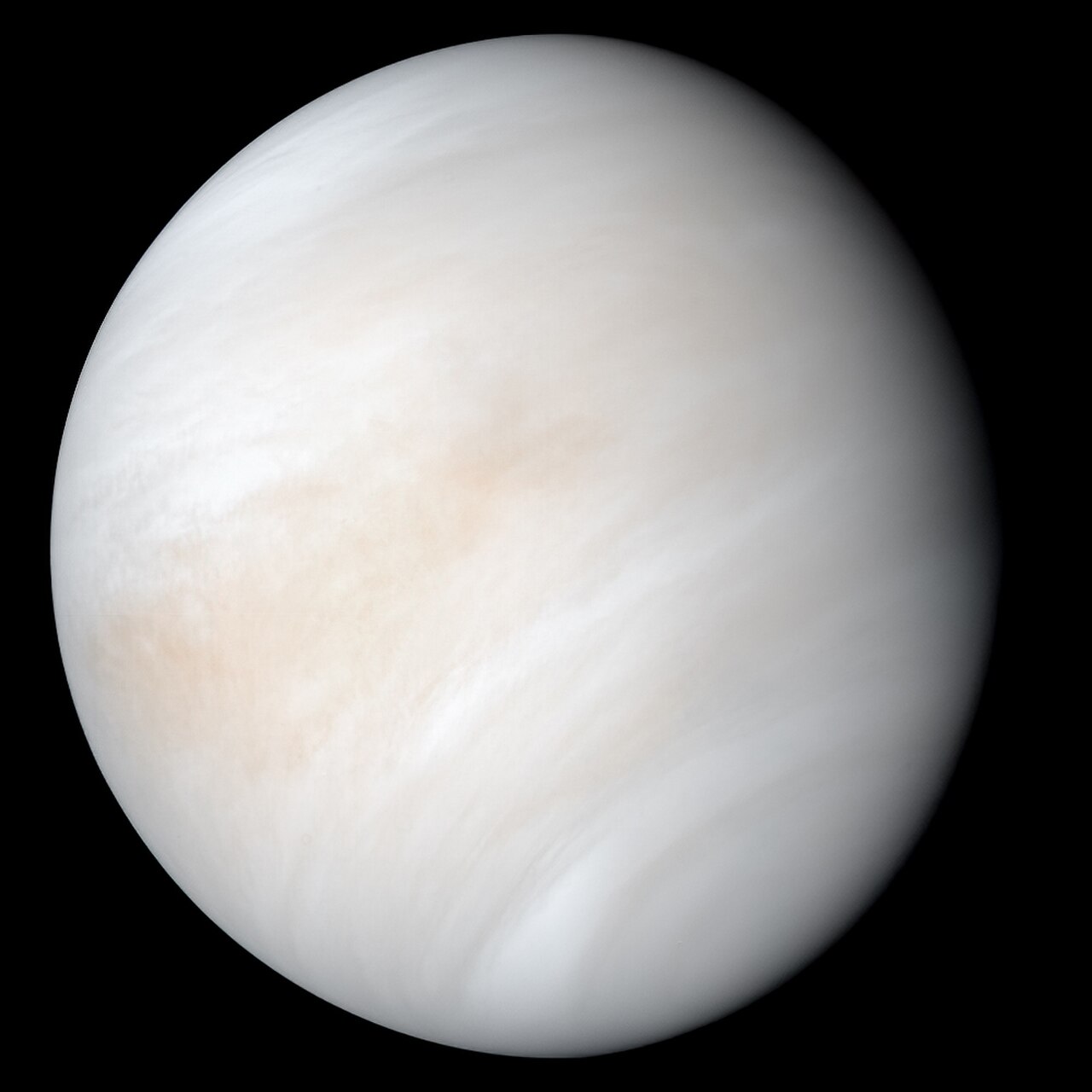
Venus has no natural moon today, but that does not rule out the possibility that it once had one.
The study examines what would happen if a moon formed around Venus, as could occur after a giant impact. The researchers modeled the coupled evolution of Venus’s rotation and the moon’s orbit, including tides raised by both the moon and the Sun.
The key factor is the relationship between the moon’s orbital distance and Venus’s synchronous radius. The synchronous radius is the distance at which a moon’s orbital period matches the planet’s rotation period. A moon outside that radius initially moves outward as it takes angular momentum from the planet’s rotation. A moon inside it moves inward.
For the study’s main set of calculations, the hypothetical moon began 5 Venus radii from the planet. At that distance, the critical Venus rotation period is about 16.1 hours. If Venus initially rotated faster than that, the moon began outside the synchronous radius and moved outward. If Venus rotated more slowly, the moon began inside it and rapidly spiraled inward toward the Roche limit, where tidal forces would destroy it.
The difference was substantial. With an initial Venus rotation period of 24 hours, a lunar-mass moon starting at 5 Venus radii reached the Roche limit in about 1 million years in the constant-Q model. With initial rotation periods of 8 or 12 hours, the same-sized moon moved outward and survived the full 4.5-billion-year calculation.
But survival was not guaranteed even when Venus was rotating rapidly.
As the moon pulled on Venus, it transferred angular momentum from the planet’s rotation into its orbit. That caused Venus to spin down. As Venus slowed, its synchronous radius moved outward. The moon therefore had to migrate outward fast enough to stay ahead of the expanding synchronous radius.
That competition is central to the study.
A more massive moon could be destroyed by the effect that drives it outward
The calculations reveal an unusual tradeoff. A more massive moon produces a stronger tidal torque, so it can move outward more quickly. But the same stronger torque also slows Venus’s rotation more quickly.
The study finds that these two effects do not increase at the same rate. The moon’s outward migration rate scales with its mass, while the expansion of the synchronous radius caused by Venus’s spin-down scales with the square of the moon’s mass.
As a result, making the moon more massive can ultimately make its survival less likely.
In the constant-Q calculations, a lunar-mass moon generally survives for the age of the Solar System when Venus begins with a sufficiently fast rotation. But moons of about two lunar masses or more can be driven into a reversal of their orbital migration. Once the expanding synchronous radius catches the moon, the moon begins moving inward and eventually reaches the Roche limit.
For example, with Venus initially rotating every 8 hours, a two-lunar-mass moon reaches the Roche limit after about 1.7 billion years in the constant-Q model. With an initial 12-hour rotation period, the same moon is destroyed in about 33 million years.
A five-lunar-mass moon is destroyed within about 100 million years even when Venus begins with a 5-hour rotation period.
The opposite extreme also matters. A moon only one-tenth the mass of Earth’s Moon produces too little torque to substantially slow Venus in the modeled system. In the constant-Q calculations, such a moon survives the full 4.5-billion-year integration.
The model used for Venus’s tides changes the outcome
The study finds that the predicted fate of a large moon depends strongly on the mathematical description used for tides inside Venus.
The researchers compare two models. The constant-Q model assumes a frequency-independent tidal dissipation. The constant-time-lag, or CTL, model instead makes the tidal torque depend on the difference between Venus’s spin rate and the moon’s orbital rate.
The difference becomes important when the moon approaches synchronous rotation.
In the constant-Q model, a sufficiently massive moon can cause Venus’s synchronous radius to overtake the moon’s orbit. The moon then reverses direction and spirals inward.
In the CTL model, the torque weakens smoothly as Venus’s rotation approaches the moon’s orbital motion. For massive moons around rapidly rotating Venus, the system can instead approach a quasi-synchronous state in which the moon survives beyond the age of the Solar System.
For an initial Venus rotation period of 8 hours and a moon twice the mass of Earth’s Moon, the constant-Q model predicts destruction after 1.7 billion years. The CTL model predicts survival. At an initial 12-hour rotation period, the constant-Q model gives destruction after about 33 million years, while the CTL model again predicts survival.
For a five-lunar-mass moon, the constant-Q model produces destruction within about 100 million years across the modeled spin periods, while the CTL model permits quasi-synchronous survival for initial spin periods of 15 hours or less.
The researchers note that neither model is a fully realistic description of a rocky planet’s interior. They discuss more complex models of rocky-body rheology and state that these could produce behavior between the two limits explored here.
An eccentric orbit adds another way to lose a moon
The moon’s initial orbital shape also matters.
The researchers used the full eccentric-orbit equations in the CTL calculations. For sufficiently rapid Venus rotation, tides can increase rather than decrease the moon’s orbital eccentricity.
For the fiducial starting distance of 5 Venus radii, the transition occurs near an initial Venus spin period of 10 hours in the small-eccentricity limit. When Venus rotates faster than this threshold, tidal effects can pump up the moon’s eccentricity.
At an 8-hour initial spin period, the system starts in this eccentricity-pumping regime. What happens next depends strongly on the moon’s mass.
More massive moons can slow Venus enough to move the system below the eccentricity-pumping threshold before the eccentricity grows substantially. Once below that threshold, the eccentricity begins to decrease and the moon can survive.
Lower-mass moons do not slow Venus as effectively. In the calculations, moons of about half a lunar mass or less can remain in the eccentricity-pumping regime for billions of years. Their growing eccentricity increases tidal dissipation, which accelerates their outward migration and further increases eccentricity. The resulting feedback can drive the moon toward the edge of the region where a prograde satellite can remain gravitationally stable.
The calculations find that this process can remove a moon even when its initial eccentricity is only 0.01.
At an initial Venus spin period of 12 hours, the situation is different. Eccentricity is damped faster than Venus’s spin changes, and the system approaches the same type of tidal equilibrium found in the circular calculations. Initial eccentricities up to 0.3 do not qualitatively change the survival boundary, while an initial eccentricity of 0.5 leads to destruction through enhanced tidal dissipation.
Earth and Venus would treat similar moons differently
The study also compares a hypothetical Venusian moon with Earth’s Moon.
Both systems can begin with a rapidly rotating planet and a moon moving outward. But the Venus system evolves more tightly because Venus orbits much closer to the Sun and has a smaller region in which a stable satellite can orbit.
In the modeled comparison, an Earth-Moon system starting with a 5-hour Earth rotation period allows the Moon to migrate outward to about 60 Earth radii over 4.5 billion years. The synchronous radius remains well inside the Moon’s orbit.
The analogous Venus system also sends its moon outward, but Venus loses rotational speed more rapidly. Its synchronous radius therefore expands more quickly and gets closer to the moon’s orbit.
For a lunar-mass moon starting under the specified conditions, the Venusian synchronous radius reaches about half the moon’s orbital distance after 4.5 billion years, compared with about 15 percent for the Earth-Moon system.
This leaves much less room for a Venusian moon to remain safely outside the synchronous radius.
The calculations also show that the moon, rather than the Sun, is the dominant source of Venus’s modeled despinning while the moon is present. In the fiducial case, the moon’s tidal torque on Venus is about 3 million times stronger than the solar tidal torque. The solar torque becomes important only after the moon has been destroyed or has reached a quasi-equilibrium state.
The results narrow the possible history of a Venusian moon
The researchers then compare their tidal calculations with recent giant-impact simulations of Venus.
Their calculations indicate that a lunar-mass moon can survive around Venus if the planet’s post-impact rotation period is roughly 12 hours or shorter. A slower initial rotation places the moon closer to, or inside, the destruction regime.
But the impact simulations introduce another constraint. The cited simulations found that impact scenarios consistent with Venus’s present rotation generally produce post-impact spin periods of about 12 hours or longer. They also found that the same impact geometries can produce debris disks inside the synchronous orbit, preventing a moon from forming in the first place.
The study therefore identifies two possible outcomes.
In one, the impact does not produce a long-lived moon because the debris remains inside the synchronous orbit and reaccretes onto Venus.
In the other, a moon does form, but the post-impact spin state places it near the boundary between long-term survival and tidal destruction.
The calculations identify a particularly important range around 12 to 15 hours for a lunar-mass moon. In that range, the moon is close to the transition between survival and destruction, with the precise outcome depending on the modeled parameters.
The researchers conclude that Venus’s present lack of a moon can therefore arise naturally from the planet’s initial conditions and subsequent tidal evolution. A later catastrophic event that stripped away an already existing moon is not required by this scenario.
The study also cautions that the connection between impact simulations and the tidal calculations is not definitive. The cited impact simulations did not explore the full range of possible pre-impact Venus rotation states, and only some of their outcomes directly match the initial conditions needed for a moon to form and then undergo the tidal evolution studied here.
The calculations also point to an early period when Venus could have had a moon
If Venus once possessed a large moon, its presence could have affected the planet during its early history.
The study notes that a roughly lunar-mass satellite would stabilize Venus’s axial tilt against chaotic changes. Strong tides raised by a close moon would also affect the planet’s rotation and a possible early ocean.
If the moon eventually reached the Roche limit, its destruction would release a large amount of energy and deposit material onto Venus’s surface and atmosphere. The researchers discuss this as a possible source of effects on surface water and the atmosphere, although those consequences are not directly modeled in the tidal calculations.
The timing matters as well. Venus’s surface has a globally young crater-retention age of several hundred million years, indicating substantial resurfacing after the time of the last giant impact. The study therefore argues that a moon destroyed and reaccreted onto Venus could not have disappeared during the most recent resurfacing interval without leaving an observable signature. The modeled early destruction timescales are consistent with moon loss occurring much earlier in Venus’s history.
The calculations do not include atmospheric thermal tides, which are known to affect Venus’s spin evolution. The researchers state that adding this effect would provide another source of despinning and would shorten the calculated satellite lifetimes, making the survival region narrower.
The result depends on a narrow combination of starting conditions
Taken together, the calculations do not produce a single fate for a hypothetical Venusian moon. They produce a sharp division between systems in which a moon can survive and systems in which it is lost.
A lunar-mass moon around a rapidly rotating Venus can migrate outward and survive for 4.5 billion years. More massive moons can instead slow Venus rapidly enough for the expanding synchronous radius to catch them. Slower initial rotation can put a moon inside the synchronous radius from the beginning, leading to rapid destruction.
Fast rotation also creates a separate problem for low-mass moons because it can drive orbital eccentricity upward.
And near synchronous rotation, the assumed tidal model can change the outcome from destruction to long-term quasi-synchronous survival.
The combination of tidal evolution and impact constraints therefore leaves Venus with a restricted set of circumstances under which a moon could both form and survive. For the conditions favored in the study, Venus’s missing moon can be explained by tidal evolution alone, without requiring a later event to remove it.
The study was published on the arXiv preprint server.