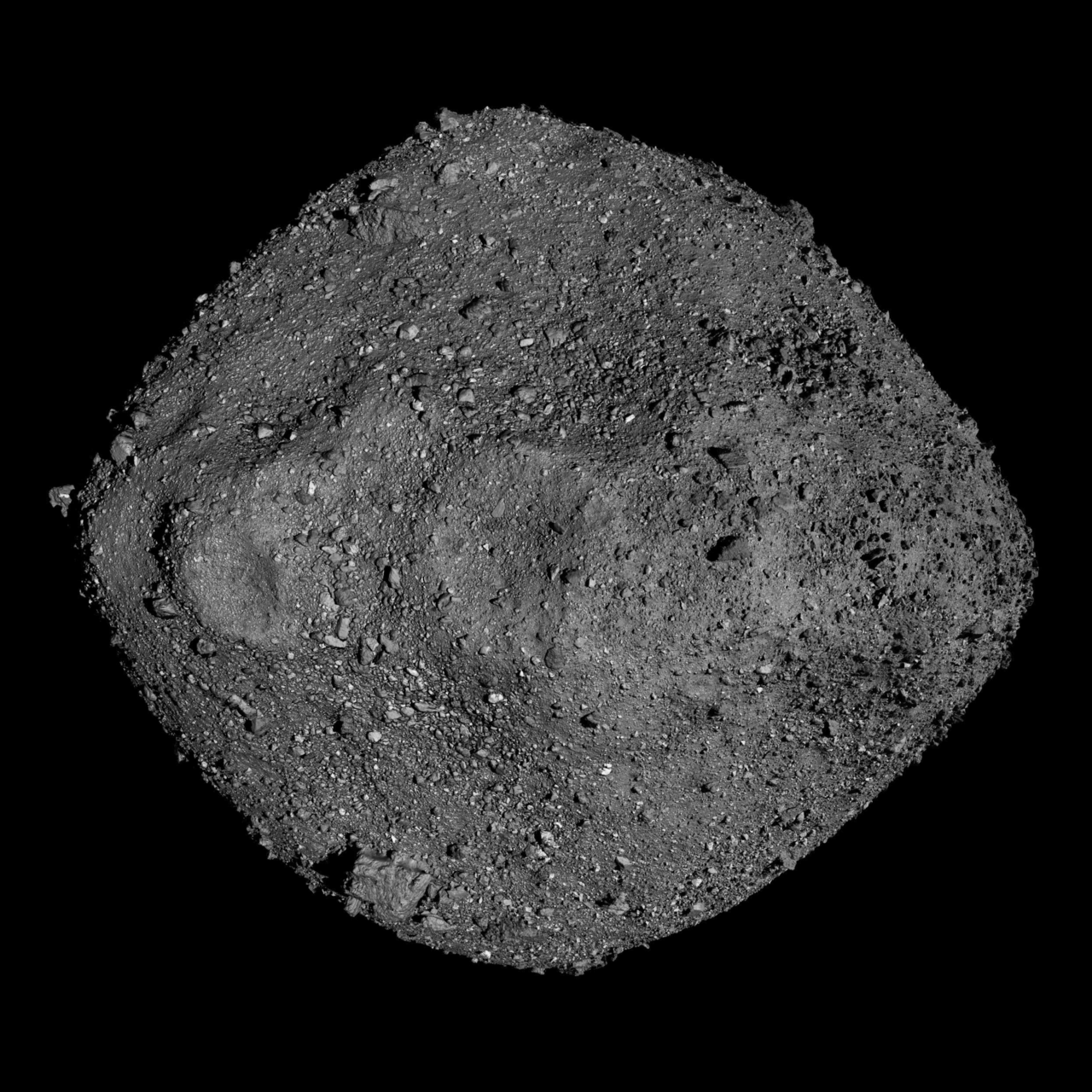
Asteroid Bennu is made of loose rock and dust, yet its surface can be extraordinarily weak. New simulations combined with measurements of material returned to Earth by NASA’s OSIRIS-REx mission show that the amount and shape of material packed between larger particles strongly affect how much strength a granular asteroid can have. For Bennu’s sampling site, the results point to a simple physical explanation for its very low strength: there are too few fine particles to fill the spaces between larger grains and create enough cohesive bonds.
Some small asteroids are not solid blocks of rock. Instead, they are large collections of separate particles ranging from dust to boulders. Their overall structure depends on gravity, forces between particles and their rotation. The researchers use the term “granular asteroid” for bodies whose interiors and surfaces are made of fragmented material rather than being dominated by a single large solid core.
That raises a basic mechanical problem. If the particles are only loosely held together, what gives an asteroid enough strength to remain intact?
For more than a decade, researchers have considered van der Waals forces as one possible source of cohesion. In the very low gravity found around small asteroids, these forces can be comparable to the weight of millimeter- to centimeter-sized particles. The strength required to keep some rapidly rotating asteroids from breaking apart can therefore be much greater than the strength expected from gravity alone.
But the strength of a granular material does not depend only on the force between individual particles. The way those particles are arranged also matters. Particle size, shape, packing and the number and type of contacts between particles all affect how forces move through the material.
Bennu provided an unusual opportunity to examine those factors directly.
The OSIRIS-REx spacecraft collected material from Bennu on October 20, 2020, during a touch-and-go maneuver. The spacecraft pushed its roughly 30-centimeter-wide sampling device into the surface at a site called Hokioi crater. Reconstruction of that event had already indicated that the sampled material had a cohesive strength of less than 1 pascal.
The samples returned to Earth contained particles with different shapes and sizes. That allowed the researchers to connect measurements of individual grains with simulations of how an entire granular material behaves.
The simulations tested particle size and shape
To investigate how regolith gains or loses strength, the researchers built virtual granular bridges between two large spherical boulders.
Each boulder was 1 meter in diameter. Between them was a matrix of cohesive particles. The researchers then pulled the two boulders apart and measured the stress required to make the granular bridge fail.
The simulations included spherical particles as well as polyhedral particles with different shapes. The polyhedral particles were dodecahedral, with their proportions changed to produce particles ranging from relatively rounded forms to flattened or elongated ones.
The researchers tested ten different shape configurations. They also tested three monodisperse particle sizes, with diameters of 2, 3 and 4 centimeters, and three modestly polydisperse size ranges of 2–3, 3–4 and 4–5 centimeters. Altogether, the study included 78 simulated granular bridges.
The model gave every particle a constant cohesive force at its contacts. This was intended to represent the type of cohesion expected from rough, irregular regolith particles in a low-gravity environment. Gravity was also included for both the particles and the larger boulders.
As the researchers increased the pulling force, the granular bridges first responded in an almost linear way. They then entered a softer, plateau-like stage as particles rearranged. Finally, the stress dropped suddenly to zero when the bridge ruptured.
The maximum stress before that sudden failure was defined as the tensile strength.
Smaller particles made stronger bridges
Particle size had a clear effect.
For particles with the same general shape, tensile strength decreased as particle size increased. In the simulations, peak stress fell from about 0.005 pascals to about 0.001 pascal as the mean particle diameter increased from 2.5 to 4.5 centimeters.
This size dependence follows an established relationship for cohesive granular materials. When the cohesive force at a contact does not depend on particle size, tensile strength is expected to decrease approximately with the square of particle diameter.
The simulations reproduced that behavior. When particle size was represented by an equivalent diameter, defined as the diameter of a sphere having the same volume as the irregular particle, the results collapsed onto a common curve. Tensile strength followed an inverse-square dependence on that equivalent diameter.
The researchers then modified the standard Rumpf relationship used for spherical granular materials. For irregular particles, they replaced the usual coordination number with a connectivity number that accounts for the different ways polyhedral particles can touch one another. These contacts can occur at points, edges or surfaces. The resulting model reproduced the overall trend in the simulations well.
Particle shape also changed the strength
Size was not the only factor.
The simulations showed that making particles less spherical increased tensile strength. For particles with the same major dimension, flattening the particles increased the maximum stress. In one set of simulations, reducing one aspect ratio from 1 to 0.4 raised the maximum stress from about 0.0008 to 0.0024 pascal.
The researchers described this effect using sphericity, a measure of how closely a particle resembles a sphere. A perfect sphere has the highest sphericity in the study’s definition, while more angular or elongated particles have lower values.
When tensile strength was scaled using sphericity, the data followed an overall trend in which strength increased as particles became less spherical. A simple scaling relationship captured much of the behavior, while an empirical relationship with a stronger exponent fit the simulations more closely, particularly for the most anisotropic particles.
The researchers traced the remaining difference partly to how efficiently particles pack together. The connectivity number stayed nearly constant as particle size changed, but the solid fraction varied non-monotonically with particle shape. That means changes in packing efficiency help determine why the effect of shape is more complicated than a simple sphericity relationship. The researchers also note that contact anisotropy and localized force chains may contribute.
The main result is that particle size and shape can be combined into a common framework for describing tensile strength in cohesive granular material. Larger particles generally produce weaker cohesion, while particles that depart more strongly from spherical shapes can increase strength through their geometry and the resulting contact network.
The Bennu samples provide the crucial test
The researchers next applied this framework to material from Bennu’s Hokioi sampling site.
Measurements of the returned material give an average particle size of about 1.2 millimeters. The measured particle-to-particle cohesive force is between 0.5 and 4 nanonewtons and does not depend on particle size. The estimated solid fraction of Bennu’s material is 69–78 percent, while the connectivity number was constrained to a range of 4.5–12. The angle of internal friction is about 32 degrees.
The researchers used these measurements to estimate how tensile strength changes with particle size.
The result is highly sensitive to the amount of fine material present. If Bennu’s particles were mostly about 10 micrometers across, the calculated tensile strength could reach roughly 100 pascals. But material that strong would have prevented the OSIRIS-REx sampling head from penetrating the surface, contrary to what happened during the mission.
At the other extreme, if the average equivalent particle diameter were about 1 millimeter, the calculated tensile strength would be only about 0.001 pascal. That is much lower than some earlier reconstruction estimates but agrees with the near-zero strength indicated by the sampling event itself.
Using 1 millimeter as the representative equivalent diameter, close to the measured 1.2-millimeter average particle size, gives a calculated tensile strength of about 0.001–0.01 pascal. The researchers describe this as effectively strengthless, even for a small asteroid.
The calculation also places a lower limit on the relevant particle size. Earlier work indicated that the cohesive strength of the Hokioi surface was less than 1 pascal. Because cohesive strength is expected to be two to four times greater than tensile strength, the researchers infer that the surface tensile strength must be no more than 0.5 pascal. Their analysis then requires an equivalent particle diameter greater than about 31 micrometers.
Too few small particles may leave Bennu weak
The particle-size distribution offers an explanation for the low strength.
Bennu’s measured size distribution has a slope of about −2.12. The researchers compare this with steeper slopes associated with idealized three-dimensional and random Apollonian packings. Because Bennu’s distribution is not steep enough, there are not enough small particles to fill the spaces between larger ones efficiently.
That matters because fine particles can occupy those spaces and create additional cohesive contacts. If they are too scarce, many of the gaps remain without enough small particles to build a strongly connected network.
The researchers therefore identify the scarcity of fine dust as the likely main driver of the very low surface strength measured at the OSIRIS-REx sampling site. Their analysis indicates that Bennu’s regolith must be dominated by particles larger than hundreds of micrometers, even though fine dust is present near the surface.
One calculation illustrates the scale involved. A 1.2-millimeter particle with aspect ratios of 0.7 has an equivalent diameter of about 0.96 millimeter. Meanwhile, the analysis of the crater produced during the TAG event indicates a cohesive strength of about 0.001 pascal, corresponding in the model to an equivalent particle diameter of approximately 0.5 millimeter. This supports the interpretation that very fine particles in the upper half-meter of regolith contribute little to its overall strength.
Even under a more favorable scenario, with an equivalent diameter of about 154 micrometers, the calculated tensile strength would remain below 0.5 pascal.
Bennu’s strength may vary with depth
The results also indicate that Bennu’s surface strength need not be uniform.
The researchers note that the particle-size distribution across Bennu’s surface is heterogeneous. If finer particles become more common at greater depths, the strength of the regolith could also change with depth. This is consistent with previous evidence for subsurface layering on Bennu.
That possibility matters at the scale of individual surface interactions, including sampling and crater formation. A spacecraft interacting with one patch of regolith could encounter material with different mechanical properties from another nearby patch.
The framework also provides a way to examine how particle geometry affects the stability of granular asteroids more broadly. The researchers state that shape- and size-dependent tensile strength could help granular asteroids resist rotational disruption. Particles with lower aspect ratios can have greater interlocking and therefore higher cohesive strength.
The researchers also propose that finer, more angular material could act as a cohesive component within an asteroid, strengthening surrounding material and contributing to different strengths in layered structures. This remains part of the interpretation of how particle-scale properties could affect asteroid interiors.
The model still has important limits
The simulations used modest particle-size dispersions, while Bennu’s actual regolith is highly polydisperse. The researchers emphasize that cohesive granular materials with broad size distributions remain poorly understood. Previous work cited in the study indicates that tensile strength can increase with size polydispersity even when the mean particle diameter stays the same.
That means a simple average particle size and connectivity number may not fully describe a highly varied asteroid regolith.
The researchers also point out that cohesive forces can differ between asteroid materials. Particle surface morphology, chemical composition and crystallographic phases can affect cohesion, friction and roughness. Those differences can change how particles pack and how forces are transmitted through the material.
Future work will need to examine more complex particle shapes, broader particle-size distributions and the combined effects of size and shape. The researchers also identify the microscopic origin of cohesive forces as an important unresolved issue for predicting asteroid strength from remote observations alone.
For Bennu, however, the connection between the returned grains and the weak surface is already clear within the model. The strength of its regolith depends strongly on the size and geometry of its particles, and the shortage of very fine particles leaves too few cohesive contacts to make the surface strongly bound.
The study was published in Nature Communications.