Two juvenile pygmy raccoons on Mexico’s Cozumel Island were observed taking paper from a trash bin, wetting it, rolling it against sand, and shaping it into balls that they later chased and batted around. The behavior was especially notable because one young raccoon watched her sister perform the sequence, tried it herself, and later completed the behavior independently after her sister was removed from the site.
The observations took place during field research on tourism’s effects on the critically endangered pygmy raccoon, Procyon pygmaeus. The species lives only on Cozumel Island, where tourism has changed coastal habitats and exposed raccoons to garbage, human-provided food and other materials.
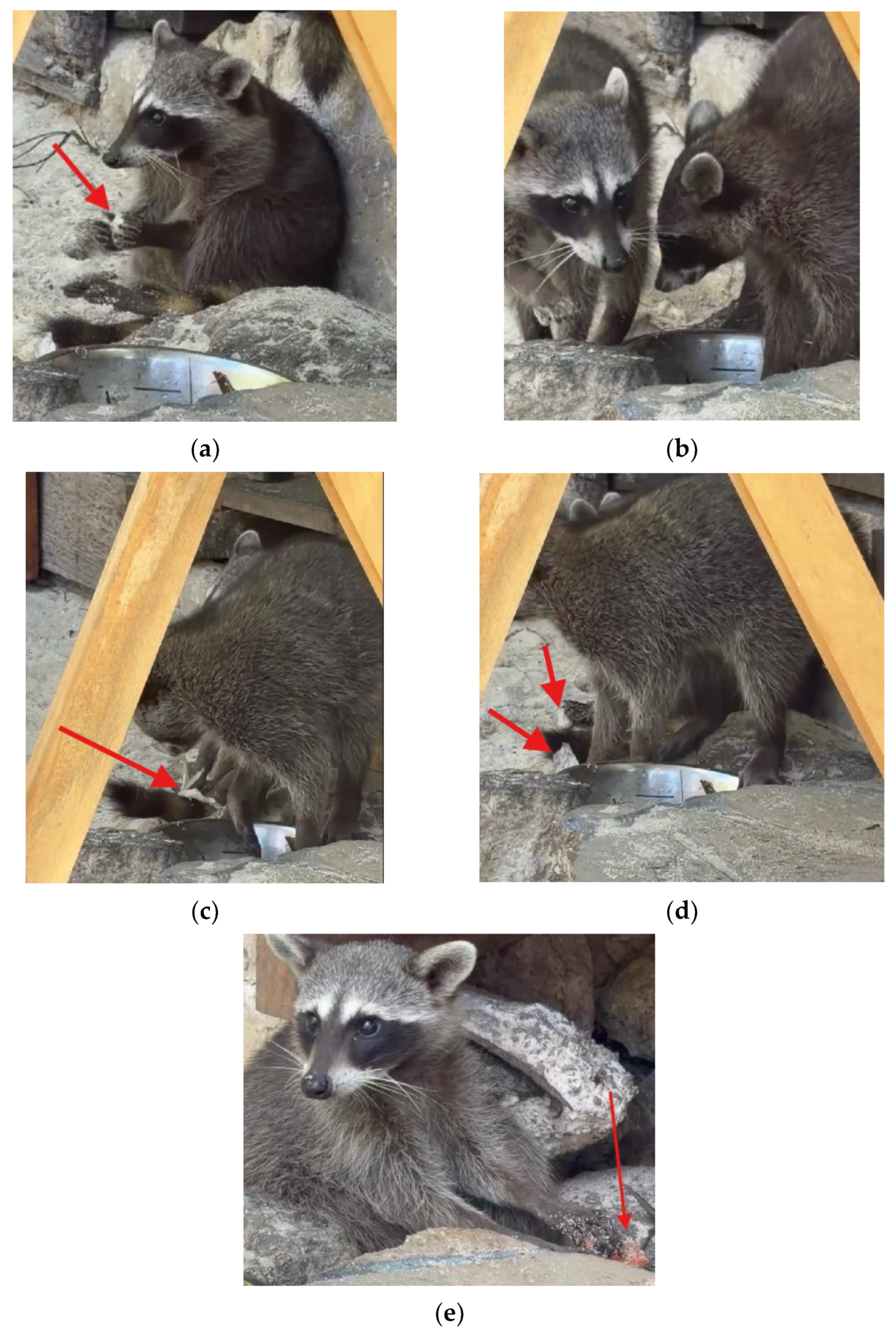
The young raccoons retrieved items such as napkins and receipts from a nearby waste bin. Instead of treating the paper as food, they carried it to a stainless-steel water bowl outside their shelter.
There, they held the paper with their forepaws and briefly put it into the water. They then placed it on the sand and worked it with their paws. They pressed, flipped and rolled the wet paper against the sand, repeatedly manipulating it between their forepaws. As sand stuck to the paper, the material became more compact.
Eventually, the raccoons produced a roughly ball-shaped object.
The researchers recorded 14 attempts during 64 hours of observation. Eight produced completed balls, while six were unsuccessful or incomplete. The attempts involved receipts, napkins, a paper towel and a food wrapper.
The finished objects were then used in play. The raccoons batted the balls across the ground, chased them and rolled them between their forepaws. Sometimes both juveniles played with the same ball, batting it between them. On some occasions, one raccoon growled at the other while trying to keep possession.
The researchers did not observe the raccoons eating the paper or food residue from it. The behavior therefore differed from their feeding and scavenging activities. Brief biting of a ball was observed once, but this was consistent with exploratory object interaction and play.
One sister watched, then learned the sequence
The strongest evidence for a social component came from observations of the two juveniles together.
On January 19, one juvenile performed the complete sequence while her sister approached and closely watched. The second juvenile then retrieved paper from the same waste bin and returned to the water bowl.
Her first attempt did not succeed. She initially worked with the dry paper but did not form a ball. Her sister took the material and completed the wetting and rolling sequence. While this happened, the observing juvenile played with the ball her sister had already made.
The second juvenile made several unsuccessful or incomplete attempts during the observations. But on January 29, after the first juvenile had been removed from the site for rehabilitative care, she independently turned a hamburger wrapper into a ball. She wet the wrapper, rolled it against sand and a rock, and then played with the finished object.
She also independently made another ball from a receipt that day.
Across the observations, the first juvenile had a higher recorded success rate than her sister. Juvenile 1 completed six of eight documented attempts, while Juvenile 2 completed two of six independently. The researchers noted that Juvenile 2’s progression from failed attempts to independent success was consistent with increased proficiency, although the small number of attempts prevented statistical testing.
The behavior was not observed at another tourism site on Cozumel. That site had juvenile raccoons of a similar age, accessible paper waste and fresh water, as well as raccoons that were highly accustomed to people. It was about 30 kilometers from the first site.
That comparison does not establish that the behavior was cultural. But it provided a different context in which the same materials and environmental opportunities were present without the observed ball-making behavior.
The behavior goes beyond feeding
Raccoons are already known for flexible problem-solving and learning. Research on common raccoons has documented their ability to interact with unfamiliar objects and solve problems in different ways. Much of that research, however, has focused on food-related tasks and possible tool use. Non-foraging object use has received less attention.
The pygmy raccoons’ behavior differed from the food-related interactions also seen at the beach club. The animals normally searched food waste first and could open discarded containers and lick food residue from them. The juveniles involved in the ball-making behavior instead went directly to the non-food waste bin, selected paper and did not lick or eat it.
The transformation of the paper was also important. The raccoons did not simply pick up an object and play with it. They altered its form through a sequence involving water, manual manipulation and sand before using it as a play object.
The researchers describe this as a previously unreported behavior in Procyon: retrieving material from anthropogenic waste, modifying it into balls and then using those modified objects in play. The observations therefore expand the known behavioral repertoire of raccoons.
Wet paper may have been particularly suitable for this behavior because water can make it more cohesive and easier to deform, grasp, shape and roll. The study considers the interaction among environmental opportunity, the properties of the material and raccoon cognition as possible factors in the emergence of the behavior.
The observations provide preliminary evidence of social learning
Animal material culture can include socially learned patterns involving objects, not only formal tools used to obtain food. Object play can involve repeated, flexible interactions with inanimate objects without an immediate practical goal.
The raccoons’ behavior fits that broader area of research. After making the balls, the juveniles batted, chased, rolled and competed over them rather than using them for feeding.
The researchers are cautious about what can be concluded from the observations. A behavior occurring repeatedly at one site is not enough by itself to establish a cultural tradition.
Still, several observations fit the possibility of social transmission. One juvenile performed the complete sequence while the other watched. The observing juvenile then attempted the same behavior and, after several unsuccessful attempts, later performed the complete sequence independently. She did so after her sister had been absent from the site for about a week.
The researchers interpret this most conservatively as a possible case of observational exposure and socially mediated copying of the broader behavior. They also note that juveniles are particularly likely to engage in object play and environmental exploration.
The observations do not establish exactly how the second juvenile acquired the behavior. Nor do they establish whether other pygmy raccoons can learn it or whether the behavior exists beyond this family.
A behavior may disappear in a small population
The observations also have a direct connection to the conservation of pygmy raccoons.
The species is critically endangered and remains poorly understood in several aspects of its behavior. The researchers argue that isolated behavioral observations can still add useful information, particularly when animals live in environments heavily altered by people.
In this case, the first juvenile observed making the complete sequence later died while in rehabilitative care, with malnutrition and exposure to anthropogenic toxicants identified as likely causes. Two other siblings had also been lost in the preceding weeks, apparently from the same cause.
That loss raised the possibility that behaviors found in small populations could disappear before researchers have an opportunity to document or study them further. The researchers therefore call for continued field-based behavioral monitoring, particularly where juvenile raccoons encounter people, tourism and anthropogenic toxicants.
The study stops short of recommending management measures specifically designed around paper-ball making or other putative traditions. The available evidence is too limited for that. Instead, it supports continued research into how pygmy raccoons behave, learn from one another and respond to human-modified environments.
The researchers conclude that the two juvenile siblings’ behavior provides preliminary evidence of creative, socially mediated, non-foraging engagement with human-made materials. They emphasize that the observations alone cannot establish a stable cultural tradition and that further behavioral research is needed to determine whether the behavior is confined to one family or reflects wider social learning among pygmy raccoons.
The study was published in Wild.