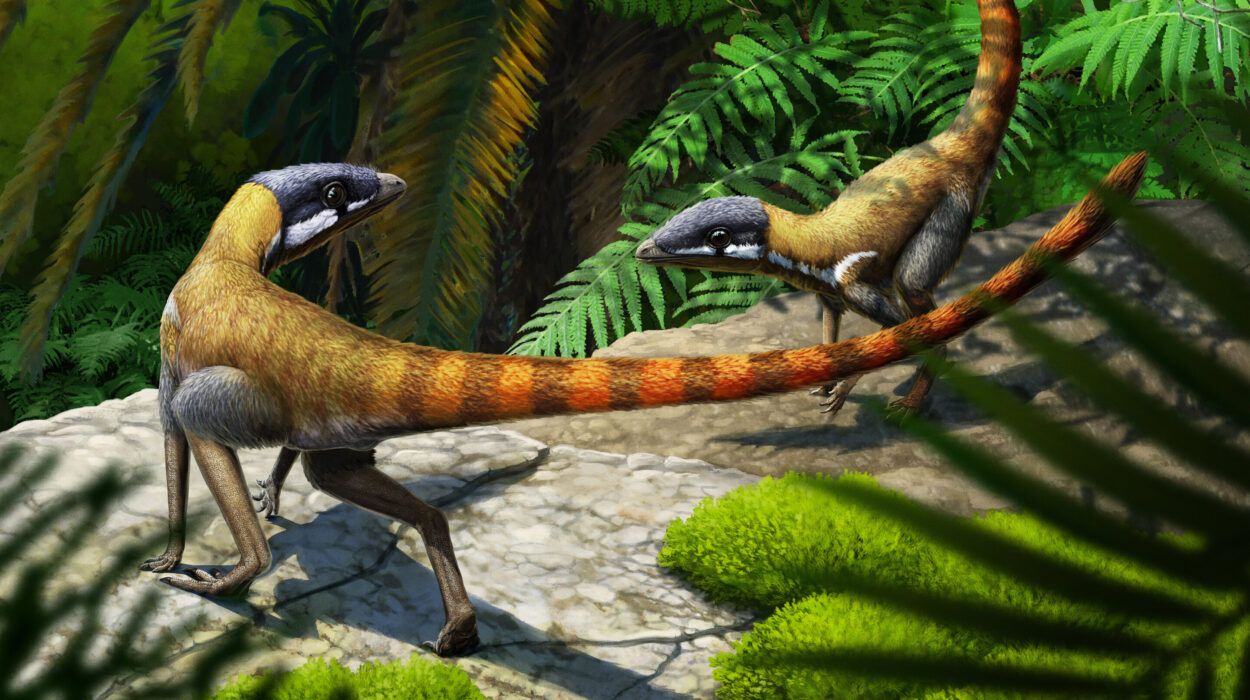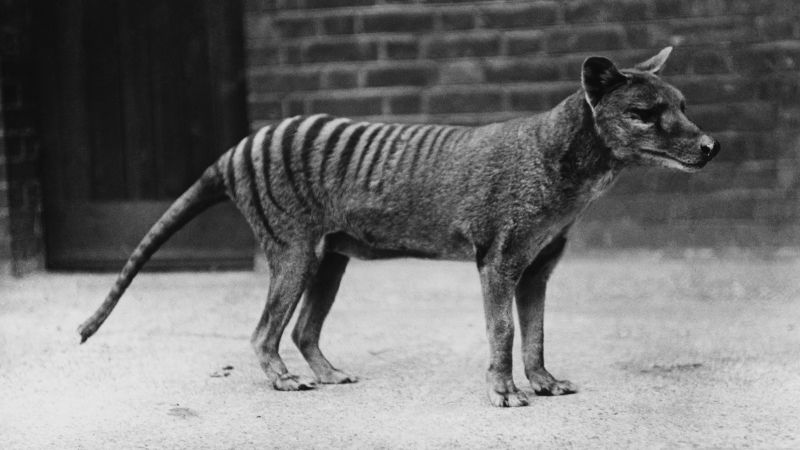
The extinct Tasmanian tiger had a skull unlike those of living mammalian predators, and its unusual combination of a very large head, long slender snout and widened canine region points to fast, high-impact bites rather than the biting styles of wolves or other familiar carnivores.
The thylacine, or Tasmanian tiger (Thylacinus cynocephalus), has long been regarded as one of evolution’s clearest examples of convergence. Its skull and overall appearance resemble those of wolves and other canids even though thylacines were marsupials and canids are placental mammals separated by roughly 122 million to 166 million years of evolution.
A new analysis of thylacine skull shape finds that the resemblance is more complicated than it first appears. Instead of matching the skull of a wolf or another living carnivore, the thylacine combines features that occur in different groups and do not occur together in the living mammals examined.
That combination includes a disproportionately large skull, a tall and slender snout, an expanded region around the canines, and an unusually large opening in the cheekbone area known as the infraorbital foramen. Together, these features are consistent with a biting style built around rapid jaw closure and high-impact contact at the canines.
The skull was wolf-like in some ways, but not in others
Researchers compared three-dimensional skull shapes from 225 specimens representing 14 mammalian families. The sample was focused mainly on faunivorous mammals weighing between 5 and 50 kilograms, making it useful for comparison with the roughly 17-kilogram thylacine. The analysis divided the skull into functional and developmental regions so that similarities could be examined separately rather than treating the entire skull as one structure.
Across the whole skull, the thylacine occupied an intermediate position between canids and other metatherians, the broader group that includes marsupials and their extinct relatives. Its closest overall shape matches were mostly mid-sized canids such as jackals and foxes, along with some smaller marsupial carnivores.
But breaking the skull into regions changed the picture.
The thylacine’s rostrum, or snout, was generally closer in shape to that of canids. Its neurocranium, the rear portion of the skull surrounding the brain, was closer to metatherians. The pattern also varied among canids. Foxes were especially similar to the thylacine in the front of the skull, while wolves and several other larger canids were more similar in parts of the rear skull.
That matters because it means there is no single living canid that provides a close functional match for the entire thylacine skull. The researchers conclude that the thylacine combines anterior and posterior features that do not normally occur together in the canids or metatherians examined.
Its head was unusually large for its body
The most striking difference emerged when the researchers considered absolute skull size.
The thylacine weighed about 17 kilograms, but its skull was much larger than expected for an animal of that body mass. Its cranial size was within about 10% of the skull sizes of mammals weighing roughly 24.5 to 66.7 kilograms. Its skull was comparable in size to those of much heavier predators, including gray wolves, African wild dogs, pumas and leopards.
The unusual size was not simply an expected consequence of the thylacine having the shape of a large-headed carnivore. Statistical analyses found that size explained some variation in skull shape, but size did not dominate the main patterns of variation. Differences among the major mammalian groups accounted for substantially more variation than size alone, and the researchers found that the thylacine’s shape was not predicted by the allometric patterns in the sample.
At the same time, the thylacine had a relatively slender snout.
Within thylacines, larger individuals continued to show the same unusual combination. As cranial size increased, the snout became narrower in several measurements compared with the canids used for comparison. The facial region across the carnassials was also relatively narrow and became significantly narrower with increasing cranial size compared with gray wolves, coyotes and red foxes. In contrast, the zygomatic arches, the bony structures that form the sides of the skull near the jaw muscles, became wider with cranial size.
A long, narrow jaw generally closes faster than a shorter, broader one because its out-lever is longer. This type of shape is associated with capturing small, fast-moving prey, although it provides less resistance to large forces and twisting loads. The thylacine was unusual because it combined that gracile snout with a much larger skull than expected for its body size.
The researchers propose that the large skull could have compensated for some of the structural weakness associated with a long, narrow snout. Larger skulls are more resistant to loads and contain more muscle than smaller skulls with the same general shape. The large head therefore points toward prey capture involving fast, high-impact bites whose forces could be spread through a relatively large volume of skull bone.
The front of the snout was built differently
Another unusual feature is the shape of the front of the upper jaw.
The thylacine had what the researchers call a “terminal rosette.” The rostrum expanded around the canines and then narrowed sharply farther back, creating a pinched section of the upper jaw. This feature was especially pronounced in the thylacine and in the researchers’ three-dimensional reconstruction of Andrewsarchus mongoliensis, a gigantic extinct early Eocene mammal.
The expanded tip changes how mass is distributed in the front of the skull. The researchers argue that it would increase rotational inertia at the tip and provide more hard tissue around the canines to resist the forces generated during impact.
The snout was also unusually tall from top to bottom. That shape can help distribute forces acting vertically, although it provides less resistance to sideways and twisting forces. The thylacine’s relatively sturdy canines are also consistent with the possibility that they experienced substantial forces during biting.
Taken together, the tall, elongated jaw, the expanded canine region and the large skull are consistent with a relatively fast snapping bite that could deliver substantial force at the canines. The researchers associate that combination with acquiring relatively small, potentially agile prey.
A large opening in the skull adds another clue
The thylacine also had an exceptionally large infraorbital foramen, an opening in the upper jaw region through which a major branch of the trigeminal nerve passes.
Its size was far greater than that recorded in living marsupials in the researchers’ comparison. Large infraorbital foramina occur in some mammals with highly developed whiskers and in some predators with large canines. The nerve passing through the opening supplies sensation to areas including the cheeks, upper lips, external nose and whiskers.
The thylacine’s whiskers, however, were described as short and fine compared with those of dasyurid relatives, so the researchers do not consider ordinary whisker-based sensing a sufficient explanation for the unusually large opening.
One possibility is that the large nerve and its associated sensory structures helped provide information from the front of the face during biting. Similar features occur in some extinct sparassodonts, a group of extinct predatory metatherians, which have also been proposed to have relied heavily on their canines. But the researchers emphasize that there is not enough information from living mammals to provide a clear explanation for the thylacine’s unusually large infraorbital foramen.
No living mammal provides a close match
The researchers considered several living mammals that might offer partial comparisons.
The maned wolf has a combination of skull shape and size that makes it the closest canid comparison when both factors are considered. It weighs about 25 kilograms, compared with roughly 17 kilograms for a thylacine, and its diet includes substantial amounts of rodents and fruit. Its skull can therefore provide some information about capturing small prey, but its smaller skull relative to body size, fruit consumption and extremely slender, long-legged body make it a poor overall ecological comparison for the hypercarnivorous thylacine.
The Ethiopian wolf has an elongated jaw and pinched snout and weighs about 14.5 kilograms, close to the thylacine’s body mass. It feeds almost entirely on small, quick-moving prey such as rodents and hares. But its snout is not as tall and its skull is smaller relative to its body, indicating important differences in the absolute mechanical properties of the two skulls.
The common opossum has a similarly large skull relative to its body, but its snout shape is among the least similar to the thylacine’s in the researchers’ comparisons. It may therefore help with questions about how a large skull was moved relative to the body, but not with the details of the thylacine’s biting system.
The researchers therefore conclude that the thylacine’s combination of cranial traits has no known functional analogue among modern mammalian carnivores.
Extinct predators may offer better comparisons
The search for comparable skulls extends beyond living mammals.
Several extinct vertebrates had large skulls combined with long snouts and widened or tall tips. Crocodiles, predatory fishes, Spinosaurus and some pterosaurs are examples. These animals were not ecological equivalents of the terrestrial thylacine, but similar skull features have been associated with fast-snapping predation.
Several extinct terrestrial mammals also had combinations of features resembling those of the thylacine. They include extinct sparassodonts, entelodontids, hyaenodonts, mesonychids and amphicyonids. The researchers say it is possible that the thylacine’s skull represented a combination of biomechanical adaptations to carnivory that is no longer present among living mammals.
That finding also complicates the long-standing comparison between thylacines and wolves.
The thylacine and gray wolf share similarities in skull development and in positive selection affecting regulatory DNA involved in skull growth and patterning. But the new functional analysis indicates that those developmental and genomic similarities are unlikely to reflect selection for the same cranial function.
Instead, the researchers point to evolutionary history and developmental differences as possible reasons that similar genetic and developmental patterns can produce skulls with different functional combinations. In particular, they note differences between marsupial carnivores, whose teeth can over-erupt, and carnivorans, whose teeth include specialized carnassials for shearing.
The thylacine genome may help explain its skull
The researchers say future work could connect the unusual skull to the biology of its development.
The thylacine genome has been sequenced, including a chromosome-scale genome assembly. Previous work found convergent positive selection between thylacines and wolves in regulatory regions associated with neural crest development. Neural crest cells contribute to important parts of the developing skull and face.
Many of the unusual thylacine features identified here, including the terminal rosette, tall transverse shape of the snout and large infraorbital foramen, occur in regions derived from the neural crest. The researchers also note that the maxillary branch of the trigeminal nerve is itself neural-crest-derived, raising the possibility that some unusual cranial features could be related to convergent changes in regulatory elements affecting the trigeminal system.
Those possibilities remain subjects for future comparative genomic research. For now, the skull itself provides the evidence for a distinctive combination of traits that does not match any living mammalian predator examined in the study.
The study was published in Nature Communications.