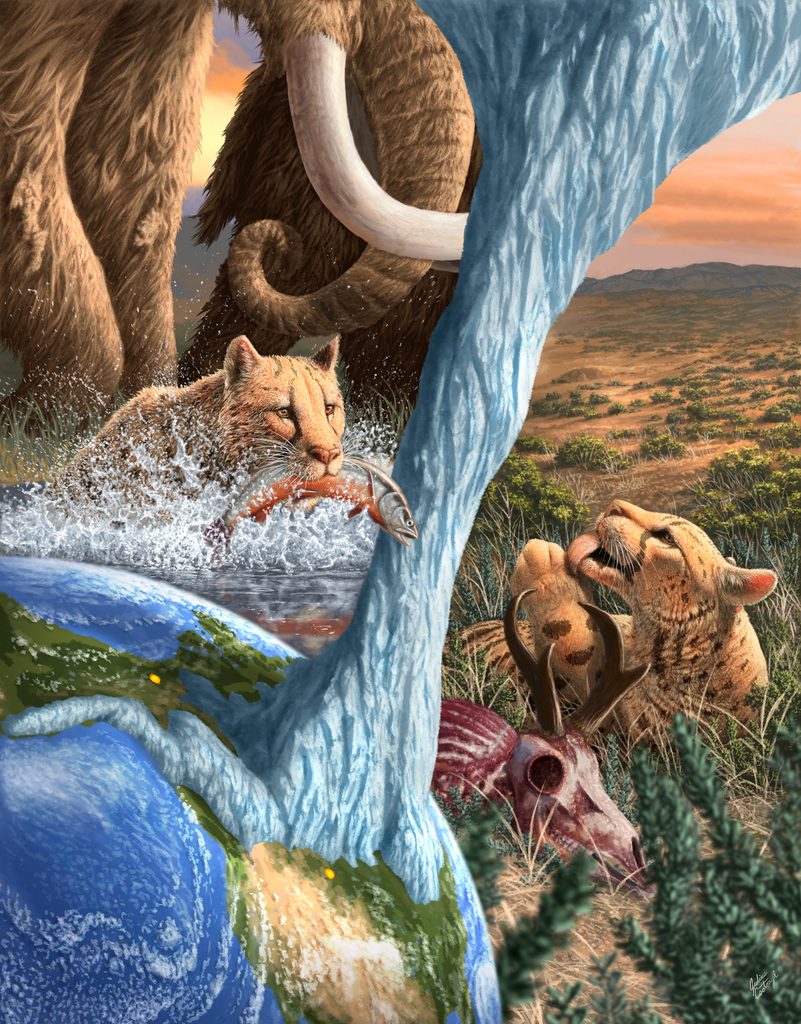
The extinct North American cat Miracinonyx trumani, long known as the “American cheetah,” lived much farther north than previously recognized and had a more varied ecological role than its name suggests. Ancient DNA identifies it as a close relative of the puma, while stable isotope evidence indicates that cats living in the Yukon relied heavily on aquatic food resources, unlike their counterparts in Wyoming.
Miracinonyx trumani has long been described as a North American counterpart to the African cheetah. Its slim body, long forelimbs and other features associated with fast running made the comparison seem natural. Fossils were also commonly found alongside the remains of pronghorn, reinforcing the idea that the extinct cat was a specialized pursuit predator.
But those similarities were misleading.
Earlier mitochondrial DNA had already placed M. trumani closer to pumas than to African cheetahs. Because evolutionary relationships among cats can be complicated by differences between mitochondrial and nuclear DNA, the researchers sought a stronger test using nuclear genomes.
They analyzed four radiocarbon-dated fossils. Three came from Canada’s Yukon Territory and one from Natural Trap Cave in Wyoming. The Yukon fossils had previously been tentatively identified as pumas, partly because they were found so far north of the known range of M. trumani.
The genetic evidence identified all three Yukon fossils as M. trumani.
The fossils date to about 31,000 to 34,000 years ago. That pushes the known range of the species more than 20 degrees of latitude northward, showing that it lived from present-day Florida to the Arctic Yukon during the Late Pleistocene.
The northern animals lived in an environment very different from the grasslands where the species was previously best known. Arctic steppe-tundra had different prey, climate and seasonal patterns of daylight.
The Yukon cats also lived alongside several other large predators, including cave lions, scimitar cats, gray wolves, brown bears and short-faced bears.
How M. trumani occupied its place among those predators remains unclear. But the findings are consistent with earlier anatomical and isotopic work indicating that the species was more likely a generalist predator than a specialized hunter of pronghorn.
The cat was a puma relative, not a cheetah
The nuclear genomes provided a clearer picture of where M. trumani belonged on the cat family tree.
The researchers generated a paleogenome with about 22-fold coverage from the Wyoming animal, which dates to about 23,500 years ago. They also generated a roughly 38-fold coverage paleogenome from the best-preserved Yukon specimen, from Bluefish Caves.
Comparisons with genomes from nine other cat species placed M. trumani as the sister species of the puma, Puma concolor. The result was strongly supported by analyses of both genes and individual DNA sites.
The lineage leading to M. trumani and the puma separated about 2.6 million years ago. That was around the transition from the Pliocene to the Pleistocene, when the climate was cooling rapidly and grasslands were expanding across North America.
The extinct cat nevertheless looked strikingly like the African cheetah, Acinonyx jubatus. The two species shared a common ancestor about 4.7 million years ago, but their similar running-related features evolved independently.
That makes M. trumani an example of convergent evolution. Similar environmental pressures can produce similar physical traits in animals that are not closely related.
The Yukon cats had an unusual dietary signal
The most unexpected evidence came from the chemistry of the fossils.
The researchers measured stable carbon and nitrogen isotopes in collagen from the ancient bones. These measurements can provide information about an animal’s place in a food web.
The Yukon M. trumani had bulk nitrogen isotope values about 6 parts per thousand higher than contemporary carnivores and their terrestrial prey in the region. The values were higher than those of the other Pleistocene carnivores examined and fell within the range seen in animals that eat aquatic prey.
The Wyoming animals looked different. Their isotope results were consistent with terrestrial carnivores that had generalist diets in open steppe-tundra environments.
The unusually high nitrogen values in the Yukon cats could not be explained by terrestrial prey alone. The researchers therefore considered aquatic food chains, including anadromous fish, as the simplest explanation. Anadromous fish move between marine and freshwater environments and can carry high nitrogen isotope values through aquatic food webs.
The researchers then used nitrogen isotopes from individual amino acids to estimate where the cats sat in the food chain.
The Yukon animals occupied an estimated trophic position of 4, consistent with tertiary consumers. The Wyoming animals averaged a trophic position of about 3, with a variation of 0.3, consistent with secondary consumers that fed mainly on terrestrial herbivores.
The isotope evidence therefore points to a major difference between the two populations.
The Yukon M. trumani appear to have specialized on aquatic resources, while the Wyoming population had a broader terrestrial diet.
The fish may have been taken in several ways
The isotope results cannot determine exactly how the cats obtained aquatic prey.
The researchers identify several possibilities. The cats could have scavenged fish carcasses along riverbanks, hunted at places where fish gathered to spawn, or caught fish in shallow water.
Late Pleistocene sites in Alaska and Yukon contain salmonids, inconnu and other anadromous or semi-anadromous fish. These remains show that aquatic food resources were available hundreds of kilometers from the coast.
The researchers therefore conclude that the isotope evidence is consistent with local dietary variation. In Arctic environments, M. trumani appears to have been an aquatic specialist, while at lower latitudes it maintained a more generalist strategy in temperate grasslands.
The two populations remained genetically similar for a long time
The genomic data also provided information about the population history of M. trumani.
Both the Yukon and Wyoming populations show long-term declines in effective population size over the last million years. The estimated effective population size fell from nearly 100,000 individuals to fewer than 10,000 by about 70,000 years ago.
The demographic histories of the two populations begin to diverge around 80,000 years ago.
Mitochondrial DNA indicates that the Yukon and Wyoming populations shared a maternal ancestor roughly 43,000 years ago. The estimated 95% highest posterior density interval was 61,100 to 31,700 years ago.
The researchers say this could mean that M. trumani maintained gene flow across the continent until late in the Pleistocene. Another possibility is that the species expanded into the Arctic Yukon relatively recently and was subsequently isolated by continental glaciers.
Both populations also had consistently low genetic diversity.
The Wyoming individual had genome-wide heterozygosity of 0.0298%, compared with 0.0384% for the Yukon individual. Those values were within the ranges reported for other cats and other taxa with low genetic diversity.
Despite the low diversity, the genomes showed no evidence of extreme demographic bottlenecks or inbreeding in the form of long runs of homozygosity. The researchers infer that M. trumani maintained a small effective population size over a long period, which may help explain why fossils of the species are relatively uncommon.
The genomes offer clues about life in the north
The researchers also searched the genomes for genetic changes that might have affected the extinct cat’s biology.
They identified 48 genes in which both M. trumani individuals carried homozygous loss-of-function variants. Among them were PER3, a gene involved in sensitivity to day length and seasonal adjustment of sleep timing, and NOS1, which affects the entrainment of circadian rhythms by light.
The researchers note that similar loss of function in PER3 occurs in many Arctic mammals. They suggest that the changes in M. trumani could reflect relaxed constraints on photoperiod-based circadian regulation, although they emphasize that the sample size is small.
Other loss-of-function variants occurred in genes involved in nutrient metabolism and taste perception.
One of those genes, PKD1L3, is associated with sour-taste perception. The researchers found four stop codons in Miracinonyx that were shared across all of the felid species in their dataset. They therefore concluded that the gene’s inactivation was shared across felids rather than being a change unique to M. trumani.
The researchers also searched for genes that might have undergone positive selection in the M. trumani lineage. They initially found 48 genes with evidence of positive selection in one analysis, and 32 of those were also identified in a second analysis. After additional filtering, 23 candidate genes remained.
None reached significance after correction for multiple testing. The researchers therefore present these genes as candidates for future investigation rather than as confirmed examples of adaptation.
The “American cheetah” name hides the animal’s ecology
The combined genetic and isotope evidence changes the picture of M. trumani.
It was not closely related to the African cheetah. Its cheetah-like body evolved independently. And the evidence does not support the idea that it was simply a specialized pursuit predator associated with pronghorn.
Instead, the species occupied different ecological roles in different parts of North America. In temperate regions, the Wyoming population appears to have been a generalist terrestrial predator. Farther north, the Yukon population appears to have specialized on aquatic resources.
The researchers conclude that this combination of ecological flexibility and geographic range gave M. trumani a predatory role with no single modern equivalent.
The findings also show why identifying extinct animals from isolated bones can be difficult. The Yukon fossils resembled those of pumas closely enough that they had originally been classified as P. concolor. Ancient DNA revealed their identity as M. trumani.
The study was published in Current Biology.