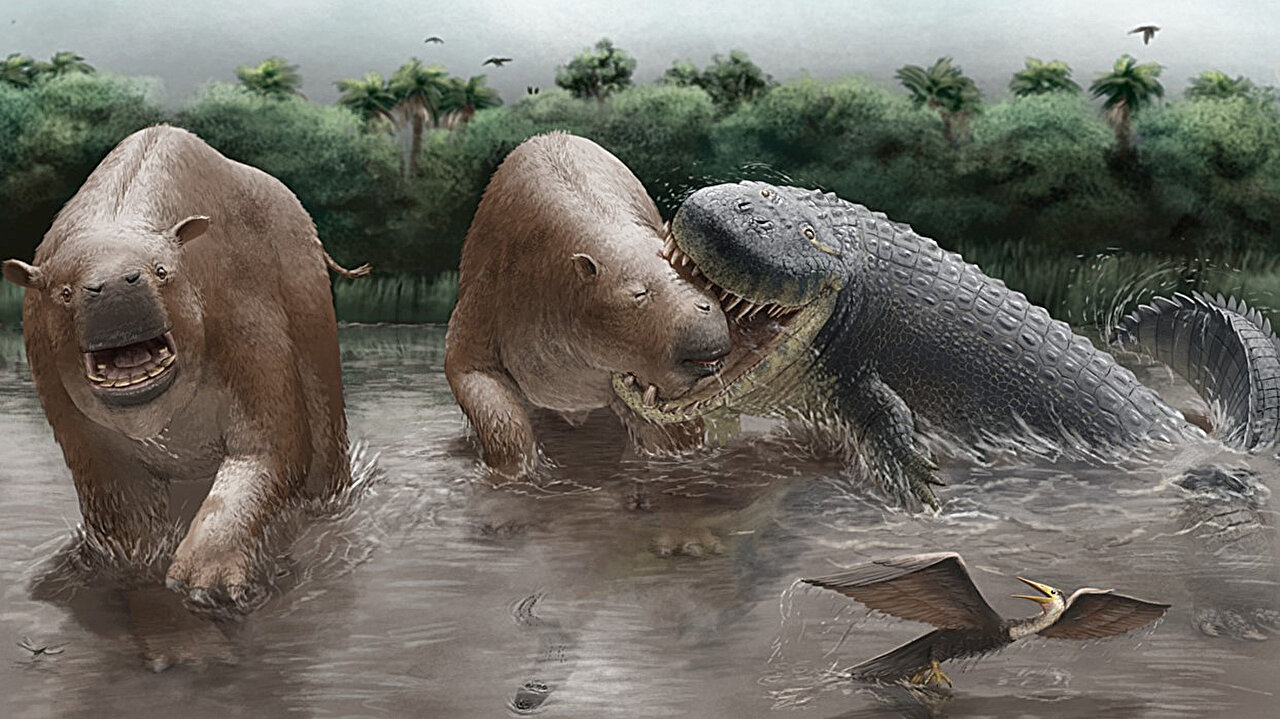
Fossil bones from Colombia preserve direct evidence that giant crocodilians attacked large mammals about 12 million years ago. The bite marks occur on three different ungulates from the Middle Miocene La Venta assemblage, and their size, shape, bone damage and estimated bite forces point most strongly to Purussaurus neivensis as the predator. The findings provide the first direct evidence from La Venta of the predator-prey relationship that had previously been proposed from ecological modeling.
Bite marks on three large mammals
The fossils come from the La Venta assemblage in the La Tatacoa Desert of Colombia, one of the most diverse and well-sampled fossil vertebrate communities in the Neotropics. The assemblage contains 156 identified vertebrate species, including nine crocodyliforms.
Researchers examined four fossil specimens belonging to three large ungulates: the toxodontid Pericotoxodon platignathus, the astrapothere Xenastrapotherium kraglievichi, and the astrapothere Granastrapotherium snorki.
The fossils preserve several types of marks made when teeth modified bone. These include punctures, pits, grooves and areas of crushed or fractured bone.
One of the most striking specimens is a partial cranium of Pericotoxodon platignathus. It contains a large puncture on the frontal bone. The roughly circular mark measures about 29.2 by 27.0 millimeters and has two opposing vertices, a shape associated with the ichnotaxon Nihilichnus hastarius.
A second Pericotoxodon specimen preserves part of a distal femur. Five punctures assigned to Nihilichnus fissuratus occur on the bone, along with four smaller pits assigned to Nihilichnus clavus.
The two astrapotheres also preserve evidence of substantial biting. The mandible of Xenastrapotherium contains two large punctures with fractures radiating from them and significant deformation of the surrounding bone. The mandible of Granastrapotherium contains a large puncture, additional damage and grooves on its surface.
None of these bones shows evidence of healing around the marks, indicating that the injuries occurred before the animals died or during feeding after death rather than being injuries that healed during life.
Why Purussaurus is the leading candidate
Several kinds of evidence point toward Purussaurus neivensis.
The largest puncture on the Pericotoxodon skull closely matches the size and shape of the teeth of adult Purussaurus preserved in the La Venta collections. The researchers measured 22 isolated Purussaurus teeth. Their basal diameters ranged from 19.6 to 43.7 millimeters, with a mean of 27.8 millimeters. The fossil puncture has a maximum diameter of 29.2 millimeters.
The shape of the marks also matters. Purussaurus had robust, conical teeth, including teeth with a rounded cross section. Its combination of body size, tooth form, snout shape and estimated bite force makes it the strongest candidate for producing the large punctures.
The researchers estimated the minimum force needed for individual teeth to penetrate the fossil bones using the area of each puncture and the compressive strength of fresh cortical bone.
The largest puncture on the Pericotoxodon cranium corresponds to a minimum estimated force of about 80,284 newtons per tooth. The researchers caution that this value is probably an overestimate because the mark occurs in the relatively thin frontal bone rather than a denser bone such as a femur or mandible.
Other punctures produce lower individual estimates, but several were probably made when multiple teeth contacted the bone at the same time. For the Xenastrapotherium mandible, two punctures have estimated minimum forces of about 40,825 and 28,339 newtons per tooth. The Granastrapotherium puncture has an estimated minimum force of about 36,873 newtons per tooth.
The researchers note that the combined forces in some of these biting events would have exceeded 40,000 newtons and in some cases approached 70,000 newtons. These estimates are within the range expected for Purussaurus based on previous bite-force estimates.
The damage records more than simple tooth contact
The fossils do not simply contain holes where teeth entered the bone. Several marks are accompanied by fractures and crushing.
The two large punctures on the Xenastrapotherium mandible are associated with extensive fractures. The surrounding cortical bone is significantly deformed, and the fractures extend through different surfaces of the jaw.
The Granastrapotherium mandible shows a similar pattern. Bone around its large puncture is crushed, with fractures extending away from the mark.
The researchers assign some of this damage to the trace fossil Brutalichnus. In these specimens, the cortical bone was broken into the internal part of the bone. Because the crushing occurs directly around the bite traces, the researchers interpret it as biogenic damage associated with the force of biting rather than simply deformation caused during burial.
The Granastrapotherium mandible also contains a strongly curved groove. The researchers interpret this as a hook score, a type of tooth mark associated with forceful movement during feeding. Such marks have been linked to actions such as shaking, thrashing or death rolling in modern crocodilians.
The marks suggest attacks focused on the head
Three of the four specimens preserve bite marks on the head region of the prey.
The Pericotoxodon cranium contains the large puncture on its frontal bone. The Xenastrapotherium and Granastrapotherium specimens preserve punctures on their mandibles.
This pattern is consistent with the prey-capture behavior of modern crocodilians, which can target the head during an ambush attack. Modern crocodilians can seize prey at close range and, in many cases, drag captured animals into water.
The researchers propose that the Miocene animals may have interacted with Purussaurus in freshwater environments in a similar way. They specifically suggest that the head-focused marks are consistent with the hypothesis that the ungulates were attacked as they approached wetlands to drink.
The authors stress that this interpretation is a hypothesis based on the location and form of the traces rather than a directly observed event.
Predation cannot always be separated from scavenging
One important limitation is that fossil bite marks alone do not always reveal whether an animal was attacked while alive or eaten after death.
The researchers therefore consider both predation and scavenging. They conclude that there is insufficient evidence to distinguish the two with certainty in every specimen, but they regard predation as the most likely explanation in most cases.
The location of the marks provides additional support. Three of the four specimens have traces on the facial region, and all the modified areas are considered high-value regions under criteria used to distinguish feeding associated with predation from scavenging.
The Pericotoxodon skull is particularly informative because its damage resembles bite marks produced on pig skulls by modern saltwater crocodiles during feeding experiments. In those experiments, crocodiles produced marks on the frontal and nasal bones while grabbing carcasses by the head.
The similarity supports the interpretation that at least some of the Miocene traces were produced during prey capture rather than simply during later consumption of an already dead animal.
One jaw records two different feeding events
The Xenastrapotherium mandible provides evidence for another part of the story.
The researchers identified large punctures and crushing on the lingual side of the jaw, along with a separate set of 10 parallel grooves on the buccal side.
The large punctures belong to Nihilichnus fissuratus. Their size and the extensive deformation of the bone are consistent with a large crocodilian, most likely Purussaurus.
The parallel grooves belong to Knethichnus parallelum. This trace is produced when a serrated tooth slips across bone. Its form does not match the large conical teeth responsible for the other marks.
The researchers therefore propose that two different crocodilian taxa interacted with the same carcass at different times. The larger punctures probably represent the attack or feeding event associated with Purussaurus, while the smaller parallel grooves probably record later scavenging by a ziphodont crocodilian, most likely Langstonia huilensis.
The researchers cannot identify the specific predator from the Xenastrapotherium punctures alone. However, the size and spacing of the traces are consistent with a crocodilian, and the size and shape of the teeth are consistent with Purussaurus.
The prey were large even by Miocene standards
The animals bearing the bite marks were substantial.
The researchers estimated a body mass of about 982 kilograms for the Pericotoxodon represented by the partial cranium, with another estimate of about 932 kilograms using a different measurement. The damaged femur represents an animal estimated at about 616 kilograms.
The Xenastrapotherium mandible represents an animal with an estimated body mass of about 1,687 kilograms.
The Granastrapotherium mandible represents an estimated body mass of about 1,822 kilograms.
These estimates place the fossils among the large mammals of the La Venta assemblage. The evidence therefore supports the earlier hypothesis that the largest ungulates in the ecosystem could serve as prey for its largest crocodilians.
Purussaurus was built for large prey
Purussaurus neivensis was the largest crocodilian in the La Venta assemblage. Its estimated body mass was about 1,793 kilograms.
The species has been classified as a macro-generalist, a crocodilian form capable of taking relatively large prey. It had a broad, U-shaped snout and teeth that varied in both size and shape. Its anterior teeth were tall and pointed, while other teeth were shorter and more rounded.
The combination of its size, tooth shape, estimated bite force and snout morphology makes Purussaurus the most likely consumer responsible for the traces found on the Pericotoxodon, Xenastrapotherium and Granastrapotherium specimens.
The researchers compare the feeding traces with those made by large modern crocodilians, particularly saltwater and Nile crocodiles. They propose that the fossil evidence indicates Purussaurus probably hunted and processed prey in a broadly similar way, while emphasizing that the details of Miocene predator and prey ecology may have differed from those of modern animals.
The size difference is substantial. The largest modern saltwater crocodiles have an estimated maximum body mass of about 1,150 kilograms, whereas P. neivensis at La Venta has been estimated at about 1,793 kilograms.
The fossil evidence fills a major gap
Before this study, giant crocodilians had already been proposed as important predators of large mammals at La Venta based on predator-prey biomass relationships.
What was missing was direct physical evidence of those interactions.
The four specimens described here provide that evidence through the traces left on fossil bone. The study identifies ichnofossils belonging to Nihilichnus, Linichnus, Knethichnus and Brutalichnus. The researchers interpret the traces as direct records of interactions between crocodilians and large mammals.
The study also points out that the specimens were found incidentally rather than through a systematic search for bone-surface modifications. A systematic examination of La Venta collections has not yet been conducted.
The authors therefore suggest that similar traces may be more common in the fossil collections than previously recognized.
The evidence also supports a broader role for crocodilians in the La Venta ecosystem. The researchers identify the fossils as records of both predation and scavenging involving large mammals and argue that these interactions were part of the ecological structure of the Middle Miocene community.
The study was published in Journal of Vertebrate Paleontology.