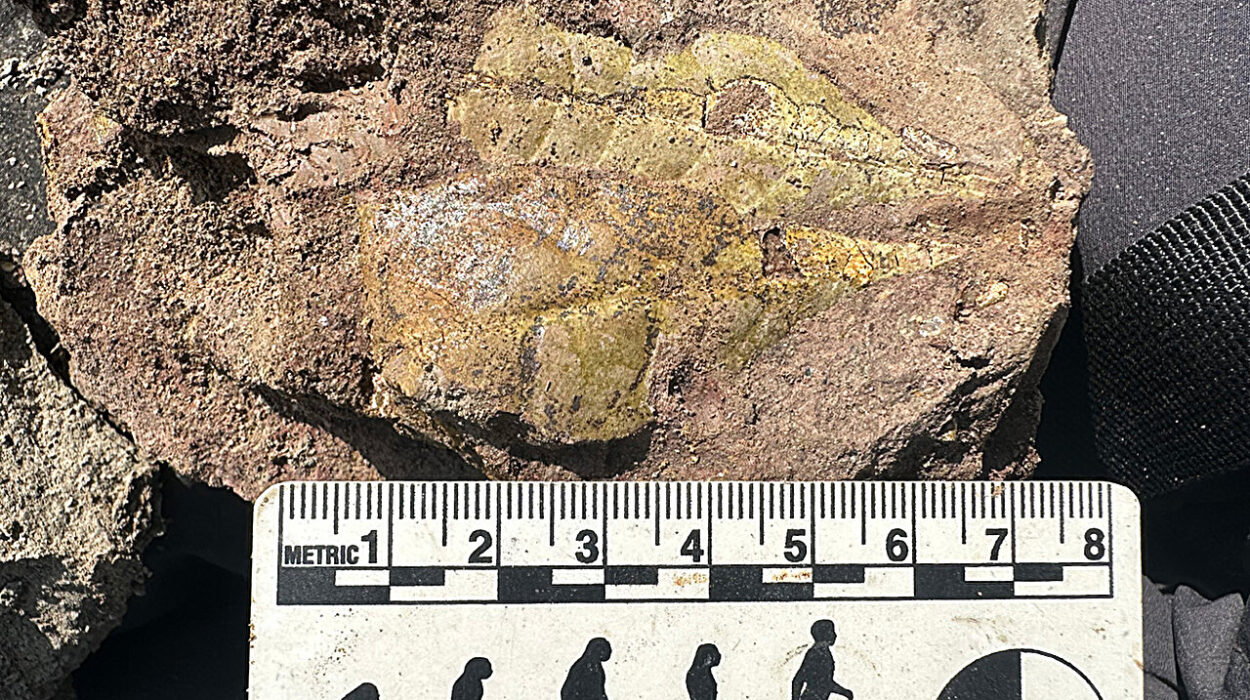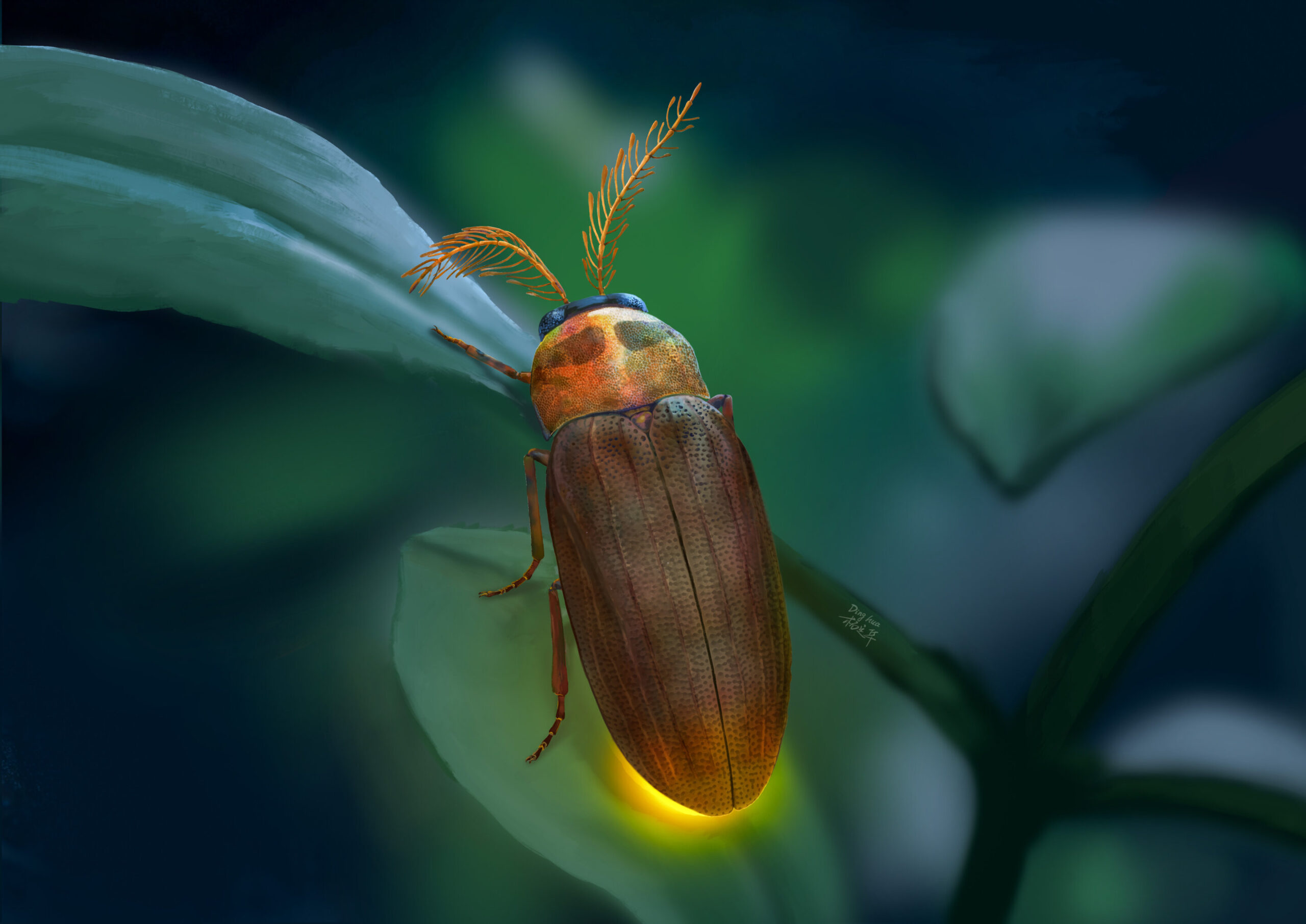
A beetle preserved in 99-million-year-old Kachin amber had a combination of sensory and signaling features unlike any known living or fossil beetle. The newly described Icaroramus perisi had four branching structures on each of several antenna segments, along with a well-developed abdominal photic organ. The unusual antennae indicate that chemical signals likely played an important role in finding mates, while the light-producing organ may have served mainly as a warning signal rather than as a mating signal.
The fossil comes from Kachin amber collected near Noije Bum Village in Myanmar’s Hukawng Valley. The specimen is a male and belongs to a new genus and species, Icaroramus perisi. The amber dates to the mid-Cretaceous, specifically the upper Albian to lower Cenomanian.
The beetle was about 11.2 millimeters long and 5.1 millimeters wide. Its body was relatively compact and moderately sclerotized, with six abdominal ventrites.
What makes the fossil especially notable is the combination of its antennae and abdominal light-producing structure. Both features are preserved clearly enough to provide information about how the beetle may have detected signals and used light.
The researchers tentatively place Icaroramus in Cretophengodidae, a fossil group of lampyroid beetles. Lampyroids include fireflies and several closely related groups known for specialized antennae and bioluminescence.
The antennae were unlike those of any known beetle
Icaroramus had 12 antennal segments. Segments 4 through 11 each carried two different pairs of long branches, producing four branches from each of those segments.
The researchers call this arrangement quadriheteroramose. The name distinguishes it from more familiar branched antennae in which each segment has only one pair of branches.
The two types of branches were not identical. The proximal pair began near the base of each antennal segment. These branches were longer, slightly wider toward their tips and covered with coarser setae. The distal pair began around the middle of the segment. These branches were shorter and narrower and had finer setae.
The result was an antenna that combined features resembling both flabellate and pectinate antennae.
No other living or fossil beetle is known to have this particular antennal structure.
The researchers also considered whether the unusual antennae could have resulted from a developmental abnormality. They concluded that this was unlikely because the left and right antennae are perfectly symmetrical. Developmental abnormalities in insect antennae commonly produce pronounced irregularities or asymmetry.
The antennae likely increased the beetle’s ability to detect chemicals
Antennae are major sensory organs in insects, and their surfaces can carry olfactory sensilla that detect chemical signals.
Branched antennae can increase the available surface area for these sensory structures. In many insects, especially males, elaborate antennae are associated with detecting sex pheromones released by females.
The structure of Icaroramus fits this general pattern. Its unusually elaborate antennae, combined with the different types of branches and setae, indicate that pheromone detection likely played a major role in locating mates.
The researchers suggest that the two kinds of branches may even have had different olfactory functions. Their different shapes and setae could indicate specialization for detecting different kinds of chemical cues or detecting them at different distances. However, the fossil does not preserve enough detail to determine the exact distribution of the sensory structures.
The interpretation is also consistent with the broader diversity of lampyroid antennae. Living members of the group have evolved many different forms, including filiform, serrate, pectinate and flabellate antennae.
In species that rely heavily on long-distance chemical communication, more elaborate antennae are generally associated with detecting those signals. Species that rely more heavily on visual signals such as bioluminescence often have simpler antennae along with more developed visual systems.
The extreme complexity of Icaroramus therefore points toward a mating system in which pheromones were important.
The unusual structure may reflect a developmental change
The four branches on each antennal segment also raise a question about how such an unusual structure could have evolved.
The researchers note that complex branched antennae have evolved independently several times within lampyroids. This repeated evolution suggests that the group has an underlying developmental capacity that can produce different forms of branched antennae.
One possible explanation for the structure of Icaroramus involves the way insect antennae develop.
In holometabolous insects, antennal segments are produced during the pupal stage through a hierarchical process. Primary segments are formed first, followed by secondary splitting that can create additional modules.
The researchers propose that the repeated branching in Icaroramus could reflect a partial reactivation of this type of developmental process. Instead of producing an entirely new antennal segment, the developmental mechanism may have produced an additional branch within an existing segment.
In this interpretation, the normal location where a branch develops near the base of a segment may have been effectively duplicated farther along the segment.
The researchers describe this as a possible case of developmental repatterning. They also note that this interpretation is a hypothesis about how the unusual morphology may have developed.
Some living phengodid beetles have been reported with a third projection on certain antennal segments. But those structures are short and broad and differ substantially from the four well-developed branches of Icaroramus.
The fossil also had a light-producing organ
The antennae were not the only unusual feature preserved in the fossil.
A lightly colored region covers the entire sixth abdominal ventrite. The researchers interpret this structure as a photic organ, meaning a light-producing organ.
The interpretation is supported by comparisons with other lampyroid fossils from Kachin amber. A similar preservation pattern occurs repeatedly in previously published specimens and in additional unpublished specimens examined by the researchers and their colleagues.
That consistency supports the interpretation that the feature represents an actual anatomical structure rather than an artifact created during fossilization.
In living fireflies, the photic organ includes a light-producing layer and a reflector layer. The reflector contains uric acid granules that help increase the intensity of the emitted light by reflecting it.
The researchers note that tissues with specialized optical properties could therefore potentially be preserved in amber as a visibly distinct structure.
The light may not have been used primarily for courtship
The presence of a light-producing organ does not necessarily mean that Icaroramus used light to find mates.
Bioluminescence in living lampyroids has several functions, including defense, illumination, mate attraction and prey attraction. The researchers discuss evidence that ancestral lampyroid bioluminescence may have functioned as an aposematic signal, meaning a warning signal that helps deter predators.
In this interpretation, light originally served a defensive role and was later recruited for other functions, including adult courtship.
The elaborate antennae of Icaroramus are important to this question. If the beetle’s antennae were specialized for detecting pheromones, the presence of a light-producing organ does not necessarily indicate that it had already evolved a fully developed light-based mating system.
Instead, the researchers propose that bioluminescence in Icaroramus may primarily have served a nonsexual function such as predator deterrence.
The same interpretation has previously been proposed for Cretophengodes, another Cretaceous lampyroid with elaborate antennae and a photic organ.
The researchers also leave open another possibility. Icaroramus could represent an intermediate stage in which bioluminescence had begun to contribute to courtship but had not replaced pheromones as the primary sexual signal.
Some living fireflies use both pheromones and bioluminescence during mate searching and courtship. The presence of multiple signaling systems in living lampyroids therefore provides a possible comparison, although the exact behavior of Icaroramus cannot be directly observed.
Its evolutionary position remains tentative
The researchers place Icaroramus within the lampyroid clade because of its partly soft-bodied appearance, 12-segmented antennae with paired branches and abdominal photic organ.
Its morphology is most similar to Cretophengodidae, which previously contained only Cretophengodes. Both have 12-segmented branched antennae, a moderately developed prosternum and six compactly arranged abdominal ventrites.
A morphology-based phylogenetic analysis also recovered Icaroramus as closely related to Cretophengodes.
But the placement is not considered certain. Extensive evolutionary convergence within Elateroidea and uneven sampling of taxa limit confidence in the result. The researchers note that Icaroramus could instead represent an independent basal lineage within the lampyroid clade.
The analysis also recovered Cretophengodidae as a sister group to Sinopyrophoridae, but the researchers caution that an alternative hypothesis, in which Cretophengodidae represents a stem lineage of Phengodidae and Rhagophthalmidae, remains possible.
For now, Icaroramus is assigned to Cretophengodidae on a tentative basis.
A rare combination preserved in amber
The single fossil provides unusually detailed evidence about both sensory and signaling structures in a Cretaceous lampyroid.
Its antennae show a form of branching not known from any other beetle, while the abdominal structure provides evidence for a photic organ. Together, these features indicate that early lampyroids included forms with highly specialized sensory systems and more than one possible signaling modality.
For Icaroramus, the evidence points most strongly toward pheromones as an important means of locating mates, while its bioluminescence may have retained an earlier defensive function. The fossil also preserves a morphology that has no surviving counterpart among living lampyroids.
The study was published in Proceedings of the Royal Society B.