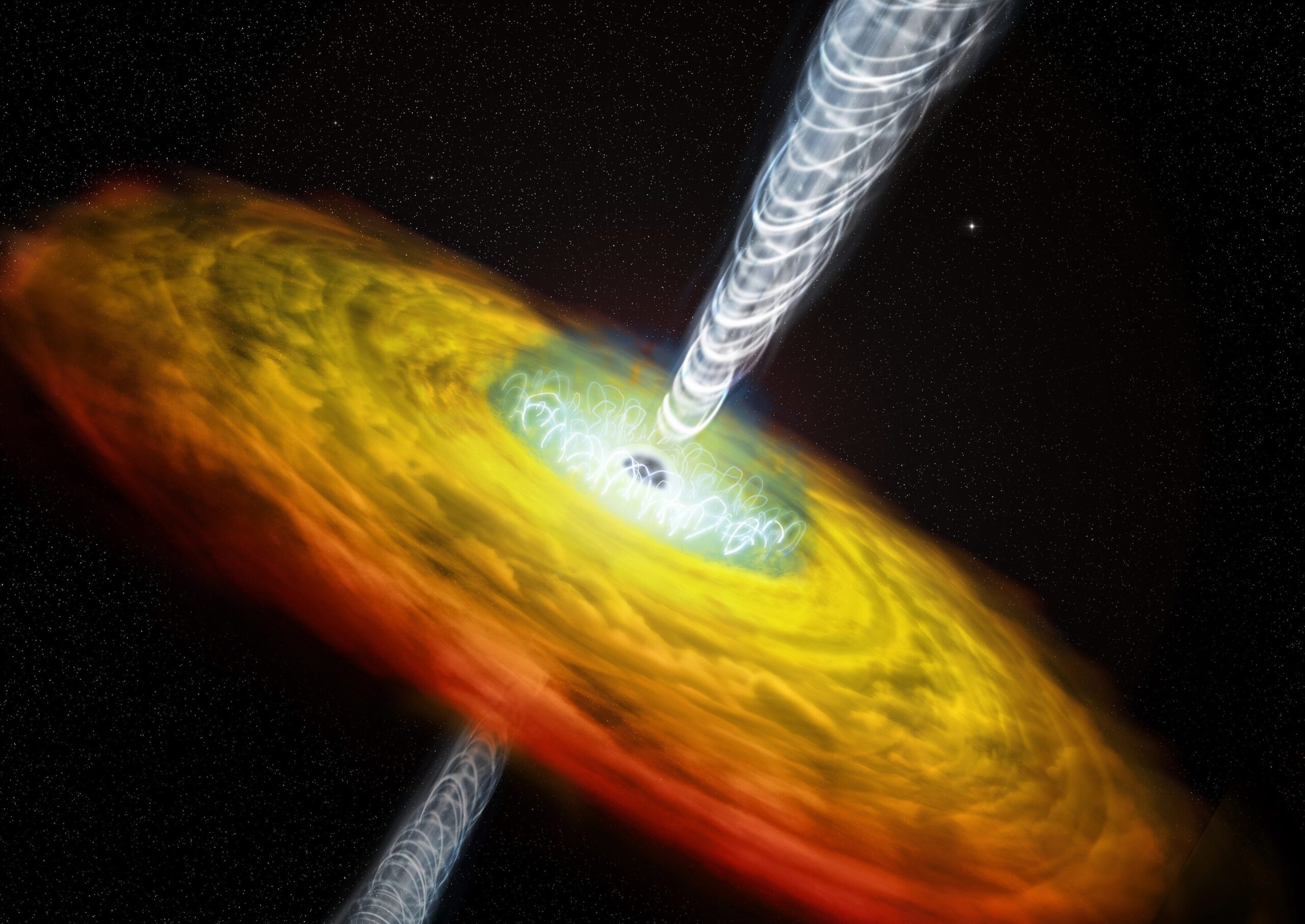
An unusual pattern of radio, optical, X-ray and gamma-ray activity from the blazar PKS 2233-148 may be partly caused by gravitational lensing, including a possible lensing event from a very low-mass object, but several explanations remain possible.
PKS 2233-148 is a blazar whose emission has shown several unusual features at different wavelengths. Radio observations reveal changes in the position of its jet, including a sudden offset from the main jet ridgeline that was accompanied by rapid brightening.
The observed increase in radio flux during that event corresponds to a magnification by a factor of about six.
The source also shows correlated variability at radio, optical, X-ray and gamma-ray wavelengths. Within this broader activity, researchers identified an especially unusual gamma-ray flare that appears to have been superimposed on the longer-term variability.
These observations led to a question with several possible answers. Could some of the apparent changes in PKS 2233-148 be produced not inside the blazar itself, but by gravitational lensing along the line of sight?
Gravitational lensing occurs when the gravity of an intervening object changes the apparent path of light from a more distant source. Depending on the mass and geometry of the lens, this can alter the apparent brightness or position of the background source.
For PKS 2233-148, the researchers examined several possible lensing configurations rather than treating one explanation as established.
The X-ray spectrum provides a lower source-redshift estimate
One important result comes from X-ray observations.
The Swift-XRT spectrum contains a neutral iron K-alpha line at 6.4 keV in the rest frame. Using this feature, the researchers obtained a source redshift of
z = 0.63 +0.04/-0.03
with a significance of 3.1 sigma.
The source’s redshift had previously been uncertain. The study also considers a higher photometric estimate of about 1.43 when examining possible lensing geometries.
The two possible source-redshift estimates matter because the geometry of gravitational lensing depends on the relative distances between the source, the lensing objects and the observer.
Along the line of sight to PKS 2233-148 are two intervening absorption systems at redshifts of 0.492 and 0.609. Their presence makes gravitational lensing an important possibility to examine.
A possible lensing event shifts part of the jet
Very-long-baseline interferometry observations show that the radio jet is not simply a smooth, fixed structure.
A sudden offset emission feature appears away from the main jet ridgeline, at the same time as rapid radio flaring. The researchers interpret this combination as consistent with a microlensing event.
In microlensing, a relatively small intervening object can temporarily magnify part of a background source. If the source contains spatially separated emitting regions, the apparent position and brightness of those regions can change as the lensing geometry changes.
For PKS 2233-148, the observed radio event indicates a flux-density magnification of roughly six.
The researchers also examined whether the intervening galaxies could produce ordinary large-scale, or macrolensing, of the radio source.
Their calculations show that a galaxy with a mass of around 10¹¹ solar masses at either of the two intervening redshifts would be expected to produce image separations of roughly 0.2 arcseconds for the nearer system and about 0.09 arcseconds for the more distant one.
Such separate structures are not detected in the radio images. The study therefore rules out macrolensing at those expected scales.
That does not eliminate smaller-scale lensing. The researchers instead consider whether stars or other compact structures within the intervening systems could produce microlensing or millilensing effects.
The gamma-ray flare could have several explanations
The most unusual part of the observed variability is a fast gamma-ray flare superimposed on the broader multi-wavelength activity.
If this rapid feature is interpreted as a microlensing event, the researchers estimate a characteristic lens mass scale of approximately 3 × 10⁻⁸ solar masses.
That mass falls within a range associated with certain low-mass dark-matter substructures and primordial-black-hole scenarios considered in the study.
But the evidence does not establish that such an object caused the flare.
The researchers tested the flare using its shape, Bayesian model comparisons, power-spectral-density behavior and simplified lensing calculations. Those analyses leave several physically plausible explanations.
One possibility is lensing by a compact object. Another is that the rapid feature was produced by intrinsic activity within the blazar, including flare-on-flare behavior. More complicated lensing geometries also remain possible.
The researchers therefore describe dark-matter lensing as an intriguing possibility rather than a demonstrated explanation.
A second possibility involves a binary black hole
The repeated structure in the radio light curve can also be examined through a different lensing scenario.
The researchers find an approximate symmetry in the OVRO radio light curve around a particular time. When the light curve is folded around the symmetry point, the earlier and later portions closely resemble one another. The observed Pearson correlation coefficient is 0.792, and it lies in the extreme tail of a distribution generated from 20,000 synthetic red-noise light curves.
This behavior can be reproduced in an illustrative model involving a compact binary system of two supermassive black holes.
In that model, each black hole can alternately act as a source and a lens for emission associated with the other. The researchers simulated a system with an orbital timescale of about 1.5 years, component masses of approximately 7 × 10⁸ and 6 × 10⁸ solar masses, and an orbital eccentricity of 0.1.
The simulation reproduces several characteristics of the observed radio flares, including their recurrence, spacing, asymmetry and relative narrowness.
The model also includes relativistic effects, emission from mini-discs around both black holes, changes in the Einstein radius, relativistic Doppler boosting, and slow changes in the orbital geometry.
In this scenario, lensing events recur at approximately the same orbital phase. Their width, symmetry and relative amplitude change as the viewing geometry changes.
The researchers find that secular orbital precession can prolong favorable alignments. Doppler boosting and the finite size of the emitting region can broaden the magnification pattern. Because the two black holes have nearly equal masses, they can alternate as lens and source.
This makes self-lensing by a supermassive black-hole binary a plausible working hypothesis for the observed radio behavior.
It is not yet a demonstrated explanation. The researchers say that independent tests using very-long-baseline interferometry, astrometry and timing across multiple wavelengths will be needed.
They also note that the time symmetry could instead arise from a source moving through the caustic structure of two intervening lens planes. A quantitative comparison between that interpretation and the self-lensing model is left for future work.
Two intervening systems can also distort the jet
The researchers investigated another possibility: that the two known intervening systems along the line of sight are responsible for at least some of the apparent complexity in the radio structure.
Because the systems are at different redshifts, the lensing calculation can treat them as two separate lens planes. Light deflected by the first lens reaches the second lens along a position that has already been altered by the first deflection.
The strength of this coupling depends strongly on the assumed source redshift.
For a source redshift of 1.43, the researchers obtain a lens-lens coupling coefficient of about 0.30. Using the lower source-redshift estimate of about 0.63 gives a coefficient of about 0.88.
The difference is important because the second intervening system is then much closer to the source in redshift.
Delensing makes the jet look straighter
The researchers used these lensing configurations in an illustrative reconstruction of the source.
The observed radio components are scattered in the image plane. After applying the lensing corrections, they map into a substantially straighter and more ordered source-plane jet.
The strongest geometrical correction occurs for the two-plane model with a coupling coefficient of 0.88, corresponding to the lower source-redshift solution of about 0.63.
That same model also produces the strongest suppression of the observed flux-density variability.
The reconstruction is not a unique lens model. The positions and masses of the lenses, their density profiles and any external gravitational shear are not independently constrained by the available observations.
Even so, the adopted Einstein radii imply lens masses of roughly 10⁸ solar masses for both lensing structures when the source redshift is taken to be 0.63.
The researchers say this mass scale is compatible with several kinds of compact massive structures, including low-mass galaxies, dense galactic nuclei or compact dark subhalos within the intervening systems. The existing observations cannot distinguish between these possibilities.
The observations do not identify one lensing explanation
Taken together, the observations point to gravitational lensing as a possible contributor to the unusual behavior of PKS 2233-148.
The jet displacement and rapid radio brightening are consistent with microlensing in an intervening system. The correlated multi-wavelength activity contains a superimposed gamma-ray feature that can also be modeled as a possible lensing event.
At the same time, the repeated radio-flare pattern can be reproduced by a self-lensing supermassive black-hole binary. The intervening systems can also alter the apparent jet structure and reduce some of the observed variability when their effects are included in a two-plane reconstruction.
The different possibilities are not necessarily mutually exclusive.
For example, if the multi-wavelength variability is produced by self-lensing inside a supermassive black-hole binary, the observed jet displacement would still require a separate stellar microlensing event. In that case, the two phenomena would be chance coincidences rather than manifestations of the same lensing system.
The researchers therefore interpret the current evidence as suggestive rather than conclusive. In particular, they caution against treating the observed flare complex as definitive evidence for dark-matter lensing.
More densely sampled observations across multiple wavelengths, together with dedicated lensing simulations, will be needed to distinguish between the competing explanations.
PKS 2233-148 is also identified as the hottest neutrino source in the southern sky. The researchers note that possible gravitational-lensing signatures have previously been reported for the neutrino-emitting AGN candidate PKS 1717+177 and for TXS 0506+056. In the latter case, earlier work reported that the core and nuclear jet might have been gravitationally lensed by an intervening dark supermassive black hole around the time of three neutrino detections.
The study concludes that the lensing signatures observed in these three IceCube neutrino-emitting blazar counterparts are best explained by gravitational lensing, while the specific lensing configuration responsible for the complex behavior of PKS 2233-148 remains unresolved.
The study was published in Monthly Notices of the Royal Astronomical Society.