Somewhere 106 light years from Earth, a relatively young star glows quietly in the dark. To the naked eye, it is invisible. To a space telescope scanning the heavens, it is a pattern of light—steady, rhythmic, dependable. And then, in 2022, something changed.
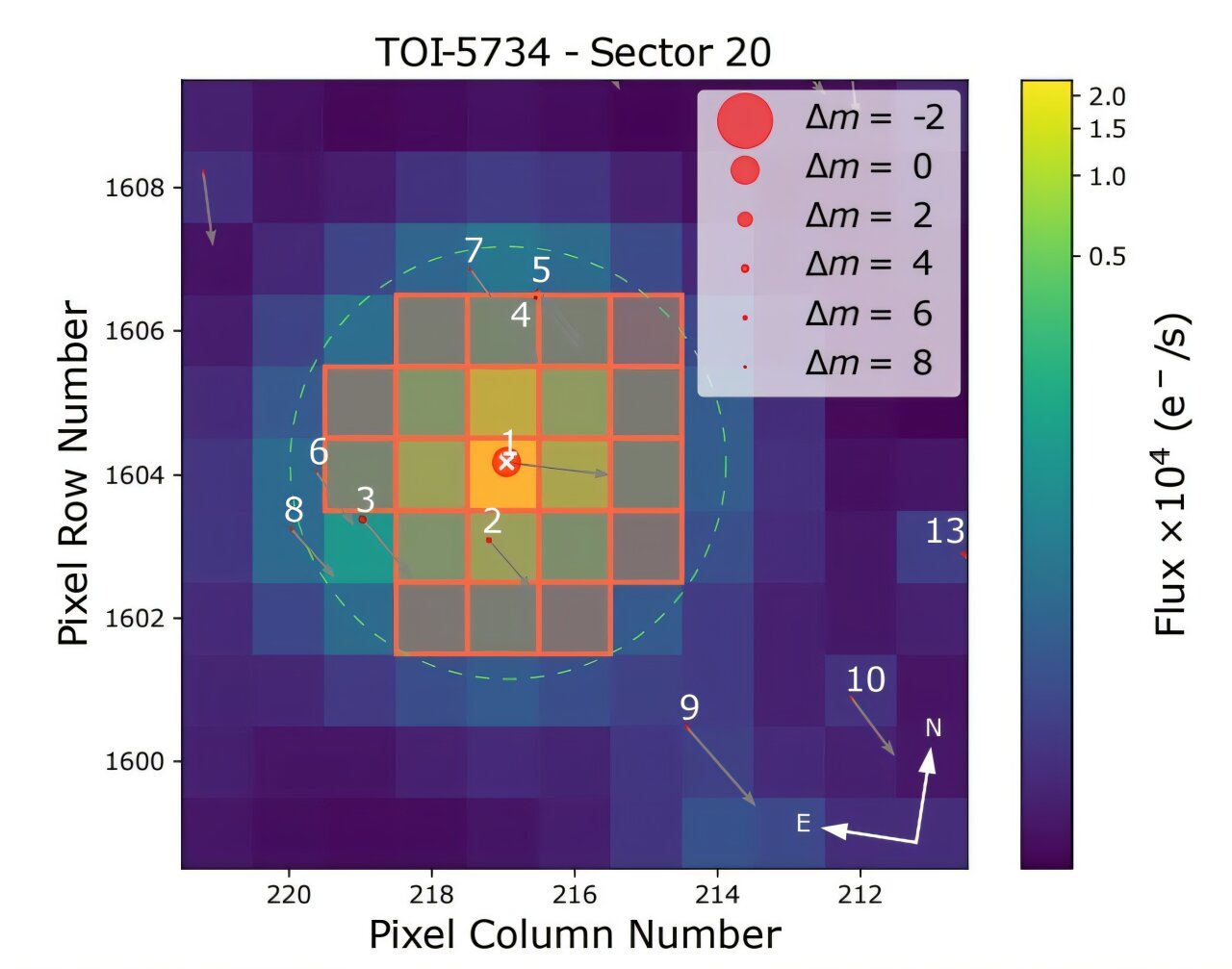
The Transiting Exoplanet Survey Satellite (TESS) noticed a subtle dip in the brightness of this star, known as TOI-5734, or TIC 9989136. The dimming was slight, almost like a breath held for a moment before being released. But it happened again. And again. Something was passing in front of the star, blocking a fraction of its light.
That tiny shadow marked the beginning of a story that would lead astronomers to uncover a new world.
The Young Star at the Center of It All
TOI-5734 is not a giant blazing beacon like our Sun. It is smaller and cooler, a K3–K4 V dwarf star with about 0.72 times the Sun’s mass and a radius of roughly 0.64 solar radii. Its surface temperature is estimated at 4,750 K, giving it a steady, warm glow rather than a fierce blaze.
The star is considered relatively young, still early in its long cosmic life. Around it, something was circling in tight formation, completing each orbit in a matter of days. TESS had seen the hint. But hints are not enough in astronomy.
To confirm the suspicion, an international team of researchers led by Simone Filomeno of the Astronomical Observatory of Rome turned to another instrument: the High Accuracy Radial velocity Planet Searcher for the Northern Hemisphere (HARPS-N), mounted on the Galileo National Telescope.
While TESS detects shadows—tiny dips in light when a planet crosses its star—HARPS-N measures the star’s subtle wobble. If a planet orbits a star, gravity ensures the star does not stand perfectly still. It trembles, ever so slightly, pulled by its unseen companion.
The combination of these two methods would determine whether the flicker was a false alarm—or a new planet.
When the Signal Became a World
The follow-up observations confirmed it. The dip in brightness was no illusion. The wobble was real. A planet was there.
Astronomers named it TOI-5734 b.
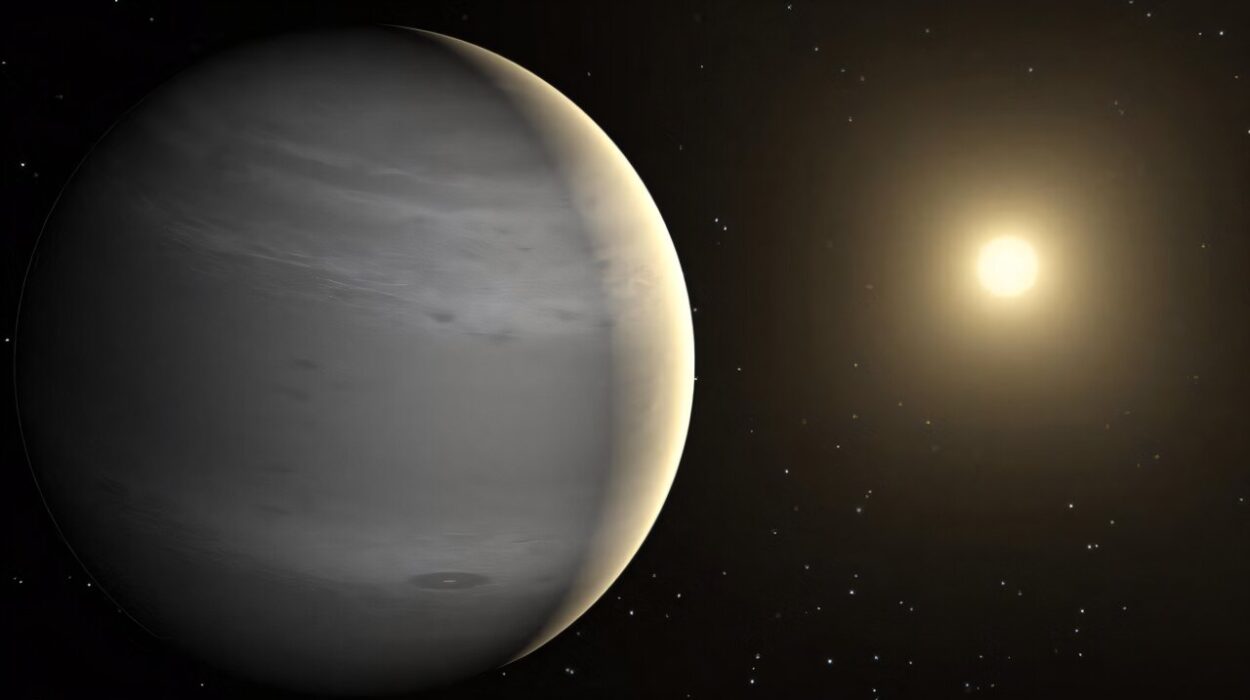
It is not an Earth twin. Nor is it a gas giant like Jupiter. Instead, it falls into a fascinating category known as a hot sub-Neptune. This means it is larger than Earth but smaller than Neptune—and it orbits very close to its star.
TOI-5734 b has a radius of about 2.1 times that of Earth and a mass roughly 9.1 times Earth’s mass. These measurements reveal something intriguing: despite its greater size and weight, its density is only slightly lower than Earth’s.
That density tells a story about what lies beneath its surface.
Racing Around Its Star
The planet’s orbit is breathtakingly tight. TOI-5734 b circles its star every 6.18 days. A year on this world lasts less than a week by Earth’s calendar.
It lies at a distance of about 0.06 astronomical units from TOI-5734. For comparison, Earth sits 1 astronomical unit from the Sun. This planet is pressed close to its star, bathing in constant radiation.
Because of that proximity, astronomers estimate its equilibrium temperature to be around 688 K. This is no cool, temperate world. It is heated relentlessly, its surface enduring conditions far warmer than anything we experience on Earth.
Its closeness to its star likely plays a major role in shaping what it is—and what it will become.
Standing at the Edge of the “Radius Valley”
One of the most intriguing aspects of TOI-5734 b is where it sits in what scientists call the “radius valley.”
This valley is not a physical location in space. It is a pattern seen when astronomers compare the sizes of many exoplanets. There is a noticeable scarcity of planets with radii between 1.5 and 2.0 Earth radii. Fewer worlds seem to exist in that range.
TOI-5734 b, at 2.1 Earth radii, lies just above this gap—on the upper edge of the valley.
That placement is not random. It hints at a deeper story about planetary evolution. Something happens to planets in this size range, something that strips or transforms them, leaving fewer survivors in the middle.
And TOI-5734 b appears to be caught in that transition.
A Rocky Core Losing Its Breath
Based on its measured mass and radius, astronomers believe TOI-5734 b is most likely a rocky world that has been largely stripped of its primary atmosphere.
Planets are often born wrapped in thick envelopes of gas. But when they orbit very close to their stars, that gas can be slowly blown away. Stellar radiation erodes the planet’s outer layers over time, peeling them back like the skin of an onion.
The researchers suggest that TOI-5734 b may be nearly depleted of this original atmospheric envelope. They do not completely rule out the possibility that it could be a water-world, but the evidence leans toward a rocky composition that has lost much of its primordial covering.
In fact, the team estimates that the planet will likely lose its remaining primordial envelope within 300 million years.
That means we may be observing it in the midst of transformation.
A Planet on the Move—At Least on the Diagram
The scientists also reconstructed the planet’s probable history using its position in the mass-radius diagram, a tool astronomers use to compare planets by size and mass.
They conclude that TOI-5734 b likely began its life in a different region of this diagram—at larger radii. Over time, as it lost portions of its atmosphere, it would have shrunk, gradually moving toward its current position near the radius gap.
In other words, this planet may not have always looked the way it does today.
It may have once been puffier, wrapped in thicker gas layers. But under the relentless influence of its nearby star, it has evolved—shedding material, compressing inward, becoming denser and more compact.
We are seeing it in a transitional state, poised near the boundary where planetary identities change.
Watching a World in Transition
There is something deeply compelling about discovering not just a planet, but a planet caught in the act of becoming something else.
TOI-5734 b is not static. It is part of an ongoing story—one written in gravity, heat, and time. Its tight orbit, high temperature, and location near the radius valley suggest that planetary systems are dynamic environments where worlds can shift categories over millions of years.
The data gathered from TESS and HARPS-N allowed astronomers to measure its size, weigh it, calculate its density, and estimate its future. With just faint dips of starlight and subtle stellar wobbles, they pieced together the life story of a world far beyond our reach.
And that story is still unfolding.
Why This Discovery Matters
The discovery of TOI-5734 b is not just another tally in the growing list of exoplanets. It offers a rare glimpse into planetary evolution in action.
Its position at the upper edge of the radius valley makes it a valuable clue in understanding why some planets lose their atmospheres while others retain them. By studying worlds like this, astronomers can better grasp how radiation from a host star shapes the destiny of nearby planets.
Because TOI-5734 is relatively young, this system also provides insight into the early stages of planetary development. Observing a planet that may lose its primordial envelope within 300 million years helps scientists test ideas about atmospheric erosion and long-term transformation.
In a universe filled with planets of staggering diversity, each new discovery adds a piece to the puzzle. TOI-5734 b reminds us that planets are not frozen in time. They evolve. They shrink. They shed layers. They move across invisible boundaries in scientific diagrams.
And sometimes, if we are fortunate, we catch them in the act.
From a faint flicker in a light curve to the confirmation of a hot sub-Neptune world, this discovery demonstrates how careful observation can turn whispers of starlight into detailed portraits of distant worlds. It deepens our understanding of how planets form, change, and survive under the influence of their stars.
Somewhere 106 light years away, TOI-5734 b continues its rapid six-day orbit, circling its young star in relentless heat. We cannot see it directly. But thanks to a brief dimming of light and the steady patience of astronomers, we now know it is there—balanced on the edge of transformation, telling us something new about how planets live and change in the cosmos.
Study Details
Filomeno et al, The GAPS Programme at the TNG: LXX. TOI-5734b: A hot sub-Neptune orbiting a relatively young K dwarf with an Earth-like density, arXiv (2026). DOI: 10.48550/arxiv.2602.18108