For decades, the graves at Skateholm I and II in southern Sweden appeared to be quiet. The dead had been laid to rest there roughly 7,000 years ago, during the Mesolithic Stone Age, in what is now Scania. Archaeologists who excavated the cemeteries in the 1980s uncovered 87 graves, along with objects made of stone, animal bones, antlers, and teeth. These finds helped confirm Skateholm as one of the most significant Stone Age burial sites in northern Europe.
But much of the story seemed to be missing. Clothing—soft, organic, delicate—rarely survives the march of time. What people wore, how they adorned themselves, and how they prepared their loved ones for burial remained largely a mystery. The earth had kept its secrets.
Until now.
A newly published study in Archaeological and Anthropological Sciences has returned to Skateholm with a different set of eyes—and a different kind of patience. Instead of searching for visible artifacts, researchers turned to the smallest traces imaginable: microscopic fibers, hairs, and feather fragments hidden in the soil itself.
And the soil began to speak.
A New Way of Seeing the Invisible
The breakthrough came from the University of Helsinki, where the Animals Make Identities project developed a method known as water-assisted fiber separation. It sounds gentle, almost simple. Yet its implications are profound.
By carefully treating soil samples with water, the team could separate and recover microscopic organic remains—tiny fragments of fur, feathers, and fibers that had endured invisibly for thousands of years. These fragments were too small to be noticed during earlier excavations. Now, they were brought into the light.
This study applied the method on an unprecedented scale, examining 35 graves from Skateholm. It marked the first time the technique had been used so extensively.
Researcher and archaeologist Tuija Kirkinen, who oversaw the analyses, specializes in microarchaeology and the study of organic material culture. For her, these fragments were not mere debris. They were cultural signals.
She notes that the technique works well, though identifying feather and hair fragments down to the species level remains challenging. That part of the method, she says, can still be refined. Even so, what they found was enough to reshape our understanding of Stone Age life—and death.
Professor Kristiina Mannermaa, who heads the broader project, describes the findings as fascinating. They underline something often overlooked: the significance of birds and their feathers in ancient societies.
The Vanishing Wardrobe of the Stone Age
Clothing from the Stone Age rarely survives. In most conditions, fur, plant fibers, and other soft materials decompose long before archaeologists can study them. Only under exceptional circumstances—such as in underwater sites or glaciers—do such materials endure.
A famous example is Ötzi, the Ice Age individual found preserved in the Alps. His fur clothing survived so well that researchers could reconstruct his outfit in detail. But such preservation is rare.
In northern regions like Fennoscandia, skeletal remains and bone objects may endure under optimal conditions, yet garments usually vanish. The result is a strange imbalance in the archaeological record: we know what tools people used, what ornaments they carved, even what animals they hunted—but not how they dressed their bodies.
The new method changes that. Even in areas with poor preservation conditions, microscopic fibers can remain trapped in soil. They are invisible to the naked eye, but they persist. And once separated, they reveal stories long thought lost.
At Skateholm, those stories were waiting patiently.
Feathers for the Dead
The analysis revealed that the people buried at Skateholm were not laid to rest in bare simplicity. They were dressed with care and intention.
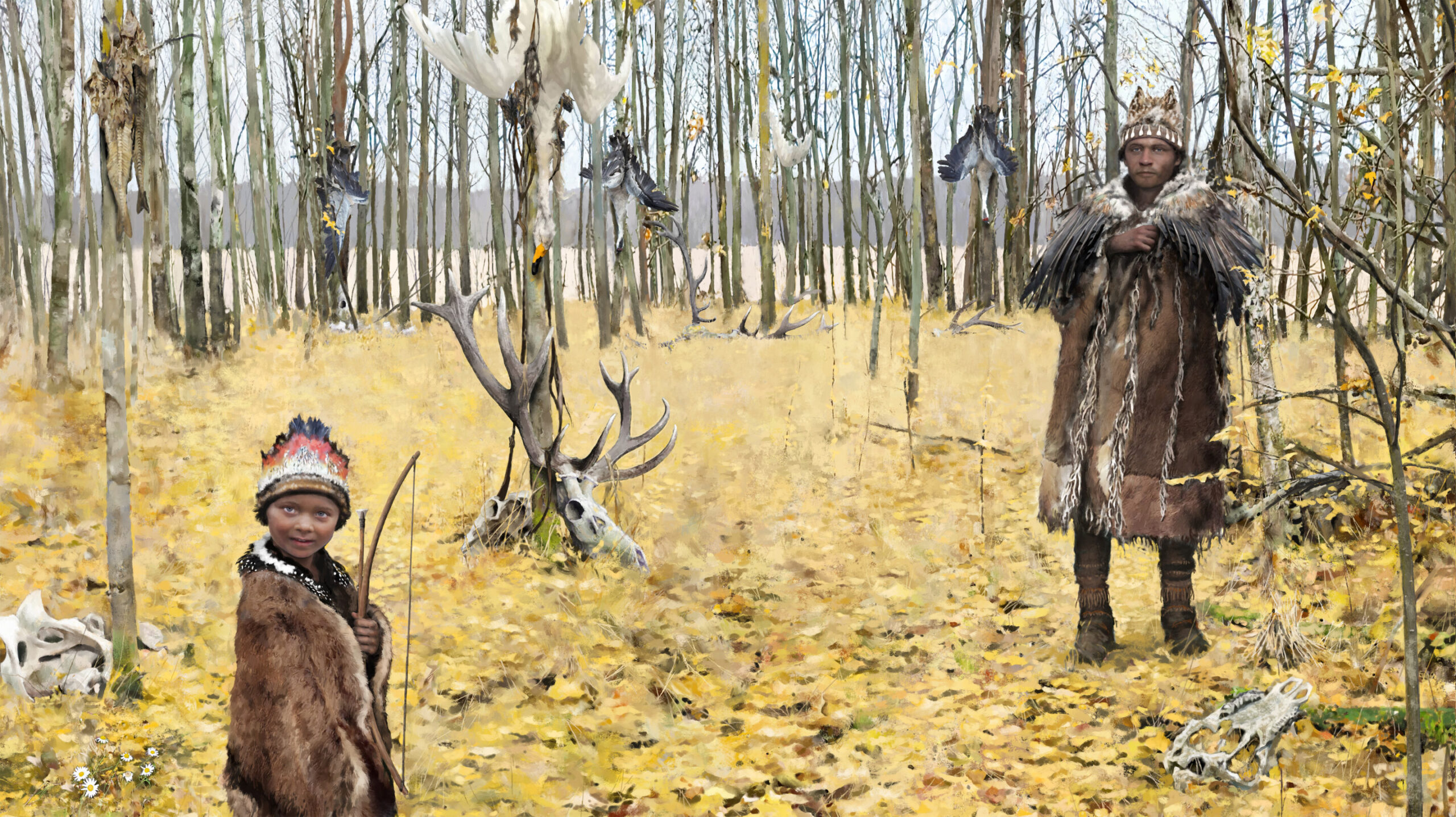
Researchers identified the skins of aquatic birds, as well as furs from mustelids, felines, and other fur-bearing animals. The presence of these materials indicates that the deceased were clothed in garments made from animal skins and adorned with feathers.
Around several skulls, fragments of hawk or eagle feathers, owl feathers, and hairs from small fur animals were discovered. Their placement suggests something striking: many of the dead wore elaborate headdresses.
These were not accidental inclusions. The feathers clustered around the heads, the fur arranged in patterns that hint at deliberate design. Even after 7,000 years, the arrangement of microscopic fragments tells of visual impact—of height, texture, and movement.
Birds, it seems, played a powerful symbolic or cultural role. Their feathers were not only decorative but meaningful enough to accompany individuals into the grave.
The soil, once silent, now suggests a society where identity could be expressed in plumage and fur.
The Graves Once Called Empty
Perhaps the most surprising revelation came from graves previously described as “empty.” During the original excavations, some burials appeared to contain nothing beyond the skeleton itself. No tools. No ornaments. No visible goods.
But the new analysis tells a different story.
In these so-called empty graves, researchers found fur and feather remains—subtle, microscopic traces that earlier methods could not detect. The absence of visible objects had masked the presence of garments and adornments made from organic materials.
One grave in particular stands out.
It belonged to a woman over 60 years of age, a considerable age in the Stone Age context. Her burial had once seemed unremarkable. No grave goods were recorded beside her bones.
Yet in the soil around her feet, researchers found a white hair from the winter pelage of a stoat or weasel, a brown feline hair, and fragments of a bird feather.
These were not random intrusions. Their location suggests that she wore footwear crafted from a mix of materials—perhaps soft fur for warmth, feathers for decoration, or even entire pieces of bird skin. The combination of white and brown hints at multicolored footwear, textured and visually distinct.
Suddenly, the image changes. The elderly woman was not buried plainly. She was dressed with intention, perhaps wrapped in garments that reflected her identity, status, or personal history.
What once seemed like emptiness was, in truth, richness hidden at a microscopic scale.
Reimagining the Stone Age
The study does more than identify fragments of ancient clothing. It challenges assumptions about what is visible and what is valued in archaeology.
Stone tools survive. Bone ornaments endure. But soft materials—those that touched the skin, shaped appearance, and conveyed identity—usually disappear. As a result, entire aspects of ancient life have remained shadowed.
With water-assisted fiber separation, that shadow recedes.
Now we see that aquatic birds were not just hunted for meat but likely valued for their skins and feathers. We see that fur-bearing animals provided not only warmth but aesthetic contrast. We see that headdresses adorned with raptor or owl feathers may have carried significance powerful enough to accompany the dead.
We even see that graves lacking visible objects may still contain profound cultural information, hidden in the soil.
The technique, as Kirkinen notes, can be applied beyond graves. Any archaeological material may contain microscopic fibers waiting to be revealed. This suggests that many past excavations could hold untapped stories in stored soil samples.
The implications ripple outward.
Why This Research Matters
At first glance, a few microscopic hairs and feather fragments might seem insignificant. But they reshape our understanding of human history.
They reveal that Stone Age clothing was more complex and expressive than previously assumed. They show that birds and their feathers held clear importance in Mesolithic society. They demonstrate that even in poor preservation conditions, traces of organic culture can endure.
Most importantly, they remind us that absence of evidence is not evidence of absence.
The graves at Skateholm were never empty. They were simply misunderstood. By looking closer—by listening to what the soil holds at the smallest scale—researchers have restored color, texture, and personality to people who lived 7,000 years ago.
In doing so, they narrow the distance between us and them. Clothing is intimate. It shapes identity, signals belonging, and carries meaning. To discover what the dead wore is to glimpse how they wished to be seen.
And that matters.
Because history is not only about tools and bones. It is about texture, softness, and feathers brushing against fur in the quiet ceremony of burial. It is about the details too small to see—until someone thinks to look.
At Skateholm, the earth has yielded more than artifacts. It has yielded humanity, stitched together from fragments no wider than a strand of hair.
Study Details
Tuija Kirkinen et al, Waterbirds, mustelids and bast fibres—evidence of soft organic materials in the Late Mesolithic Skateholm I and II cemeteries, Sweden, Archaeological and Anthropological Sciences (2026). DOI: 10.1007/s12520-026-02415-7