For generations, Old Dongola sat in history like a fading silhouette. Once the proud capital of Makuria, a powerful Christian kingdom in what is now northern Sudan, it seemed to slip into shadow by the mid-fourteenth century. The city that had once commanded attention along the Nile entered what scholars often call Sudan’s “Dark Ages.” Its streets shrank. Its political voice dimmed. And for nearly three centuries, its story felt like a whisper carried away by desert winds.
Then, from a rubbish heap, a scrap of paper began to speak.
A recent study published in Azania: Archaeological Research in Africa has brought forward new historical evidence about one of pre-colonial Dongola’s earliest rulers, a figure long thought to be semi-legendary: King Qashqash. What once lived mainly in fragments of oral tradition now has ink, commands, and a royal signature to anchor it in reality.
A Kingdom That Refused to Be Forgotten
To understand the weight of this discovery, we have to return to the city itself. Old Dongola was not some isolated settlement clinging to the Nile. According to lead author Tomasz Barański, Nubia was a corridor of movement—a living artery between the Mediterranean world and sub-Saharan Africa. Through it flowed gold, ivory, and enslaved people. But more than goods traveled these routes. So did ideas, religions, technologies, and political models.
Nubia was not passive. Its communities shaped, adapted, and negotiated the influences passing through. When Arabization and Islamization later transformed the region, Barański emphasizes that these changes were not sudden ruptures. They were part of a long pattern of exchange and adaptation that had defined Sudan for centuries.
And yet, by the mid-1300s, Dongola was no longer Makuria’s capital. The city contracted until it centered mainly on its citadel and the buildings immediately around it. Historical references from this period are sparse. Among them are fragmentary mentions of a man named Qashqash. In the Kitāb al-Ṭabaqāt, a nineteenth-century bibliographical dictionary compiled from oral stories about Sudanese holy men, Qashqash is said to be the great-grandfather of Sheikh Ḥilālī, himself linked to Muḥammad b. ʿĪsā Suwār al-Dhahab, one of Sudan’s most important holy figures.
But was Qashqash truly a king? Or had he become more myth than man?
The Citadel and Its Secrets
In 2018, a project titled “Urban Metamorphosis of the community of a Medieval African capital city” (UMMA) began a new phase of investigation into Dongola’s past. Researchers turned their attention to the citadel and its surroundings. Among the structures they excavated was Building A.1, which local oral tradition identifies as the residence of Dongola’s kings.
The site yielded objects tied to elite life: fragments of cotton, linen, and silk; leather shoes; an ivory artifact; a rhino-horn dagger handle; and even a gold ring. These finds hinted at status and authority. But the most powerful discovery was far less glamorous.
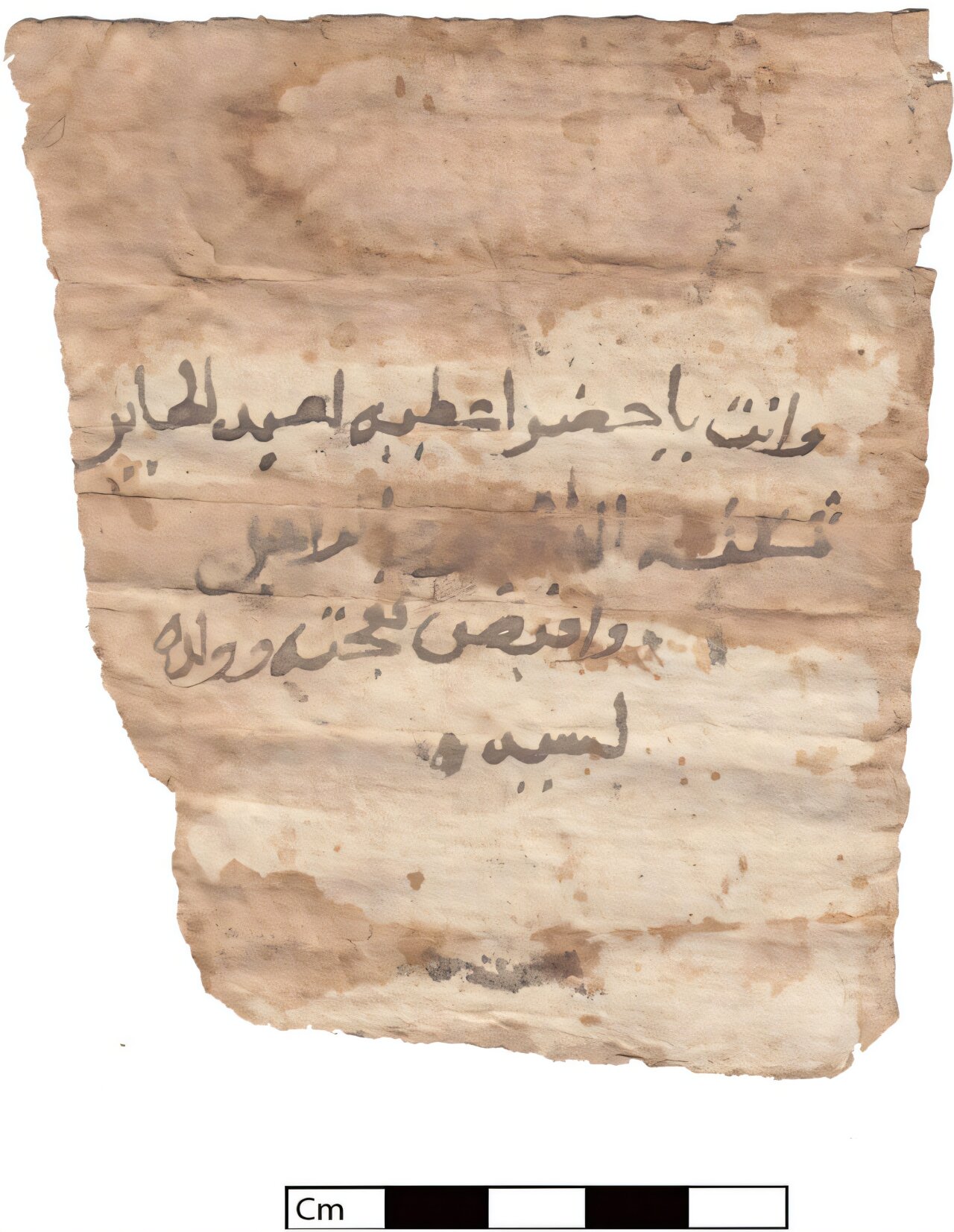
From a rubbish heap emerged more than 23 new Arabic texts. Among them was an order issued in the name of King Qashqash.
The scrap was small. The handwriting imperfect. Yet its impact was immense.
A King Speaks Across the Centuries
The document begins with unmistakable authority: “From King Qashqash to Khiḍr son of ŠHDT/ŠHB(T?).”
The order is practical, almost mundane. It instructs Khiḍr to take three ʾRDWYĀT from a man named Muḥammad al-ʿArab, to give him a ewe and her offspring, to collect another ewe and her offspring from ʿAbd al-Jābīr, and to deliver them to their master without delay. The letter ends with a firm command: “Do not hesitate!” It notes that the scribe Ḥamad wrote it and concludes with greetings.
It continues with further instructions: Khiḍr is to give ʿAbd al-Jābīr three cotton cloths and a head—or possibly three cotton headwear—and collect the ewe and her offspring for their master.
At first glance, it reads like routine administration. Livestock. Cloth. Exchanges between named individuals. But in its ordinary tone lies extraordinary proof. This is not legend. It is governance in action. It is a king issuing orders within a functioning network of obligation and exchange.
For the first time, Qashqash stands not just as a name in oral tradition but as a ruler whose commands circulated in written form.
Arabic in Transition
The text also reveals something subtler but equally powerful: the transformation of language itself.
Analysis shows that the scribe was not fully literate in Classic Arabic. He used possessive pronouns without distinguishing number or gender. The lettering is compressed, resembling colloquial speech more than formal classical standards. This suggests that Arabic was becoming the primary written language of the royal court, even if it had not yet replaced local languages as the city’s everyday tongue.
This is Arabization in motion—not as a sudden imposition, but as an evolving practice. The ink captures a society negotiating identity, language, and power in real time.
The choice of goods in the letter reinforces this picture. The mention of a potential headdress, mandūf al-raʾs, is especially striking. Such an item was typically reserved for rulers and members of the highest nobility in Nubia. The exchange described in the document reflects broader patterns of reciprocal gift-giving known from other Funj-period sources. Authority was not simply declared; it was enacted through carefully balanced relationships.
A Network Hidden in Plain Sight
Barański suggests that this letter is only one thread in a much larger web. Preliminary analysis of the texts from Building A.1 indicates distinct patterns in how correspondence circulated. There are hints of a coherent communication network that connected religious and administrative elites—and possibly even leaders of nomadic groups herding flocks in surrounding regions.
In other words, Dongola during its so-called Dark Ages was not a silent ruin. It was a city operating within a system of exchange, patronage, and communication. Its rulers managed micropolitics, balanced obligations, and maintained influence through material and written means.
The scrap of paper is not just a message about sheep and cloth. It is evidence of a living administrative world.
From Semi-Legend to Historical Reality
For years, King Qashqash occupied an uncertain space between myth and memory. Now, his existence is anchored in archaeological evidence. The document provides the earliest known proof of a post-medieval ruler of Dongola. It bridges oral tradition and material culture.
The significance lies not only in confirming one man’s rule but in illuminating an era long obscured. The Dark Ages of Sudanese history were not empty centuries. They were complex, adaptive, and interconnected. Arabization and Islamization were not abrupt cultural replacements but parts of a longer continuum of exchange and negotiation.
Why This Discovery Matters
The discovery of this seemingly insignificant scrap of paper reshapes how we see a pivotal period in northeastern Africa. It demonstrates how archaeology can connect physical artifacts with written history, turning rumor into record. It shows that political authority persisted in Dongola even after its decline as Makuria’s capital. It reveals language in transition, culture in adaptation, and power expressed through networks of gift and obligation.
Most importantly, it reminds us that history’s silences are often temporary. Beneath layers of dust and discarded debris, voices wait. In this case, the voice belonged to a king whose name once hovered between legend and doubt. Now, through ink and parchment, King Qashqash stands as a documented ruler, part of a dynamic society negotiating change in a world that was anything but dark.
The research proves that even the smallest fragment—a scrap thrown away centuries ago—can illuminate entire chapters of human history.
Study Details
Tomasz Barański et al, The King of Nubia at work: archaeological context and text edition of a sixteenth/seventeenth-century Arabic document from Old Dongola, Azania: Archaeological Research in Africa (2026). DOI: 10.1080/0067270x.2026.2615518