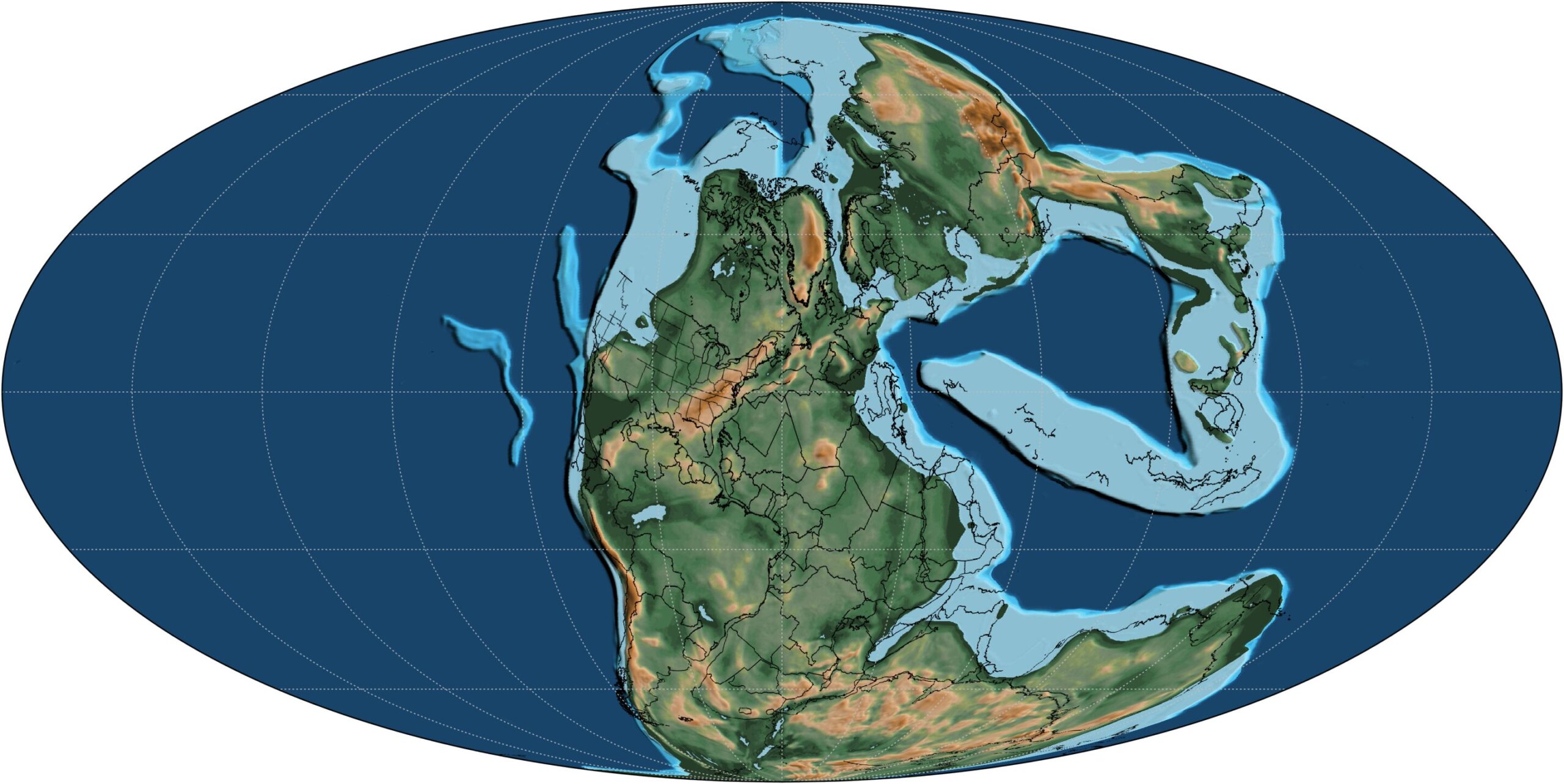
Two hundred million years ago, Earth looked nothing like the globe we recognize today. All the continents were locked together in a colossal landmass called Pangea, a supercontinent so vast it stretched nearly pole to pole. Then, during the Early Jurassic, that unified world began to tear itself apart.
New oceans slowly opened like widening scars. Continents drifted away from one another. The geography we now take for granted was born from that ancient rupture.
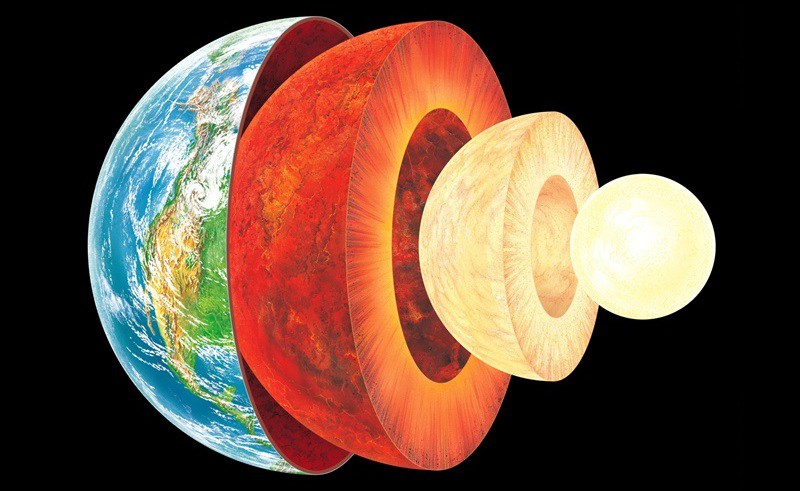
For decades, scientists have told a dramatic story about why this happened. They imagined Pangea acting like a planetary blanket. Continents, after all, are thicker than oceanic crust. When they merge into one massive block, they reduce the escape of heat from Earth’s interior. Over tens of millions of years, this “thermal insulation” was thought to trap heat in the mantle, the thick layer of rock between Earth’s crust and core.
The idea was compelling. Heat builds. Pressure rises. The mantle grows unusually hot. Eventually, tectonic forces pull the supercontinent apart, unleashing pent-up thermal energy. Magma surges upward, forming thick new oceanic crust. Massive volcanic events erupt, including outpourings like the Central Atlantic Magmatic Province. In this version of events, Pangea’s breakup was fueled by a global fever beneath the planet’s surface.
But what if Earth wasn’t burning quite as hot as we thought?
Reading the Rocks for Ancient Heat
Testing the temperature of Earth’s mantle from hundreds of millions of years ago is no simple task. The mantle itself lies far beyond direct reach. Worse still, much of the earliest oceanic crust formed during Pangea’s breakup has since disappeared, recycled back into the mantle through subduction, where tectonic plates sink beneath one another.
So how do you measure ancient heat that you cannot touch?
You look for clues left behind.
In a new study published in Earth and Planetary Science Letters, scientists from the Université de Strasbourg turned their attention to the thickness of the earliest oceanic crust formed as Pangea split apart. They focused on rifted margins in what are now the Atlantic and Indian oceans, regions where continents stretched and fractured, giving birth to new ocean basins.
Here’s the key: when mantle rock rises beneath a spreading plate boundary, it partially melts. The hotter the mantle, the more melting occurs. More melting means more magma. More magma creates thicker oceanic crust.
Today, oceanic crust formed at mid-ocean ridges averages about 6.1 kilometers thick. If Pangea had truly trapped enormous amounts of heat beneath it, scientists would expect the earliest crust formed during its breakup to be consistently thicker than that modern average.
That was the test.
A Surprise Beneath the Atlantic
The researchers reconstructed the thickness of ancient oceanic crust formed shortly after Pangea’s fragmentation. Instead of discovering uniformly thick crust—a signature of a globally overheated mantle—they found something far more nuanced.
The crust clustered into two main groups.
One group averaged around 5.5 kilometers thick. The other centered near 6.7 kilometers.
The thinner group, mostly from the Equatorial Atlantic, was actually below the modern average of 6.1 kilometers. That was unexpected. If the mantle had been dramatically overheated everywhere beneath Pangea, thinner-than-average crust shouldn’t have formed.
The scientists suggest that this thinner crust may reflect a relatively “cold” thermal anomaly. In equatorial regions, thick continental lithosphere—the rigid outer layer of Earth—existed before rifting began. That thick lithosphere may have influenced the thermal structure beneath it, leading to less melting and thinner crust when the continents began to separate.
The thicker group, averaging 6.7 kilometers, did show some additional melting. But even here, the increase was modest. According to the study, this could be explained by a rise in mantle potential temperature of only 9–15°C. Mantle potential temperature is a measure geologists use to estimate how hot mantle material would be if brought to the surface without melting.
In the Central Atlantic, the mantle may have been elevated by at most 60°C, producing crust up to roughly 9 kilometers thick. But even that higher figure does not point to a wildly overheated, supercontinent-scale thermal event.
Instead of a roaring furnace beneath Pangea, the evidence suggests something more restrained.
A Slow Cooling, Not a Fiery Release
The team also looked at how crustal thickness varied over time. Their statistical analysis revealed a slight increase in initial oceanic crustal thickness with age—about 1.5 meters per million years.
At first glance, that might sound trivial. But over 150 million years, it would amount to crust about 6.3 kilometers thick on average—roughly 0.2 kilometers thicker than today’s young oceanic crust.
Still, the researchers caution that this relationship is weak. It does not suggest dramatic thermal swings.
If thicker crust were solely due to a warmer mantle, the observed trend would imply mantle cooling of about 0.04–0.06°C per million years over the past 180 million years. That rate aligns closely with long-term estimates of Earth’s gradual heat loss—around 30–50°C per billion years—a process known as secular cooling.
In other words, the mantle beneath the Atlantic and Indian oceans appears to have cooled steadily and gradually, consistent with Earth’s long-term thermal evolution. There is no clear fingerprint of a massive thermal spike tied specifically to Pangea’s breakup.
The supercontinent may not have been sitting atop a giant heat bubble after all.
A Breakup Written in Complexity
If extreme heat wasn’t the sole driver, then what tore Pangea apart?
The new findings suggest that the breakup was likely shaped by a combination of regional processes rather than a single global cause. Tectonic stresses within Earth’s plates, pre-existing weaknesses in the continental lithosphere, and variations in mantle composition may all have played important roles.
Some regions may have already been vulnerable to rifting because of older fault systems or thinner lithosphere. In those places, continents could split apart without needing extraordinary mantle temperatures. Elsewhere, modest thermal upwellings—columns of slightly warmer rock rising from deeper in the mantle—may have added localized heat, but not on a supercontinent-wide scale.
The story that emerges is not one of a planet exploding from pent-up energy, but of a world gradually reshaped by subtle differences and long-term forces working together.
It is a quieter, more intricate narrative.
Why This Changes Our View of Earth
Understanding how supercontinents assemble and break apart is not just about reconstructing ancient maps. These cycles influence long-term climate patterns, sea-level changes, and even biological evolution.
The arrangement of continents shapes ocean circulation. It affects weathering processes that regulate atmospheric carbon dioxide. Volcanic events associated with rifting can release enormous quantities of greenhouse gases. When continents move, the entire Earth system responds.
For years, the idea of a globally overheated mantle beneath Pangea offered a dramatic, unified explanation for its breakup. It was elegant and powerful. But science advances by testing even its most compelling stories.
By analyzing measurable crustal thickness and carefully estimating ancient mantle temperatures, this study reveals a more nuanced picture. The mantle beneath the early Atlantic and Indian oceans was not uniformly blazing hot. In many places, temperatures were only modestly elevated—or even close to average.
Rather than a catastrophic release of trapped heat, Pangea’s breakup may have been guided by a delicate interplay of tectonic stresses, regional thermal variations, and inherited structural weaknesses.
The lesson is humbling. Earth’s most dramatic transformations do not always require extreme causes. Sometimes, vast oceans and drifting continents are born from relatively modest changes deep below our feet.
This research matters because it reshapes how we think about planetary evolution. It reminds us that global events can arise from complex regional processes. And it underscores that Earth’s interior, though hidden from view, leaves subtle signatures that scientists can still read hundreds of millions of years later.
The breakup of Pangea was not just a fiery rupture. It was a carefully written chapter in Earth’s long thermal story—a story of slow cooling, shifting plates, and a planet constantly reinventing itself.
Study Details
Daniel Sauter et al, Was the mantle warmer when Pangea broke up? insights from initial oceanic crustal thickness alongside the rifted margins of the Atlantic and Indian Oceans, Earth and Planetary Science Letters (2026). DOI: 10.1016/j.epsl.2026.119897.