Researchers have successfully “closed” the global sea level budget by accounting for significant heating in the deep ocean below 2,000 meters, a region previously omitted from most calculations. The findings reveal that deep-sea warming now contributes approximately 10% of the total observed sea level rise, solving a data discrepancy that emerged after 2016.
For decades, climate scientists have operated like meticulous accountants, tracking every millimeter of water added to the world’s oceans to ensure the “books” of planetary change remain balanced. This process, known as the global mean sea level (GMSL) budget, relies on matching the observed rise in sea levels with known causes, such as melting glaciers and the expansion of seawater as it warms. However, around 2016, a mysterious gap appeared in these records; the math no longer added up, and the observed rise in sea levels began to outpace the known inputs.
The discrepancy suggested that a hidden force was pushing the oceans upward, invisible to the standard tools used to monitor the planet’s health. A new study published in the journal Earth’s Future has finally located this missing volume of water. By peering into the dark, crushing depths of the abyss, an international team of researchers has demonstrated that the deep ocean is warming at a rate that can no longer be ignored by the scientific community.
The Growing Influence of the Abyss
Historically, most focus on ocean warming has remained near the surface, where the atmosphere directly interacts with the water. However, the average depth of the global ocean is approximately 3,682 meters, leaving a vast portion of the water column largely unmonitored. Lead author Anny Cazenave, an emeritus scientist at the Laboratory of Space Geophysical and Oceanographic Studies (LEGOS), spearheaded the investigation to determine if the “hole” in the sea level budget was hiding in these lower reaches.
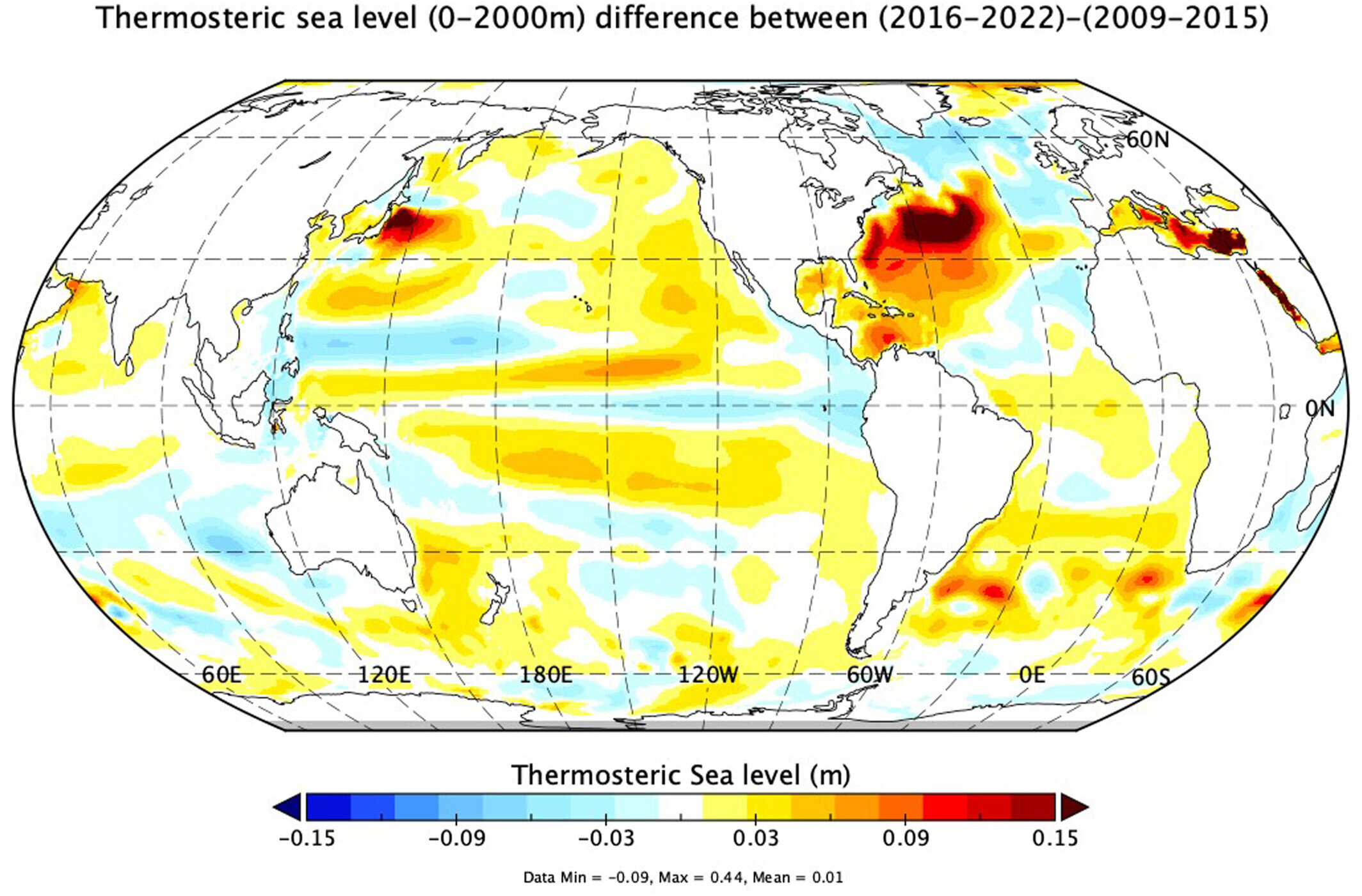
The team’s analysis confirmed that the deep ocean, specifically the layers below 2,000 meters, is absorbing enough heat to cause significant thermal expansion. Between 2005 and 2022, the contribution from these depths was estimated to be 0.4 millimeters per year. While that may sound like a small figure, it accounts for roughly 10% of the observed GMSL rise during that period. By including this data, the researchers were able to “almost close” the budget, bringing the scientific accounting of sea level rise back into alignment for the first time in years.
Beyond the Reach of Argo
The difficulty in tracking this deep-sea heat stems from the limitations of current technology. Since the mid-2000s, scientists have relied on the Argo buoy program, an international array of over 4,000 automated floats. These buoys drift through the water, diving to depths of 2,000 meters to record temperature, salinity, and pressure before returning to the surface to beam data to satellites.
While the Argo network has provided invaluable data—showing that the top 2,000 meters of the ocean has warmed by about 220 zettajoules since 2005—it is blind to anything deeper. This warming in the upper layers represents an average water temperature change of 0.077°C, or 0.67 watts per square meter of Earth’s surface. Unfortunately, as of March 2026, the “Deep Argo” program, designed to reach depths of 4,000 to 6,000 meters, remains in its infancy. With only a few of these advanced buoys deployed, there is currently insufficient hardware to measure the deepest parts of the ocean directly.
Reconstructing the Ocean Through Reanalysis
To bridge this data gap, the research team employed a sophisticated technique known as climate reanalysis. This method uses numerical computer models to synthesize historical measurements with known physical laws, creating a consistent record of variables that were never directly measured. It is a proven strategy in climate science; for instance, the 20th Century Reanalysis (20CRv3) used marine reports and surface pressures to estimate global climate as far back as 1836, long before modern thermometers were widespread.
For this study, the group utilized the Cnr ISMAR Global historicAI Reanalysis (CIGAR), a model developed in 2024. They combined this with satellite altimetry data from Copernicus, which measures the actual height of the ocean surface, and mass models from the GRACE satellite program, which tracks changes in ocean weight. The researchers also integrated data on global glacier mass balance, Greenland and Antarctica ice sheet stability, and even land water storage, such as the amount of water trapped behind dams.
By layering these diverse datasets—from the weight of the ice sheets to the temperature of the upper water column—the models revealed that the only way to match the observed sea level rise after 2016 was to account for the expansion of the deep ocean. This synthesis proved that the “missing” water wasn’t missing at all; it was simply the result of the deep sea expanding as it absorbed the planet’s excess heat.
Why This Matters
The closure of the sea level budget is more than just a win for scientific record-keeping; it fundamentally changes our understanding of how the planet stores energy. For years, the deep ocean was treated as a static or negligible factor in short-term sea level projections. This study proves that the abyss is an active participant in the climate system, contributing a steady 0.4 millimeters to global sea levels every year.
Understanding this contribution is vital for coastal planning and climate forecasting. If the deep ocean is warming, it indicates that heat is penetrating much further into the Earth’s systems than previously confirmed. The next challenge for scientists is to determine whether this deep-sea warming is a result of internal climate variability, a forced anthropogenic (human-caused) response, or a mix of both. By using CMIP-type coupled climate models—which simulate the interactions between the atmosphere, land, and ice—researchers hope to uncover why the deep ocean has suddenly become such a prominent player in the rising tides of the 21st century.
Study Details
Anny Cazenave et al, Evidence of Increased Deep Ocean Warming From a Sea Level Budget Approach, Earth’s Future (2026). DOI: 10.1029/2025ef007403