An international team of astronomers has identified a massive, ultra-faint supernova remnant named Abeona located 1,500 light years below the Galactic plane. Utilizing the Australian Square Kilometre Array Pathfinder, researchers confirmed that this expanding shell of stellar debris is likely the result of a Type Ia explosion and represents a rare opportunity to study high-energy particle acceleration in the Galactic halo.
Deep in the outskirts of our galaxy, far from the crowded, star-studded lanes of the Milky Way’s disk, the ghostly remains of a dead star have been hiding in the darkness. While most stellar explosions occur within the dense neighborhood of the Galactic plane, some stars—the “wanderers” of the cosmos—drift far from home before meeting their violent ends. For years, a faint radio signal hinted at the presence of one such outcast, but its signal was so weak it remained unconfirmed. Now, thanks to high-sensitivity radio observations, scientists have finally unmasked this elusive structure, revealing a massive, expanding shell of energy that challenges our understanding of how cosmic debris behaves in the lonely reaches of the Galactic halo.
Confirming a Mythic Wanderer
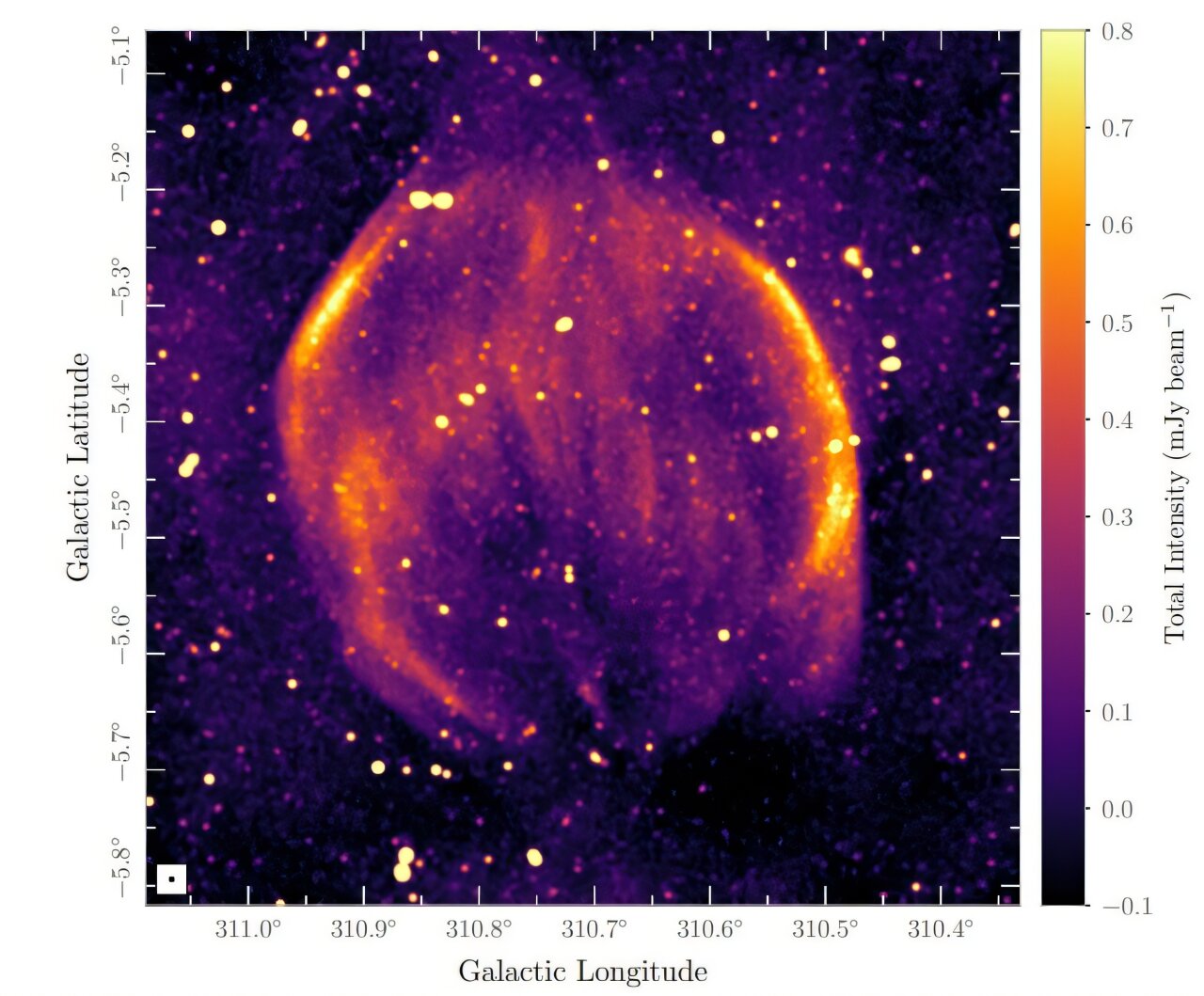
The discovery, led by Christopher Burger-Scheidlin of the Dunsink Observatory in Ireland, marks the culmination of a decade-long search. First identified as a potential candidate in 2014, the source designated G310.7–5.4 required the advanced capabilities of the Australian Square Kilometre Array Pathfinder (ASKAP) to be officially classified as a supernova remnant (SNR). In recognition of its isolated location and the long journey its progenitor star took before exploding, the team named the remnant Abeona, after the Roman goddess who protected travelers on their departing journeys.
Unlike the brilliant, colorful images of nebulae often captured by optical telescopes, Abeona is nearly invisible to traditional light-based instruments. It was identified as a faint, extended, bilateral radio shell, appearing as a delicate structure in the radio spectrum. The sheer scale of the discovery is immense; the shell measures approximately 30 arcminutes in diameter, which translates to a physical size of roughly 137 light years across. Despite its vast size, it is incredibly difficult to detect, characterized by a radio flux density of only 1.5 Jy.
One of the Faintest Known Remnants
What makes Abeona particularly significant to the scientific community is its extreme subtlety. Data from the research paper, published on the arXiv preprint server, reveals that the object has a radio surface brightness of just 24,000 Jy/sr. This figure places it among the faintest radio SNRs ever recorded. The lack of any detectable infrared counterparts further distinguishes the object, strongly suggesting that its light is the result of non-thermal emission—a key indicator that the shell is composed of material swept up by a powerful shockwave rather than heat from nearby stars.
The location of the remnant is equally striking. Positioned approximately 1,500 light years below the Galactic plane and at a distance of some 16,000 light years from Earth, Abeona sits in a region of space where the interstellar medium is much thinner than in the main disk of the galaxy. This high-altitude position allows the remnant to expand with less interference, providing a “cleaner” look at the physics of the explosion’s aftermath.
High-Energy Particles and Polarized Light
By analyzing the northern section of the shell, the team discovered linearly polarized radio emission. This is a classic signature of synchrotron emission, which occurs when charged particles spiral around magnetic field lines at speeds approaching the speed of light. This finding was further bolstered by the presence of a spatially overlapping gamma-ray source known as 4FGL J1413.9–6705.
The overlap between the radio shell and the gamma-ray source suggests that Abeona is currently acting as a massive particle accelerator. The shockwave from the original explosion is likely boosting particles to high energies, turning the remnant into a laboratory for studying the origins of cosmic rays. Because Abeona is now only the thirteenth known object in a rare subset of off-plane SNRs to show such significant high-energy emission, it provides a vital data point for physicists trying to understand how these particles diffuse through the galaxy.
The Mystery of the Missing Core
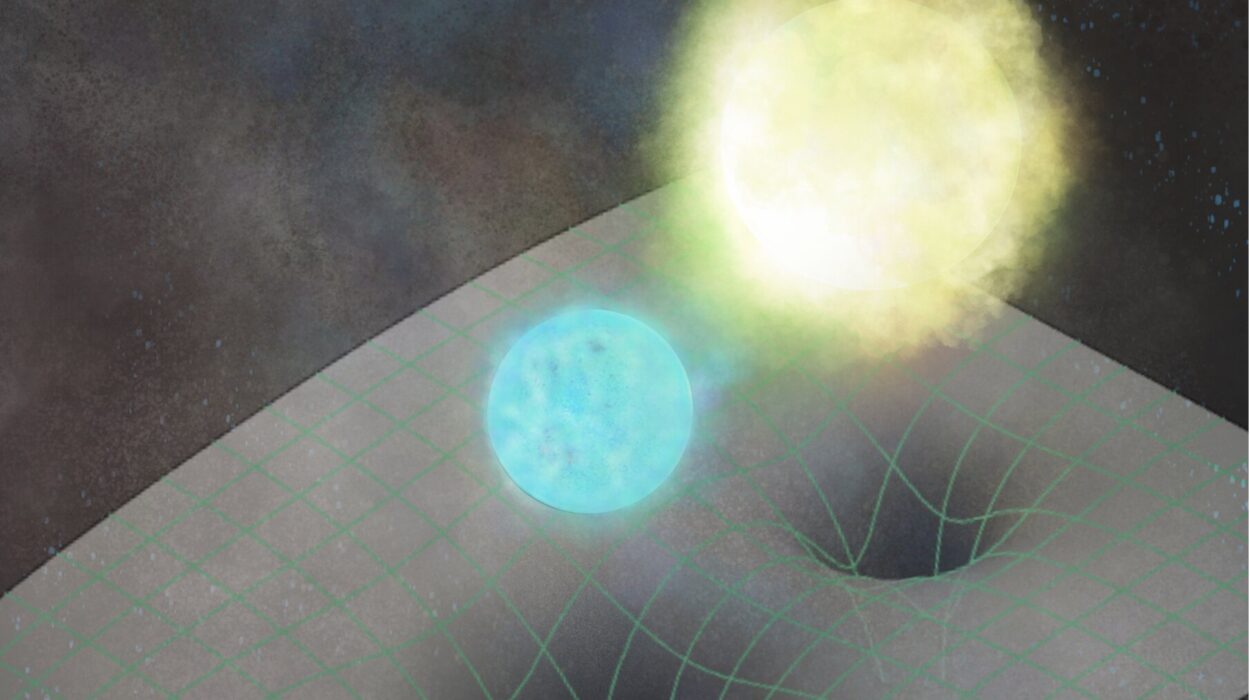
In terms of its origin, the researchers noted a conspicuous absence: there is no identified compact-object remnant, such as a neutron star or pulsar, at the center of the shell. This lack of a central “heart” led the team to conclude that the precursor was most likely a Type Ia supernova. These explosions occur in binary systems when a white dwarf star consumes too much matter from a companion, leading to a total thermonuclear detonation that leaves nothing behind but an expanding cloud of debris.
The Type Ia origin fits the narrative of Abeona as a traveler. These stars are often old enough to have migrated significant distances from their birthplaces in the Galactic plane before they finally reach the tipping point of explosion.
Why This Matters
The discovery of Abeona is more than just the addition of a new name to a celestial catalog; it represents a breakthrough in our ability to observe the “invisible” components of our galaxy. By successfully detecting one of the faintest SNRs known, astronomers have proven that modern radio telescopes like ASKAP can find structures that were previously thought to be lost to the background noise of space.
Furthermore, remnants located at these high Galactic latitudes are essential for testing theories of cosmic ray acceleration. In the crowded Galactic plane, it is often difficult to distinguish which energy signals come from the remnant and which come from the surrounding environment. In the quiet of the Galactic halo, Abeona stands as a clear, isolated subject for study, offering a unique window into the violent processes that seed the universe with high-energy particles and heavy elements. As researchers continue to monitor this “goddess of outward journeys,” they may finally unlock the secrets of how the most energetic components of our universe travel across the vast distances of the Milky Way.
Study Details
Christopher Burger-Scheidlin et al, Radio detection of supernova remnant G310.7-5.4 with γ-ray counterpart: Abeona SNR, arXiv (2026). DOI: 10.48550/arxiv.2604.19897