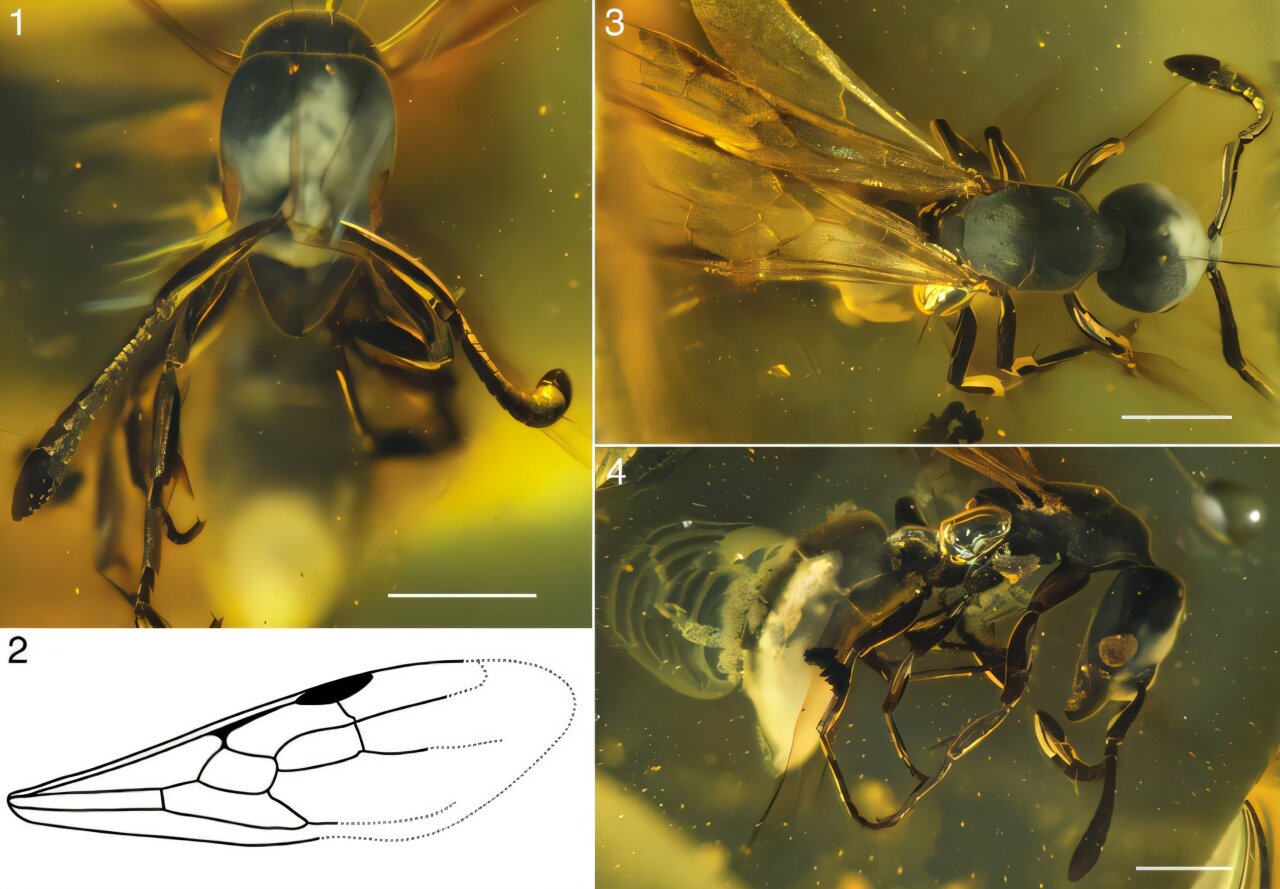
Sixteen million years ago, in a Caribbean forest humming with life, a winged ant paused at the wrong place at the wrong time. Resin seeped from a tree, sticky and golden, and in a moment that would outlast empires and oceans, it trapped her. Today, that tiny, suspended queen has a name: Hypoponera electrocacica.
Her discovery, described by Dr. Gianpiero Fiorentino and colleagues in the Journal of Paleontology, marks something extraordinary. This is the first known fossil of the genus Hypoponera ever found in the Western Hemisphere. For a group of ants that quietly thrives across much of the modern world, this small queen represents a long-missing chapter in their deep history.
For years, scientists suspected that Hypoponera must have lived in the Caribbean during the Miocene, but suspicion is not proof. Now, sealed in amber from the northern mines of the Santiago province in the Dominican Republic, proof gleams in fossilized resin.
The Ant That Was Almost Invisible
To understand why this discovery matters, you have to understand Hypoponera itself. The genus includes more than 150 species, spread widely across tropical and subtropical environments. These ants typically live in soil and leaf litter, forming colonies that may number only a few dozen workers or grow as large as 1,500 individuals.
They are abundant. They are widespread. And yet, they are strangely mysterious.
According to Dr. Fiorentino, Hypoponera has long been treated as a kind of scientific “waste basket” category—a place where species were grouped together when their relationships to others were unclear. The evolutionary connections between modern species remain poorly understood. Trying to link a fossil to a modern lineage is, as he describes, very challenging.
The difficulty lies in their subtlety. Hypoponera lacks striking or dramatic features that make identification straightforward. In fact, their identity often emerges not from what they are, but from what they are not. Entomologist J. Longino once compared the situation to a children’s toy: if the ant subfamily Ponerinae were a “Mr. Potato Head” game, Hypoponera would simply be the potato. No flashy accessories. No dramatic traits. Just the base form.
This quiet ordinariness may be exactly why they have remained so overlooked in the fossil record.
Amber’s Selective Memory
The Dominican Republic is famous for its resin deposits. Some are copal, only hundreds or thousands of years old. Others have hardened into true amber, dating back around 16 million years.
The fossil of Hypoponera electrocacica comes from these older deposits. The amber mines of northern Santiago province have yielded countless preserved organisms, offering vivid windows into Miocene forests. But what amber preserves is not random. It is biased.
Amber begins as sticky tree resin. Creatures that live in trees, crawl along bark, or fly through forest canopies are far more likely to become trapped. As Dr. Fiorentino explains, this creates a preservation bias toward arboreal species.
That bias is clearly visible in Dominican amber. Well-represented ant genera include Pseudomyrmex, Cephalotes, and Azteca, all known for arboreal habits. These ants lived where resin flowed.
Hypoponera did not.
These ants dwell in leaf litter and soil. They are small, ground-bound, and often hidden beneath the forest floor. While modern scientists can easily find them by studying leaf litter, it is exceedingly unlikely for such ants to encounter fresh resin high on a tree trunk.
That is why finding a Hypoponera fossil in amber is so remarkable. It represents a rare crossing of ecological worlds: a forest-floor ant meeting tree resin. It suggests that even species we think of as unlikely candidates for amber fossilization did, at least occasionally, become part of that golden archive.
A Queen with Wings, Suspended Mid-Journey
The fossil itself reveals another twist. The trapped ant is not a worker. She is a winged queen, a member of the reproductive caste.
Worker ants are the most studied members of modern colonies. Their forms and features are well documented. Queens, by contrast, can differ significantly, and in the case of Hypoponera, matching fossil queens to modern counterparts is especially difficult without comparative reproductive specimens.
This makes classification challenging. The fossil displays many morphological features, but without a comprehensive evolutionary review of Hypoponera, linking her precisely to modern lineages remains uncertain.
Yet even with these limitations, two important conclusions stand firm.
First, Hypoponera was present in the Caribbean at least 16 million years ago. The fossil confirms the genus lived in the region during the Miocene.
Second, the fossil species appears strikingly similar to modern representatives. Across millions of years, through shifting climates and changing landscapes, these ants have retained a familiar form.
There is something quietly powerful in that resemblance. It suggests stability. Continuity. A lineage that endured.
A Missing Piece from Across the Ocean
Before this discovery, the only other known fossil of Hypoponera came from Baltic amber. That specimen, Hypoponera atavia, was first identified in 1868 and later reclassified in 2002.
Until now, the fossil record of Hypoponera in the Western Hemisphere was blank.
The new species, Hypoponera electrocacica, changes that. It extends the known fossil history of the genus across the Atlantic and into the Caribbean. It confirms that Hypoponera was not merely a modern tropical success story but part of ancient ecosystems in this region.
The fossil may not yet solve the puzzle of Hypoponera’s evolutionary relationships. As Dr. Fiorentino notes, until a comprehensive review of the genus is completed, its broader evolutionary significance may remain limited. But it is now described, documented, and ready.
It waits, much like the queen once did, for the right moment to connect with new discoveries.
Rewriting the Forest Floor of the Miocene
Perhaps the most intriguing implication lies not just in the identity of the ant, but in what her presence suggests about ancient ecosystems.
Amber has long shaped our understanding of Miocene forests. Because it favors arboreal species, our picture of these ecosystems has been weighted toward life in the trees. The canopy seems rich and diverse, full of ants adapted to branches and bark.
But what about the forest floor?
Leaf litter and subterranean communities likely hosted immense diversity as well. Yet those lineages are underrepresented in amber collections. Their absence in fossils does not necessarily mean absence in life. It may simply reflect preservation bias.
Finding Hypoponera in amber challenges assumptions about what was present. It suggests that the paleontological community of 16 million years ago included more ground-dwelling diversity than previously documented.
Each rare leaf-litter fossil reshapes the narrative. It reminds scientists that the fossil record is not a perfect mirror of ancient life. It is selective, shaped by chance and chemistry.
And sometimes, against the odds, it reveals something unexpected.
Why This Discovery Matters
At first glance, a small fossil ant might seem like a minor addition to science. But Hypoponera electrocacica represents much more than a new name.
It confirms that Hypoponera inhabited the Caribbean during the Miocene, anchoring the genus in deep time within the Western Hemisphere. It demonstrates that even lineages poorly suited to amber preservation occasionally became fossilized, offering glimpses into hidden layers of ancient ecosystems. It highlights the challenges of reconstructing evolutionary relationships in understudied groups. And it underscores the importance of continuing to describe and document fossils, even when their immediate implications seem modest.
Science often advances not through dramatic revolutions, but through careful accumulation of evidence. A winged queen in amber may not rewrite textbooks overnight. Yet she fills a gap that once stood empty.
Sixteen million years ago, she was simply an ant beginning or ending a flight. Today, she is a messenger from a vanished forest, reminding us that even the most unassuming creatures carry stories that stretch across geological ages.
In the golden stillness of amber, the forest floor rises to meet us again.
Study Details
Gianpiero Fiorentino et al, The ant genus Hypoponera (Hymenoptera: Formicidae) in Dominican amber, Journal of Paleontology (2026). DOI: 10.1017/jpa.2025.10213