Ancient shark scales preserved in coral reef sediments are giving scientists a way to estimate how many sharks lived around Panama’s reefs before intensive fishing, revealing a striking difference between the Pacific and Caribbean coasts. Before major human fishing pressure, Pacific reefs supported roughly 20 times more sharks than Caribbean reefs, and that difference has important consequences for how reef recovery should be judged.
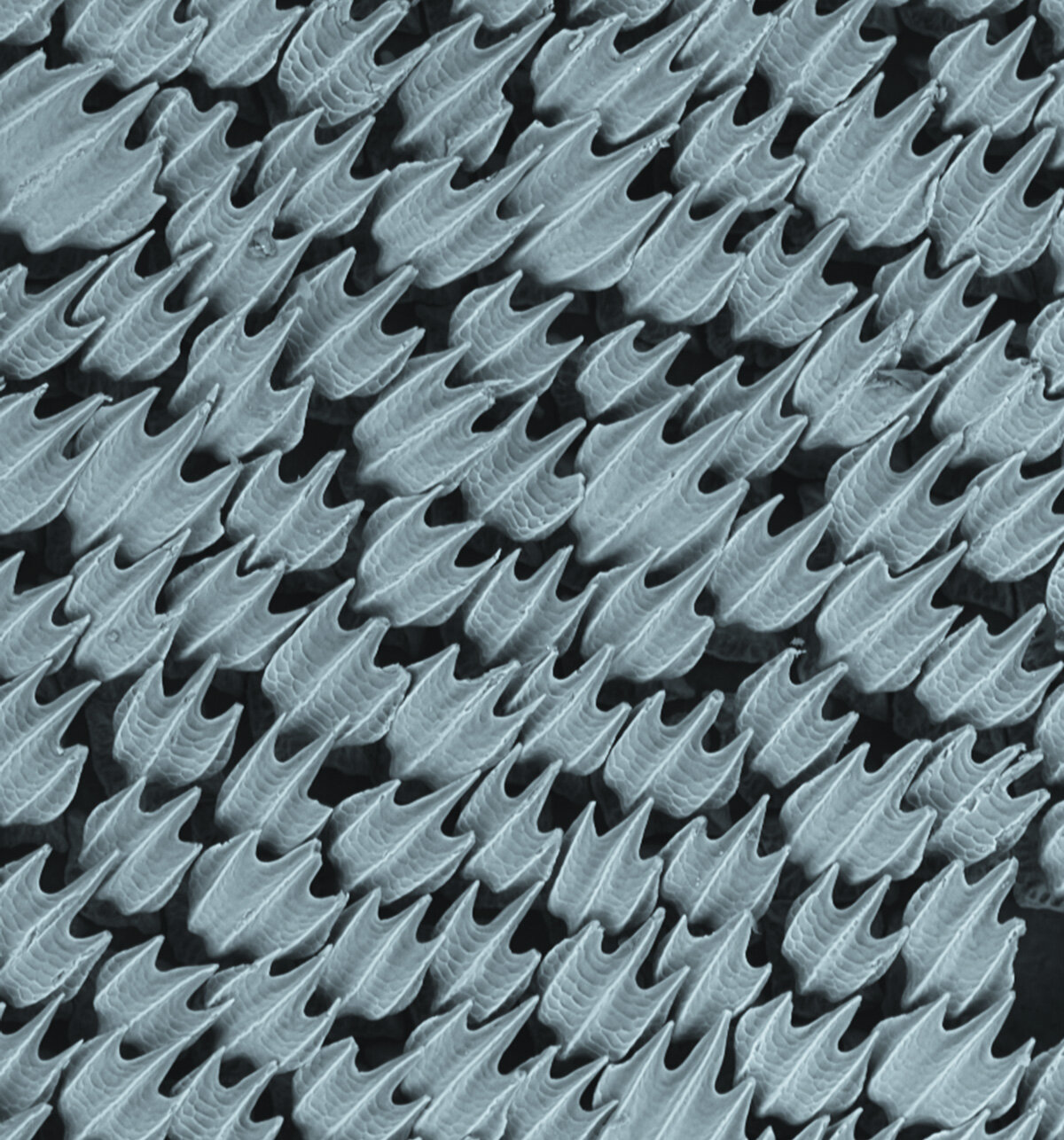
Sharks continuously shed tiny tooth-like scales called dermal denticles throughout their lives. These scales settle into reef sediments, where they can remain preserved for millions of years.
By counting denticles in sediment layers whose ages can be established, researchers can estimate past shark abundance. The approach gave scientists a rare opportunity to compare shark populations from a time before intensive fishing with those of the modern era.
The researchers applied the method on both sides of the Isthmus of Panama. They examined sediments deposited between 7,000 and 3,000 years ago, long before intensive fishing, and compared them with sediments from the past century.
Across 157 samples, the team recovered 3,497 shark denticles.
The first results already pointed to a large difference between the two coasts. In Bocas del Toro on Panama’s Caribbean coast, the researchers found about 50 denticles in 10 kilograms of reef sediment. A much smaller sample from a Pacific reef contained 200 denticles in just 1 kilogram.
As the researchers accounted for differences in dating and sampling effort, the pattern remained.
Pacific reefs had far more sharks before intensive fishing
The prehistoric sediments indicate that reefs in the Gulf of Panama on the Pacific coast supported roughly 20 times more sharks than reefs on Panama’s Caribbean coast.
The two regions are separated by only about 100 kilometers and share many of the same shark species. Yet their historical shark abundances were very different.
The difference became even greater in modern sediments.
On the Caribbean coast, shark denticle accumulation declined by about 75%. On the Pacific coast, modern denticle accumulation is statistically unchanged from the prehistoric baseline.
As a result, present-day Pacific reef sediments yield about 100 times more denticles than Caribbean reef sediments.
That contrast is especially notable because the Pacific coast has experienced much greater fishing pressure. More than 98% of Panama’s fishing takes place there.
Ocean productivity helps explain the difference
The researchers argue that the contrasting environments of the two coasts help explain why their shark baselines were so different.
The Gulf of Panama is highly productive because seasonal upwelling brings nutrients from deeper water toward the surface. That provides enough food to support large predator populations.
The Caribbean coast is more nutrient-poor. Its clear waters are associated with energy being held in reef biomass rather than supporting the same level of predator abundance.
The researchers conclude that sharks on the Caribbean coast therefore occur at lower abundances and are more vulnerable to fishing.
This difference matters when scientists and conservation managers try to decide how many sharks a reef should contain.
A common approach is to use the healthiest nearby reef as a reference for setting recovery targets. But the Panama results indicate that this can be misleading when naturally different environments are compared.
Using the Pacific coast as a reference for Caribbean reefs, or assuming that fishing has affected the two coasts in similar ways, could produce a conservation target that is wrong by an order of magnitude or more.
The researchers argue that ocean productivity should therefore be considered alongside fishing history when setting recovery goals.
The Pacific baseline may hide recent declines
The unusually strong Pacific baseline does not mean that sharks there are free from current pressure.
The researchers caution that sediment samples covering the past 100 years may not capture recent changes clearly. Targeted shark fishing in the Gulf of Panama increased during the 1980s, so declines that occurred more recently could be diluted when averaged across an entire century.
Other work by Smithsonian Tropical Research Institute staff scientist Héctor Guzmán indicates that shark populations in Pacific Panama are under pressure from intensified fishing today.
The researchers also point to a recent change in the Gulf of Panama’s ocean conditions. The upwelling that brings cold, nutrient-rich water into the gulf failed for the first time on record.
Taken together, the researchers suggest that Pacific sharks have a high capacity to recover, but that intensified fishing and changing ocean conditions could be pushing them toward a state not seen for millennia.
The denticle method took years to develop
The idea of using shark scales in reef sediments began more than a decade ago.
The project started 12 years ago with the idea of searching reef sediments for shark denticles. The researchers then had to determine what information the denticles could provide, develop ways to extract them from reef sediments and learn how to interpret the fossil assemblages.
Panama provided an unusual setting for testing the method because its two coasts are close together but have very different ocean conditions.
The resulting sediment record provides prehistoric reference points that would otherwise be difficult to establish because nearly every reef has experienced some form of human influence.
The study was published in Science.