Fossilized leaf cells from forests that grew 56 million years ago have allowed scientists to reconstruct how densely those forests were packed during a period of rapid global warming. The evidence points to a major shift toward more open canopies as warming and drying stressed trees during the Paleocene-Eocene Thermal Maximum, or PETM.
The PETM was a period of rapid carbon release and global warming. To understand how forests responded, researchers examined fossilized leaf fragments preserved in organic-rich rocks from Wyoming’s Hanna Basin.
Their goal was to estimate a measurement called the leaf area index, or LAI. It describes how much leaf area occupies a given area of ground and can be used to quantify the density of a forest canopy.
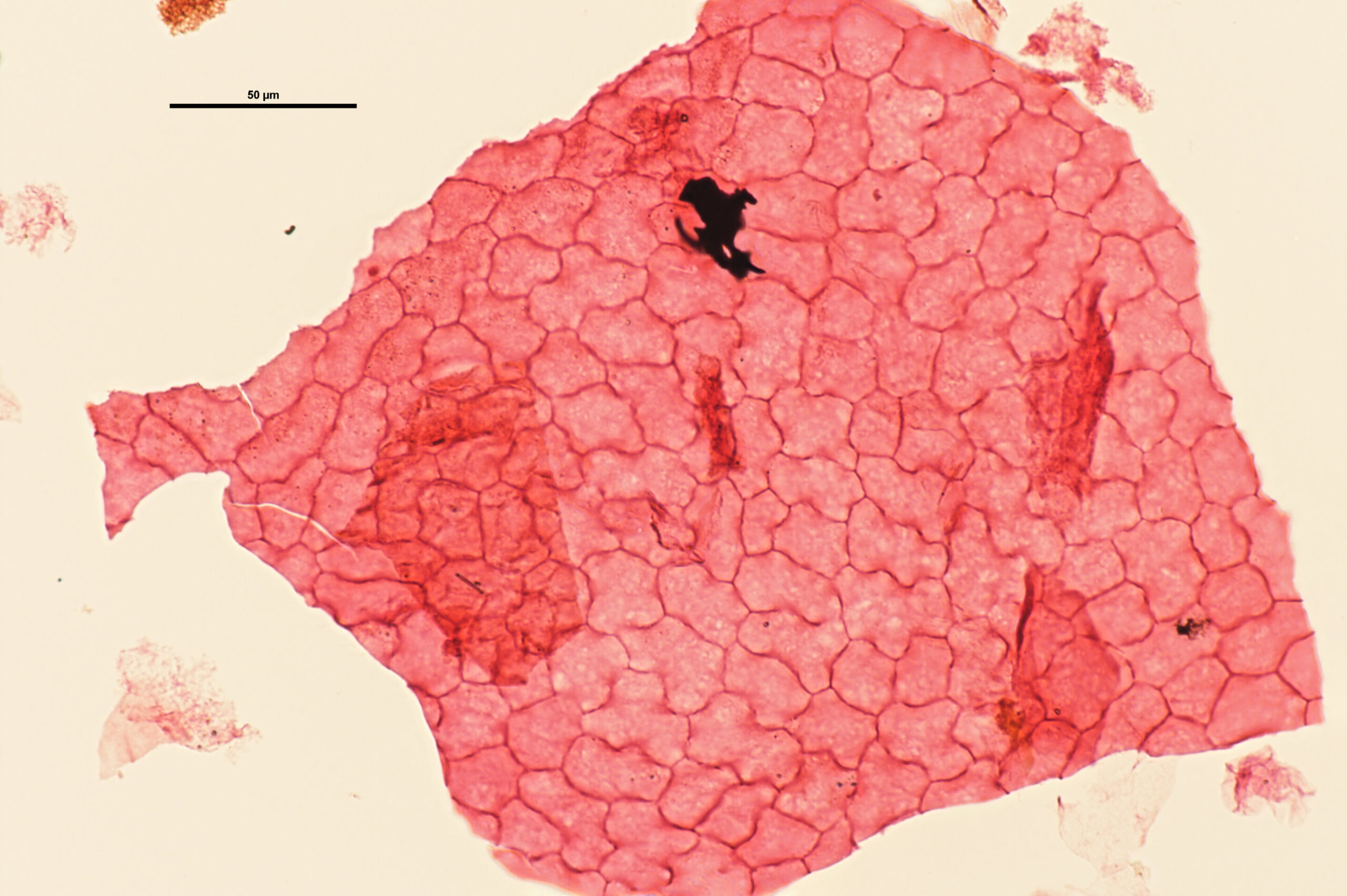
The researchers developed a method that links the microscopic structure of fossil leaves to LAI. They first studied modern forests in South and Central America. At each site, they photographed the canopy with a fisheye lens pointed upward while collecting leaf cuticles from soil directly below.
They then compared the photographs with measurements of thousands of epidermal cells from the collected leaf fragments.
Leaf cells preserve clues about canopy density
The key to the method lies in the shape of cells on the outer layer of a leaf.
Leaves growing in shadier parts of dense forests have more elongated, narrower epidermal cells than leaves exposed to greater amounts of sunlight. The researchers found that these differences in cell shape were strongly correlated with vegetation density.
That relationship provided a way to estimate LAI from fossil leaf fragments.
The researchers had previously used microscopic silica-filled plant cells called phytoliths to measure LAI. But leaf cuticles required a different calculation because different types of fossil material can be affected differently during preservation.
By establishing the relationship between modern leaf-cell shapes and canopy density, the researchers could apply the resulting model to fossil material from 56-million-year-old rocks.
Wyoming preserves the fossil evidence
The Hanna Basin in Wyoming provided an unusually useful record for this work because it contains coal and lignite, rocks rich in preserved organic material.
The research team collected hundreds of samples there over more than a decade, looking for evidence of forests from before and after the PETM.
Those ancient forests looked very different from Wyoming’s modern landscape. Giant dawn redwood trees of the genus Metasequoia grew alongside sycamores, alders, palms and other subtropical and tropical plants.
The fossil record allowed the researchers to compare forest structure across the PETM interval.
The forests became more open during the PETM
The reconstructed LAI values indicate that forest canopies became more open during the PETM, with fewer large trees.
The researchers associate this change with the combination of elevated atmospheric carbon dioxide, warming and reduced rainfall during the event. They report that plant species also migrated northward as conditions changed.
According to the researchers, the loss of canopy cover affected processes including climate, nutrient cycling and weathering, as well as the animals living in those forests.
The findings also fit with evidence of widespread browning of landscapes during the PETM.
Modern forests are also showing changes in canopy cover
Satellite measurements of modern global LAI have recorded changes in Earth’s vegetation since the 1980s. The researchers note that Earth initially experienced a greening trend associated with increased atmospheric carbon dioxide, which can fertilize plant growth.
As temperatures have increased, however, that trend has begun reversing in many areas, with parts of Earth now showing browning.
The researchers interpret this reversal as evidence that higher temperatures are increasingly harming forests.
They also note that modern forests face several pressures at once, including warming, drought stress, pathogens, insect infestations and wildfires. Deforestation, habitat fragmentation, invasive species and land-use change add further pressures.
The ancient record cannot reproduce all of those modern conditions, but the researchers say the PETM provides evidence of how forest structure changed during a period of rapid carbon release and warming.
The study was published in Science.