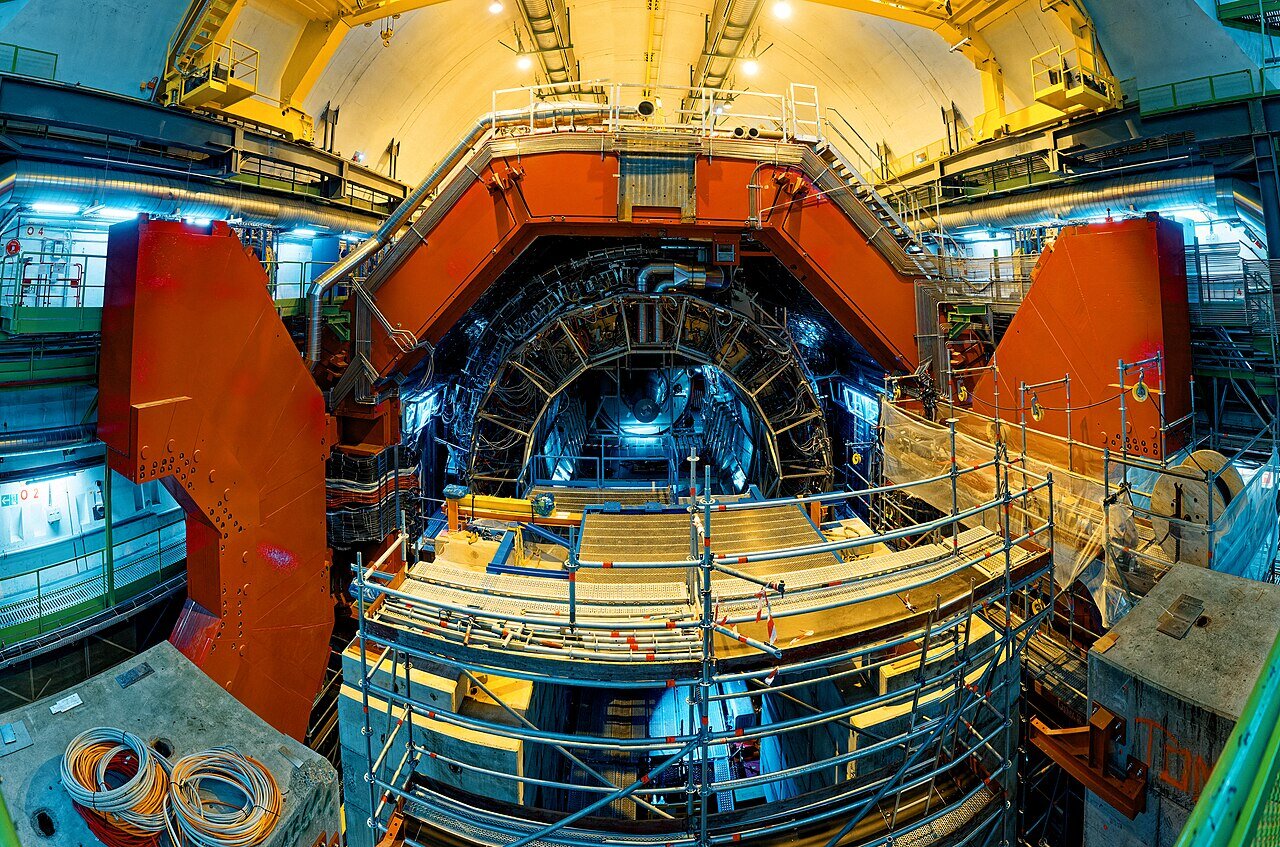
Inside atomic nuclei, gluons do far more than simply bind quarks together. A new measurement from the ALICE experiment at CERN has given physicists a more detailed look at how these particles behave at extremely small scales, finding evidence that challenges nuclear shadowing as a complete explanation and is instead consistent with gluon saturation.
Gluons are the particles associated with the strong force that binds quarks together. Because their behavior helps determine the structure of matter, physicists want to understand how gluons are distributed and how they interact inside atomic nuclei.
The new work uses an unusual way to study them. Researchers working with the ALICE experiment at CERN’s Large Hadron Collider examined a process called incoherent J/ψ photonuclear production.
The J/ψ is a particle that can briefly form when a high-energy photon interacts with a nucleus. In the LHC’s Run 2 data, fast-moving lead nuclei passed close to one another without directly colliding. The intense electromagnetic fields around the nuclei acted like sources of high-energy photons. When one of those photons interacted with another nucleus, it could produce a J/ψ.
That process gave the researchers a way to examine the gluon structure inside the nucleus.
Unlike measurements that average over an entire nucleus, incoherent J/ψ production is sensitive to local variations in gluon density. That makes it possible to investigate smaller structures inside the nucleus.
The researchers measured the process across photon-nucleus energies ranging from 20 to 633 billion electron volts. They also measured momentum transfer, which determines how finely the nucleus is being examined.
Looking at progressively smaller regions
The different momentum-transfer measurements allowed the ALICE team to examine the nucleus at spatial resolutions of 0.6, 0.3 and 0.2 femtometers.
The smallest of those scales corresponds to structures about one-quarter the size of a proton.
This finer resolution is important because the researchers were looking for changes in how gluons behave as the measurement reaches smaller regions. The resulting multidimensional measurement combined the interaction energy with momentum transfer, providing information that earlier measurements did not capture in the same way.
The measurements produced a notable result at the smallest spatial scales explored.
The production rate of J/ψ particles was significantly suppressed, with a statistical significance of about three standard deviations.
Why the suppression matters
One explanation that has been used to describe earlier measurements is nuclear shadowing. In that picture, gluons inside a nucleus partially overlap, reducing the probability of some particle-production processes.
The new measurements indicate that nuclear shadowing alone cannot fully account for the observed data.
Instead, the observations are consistent with gluon saturation, a phenomenon predicted by quantum chromodynamics, the theory that describes the strong force.
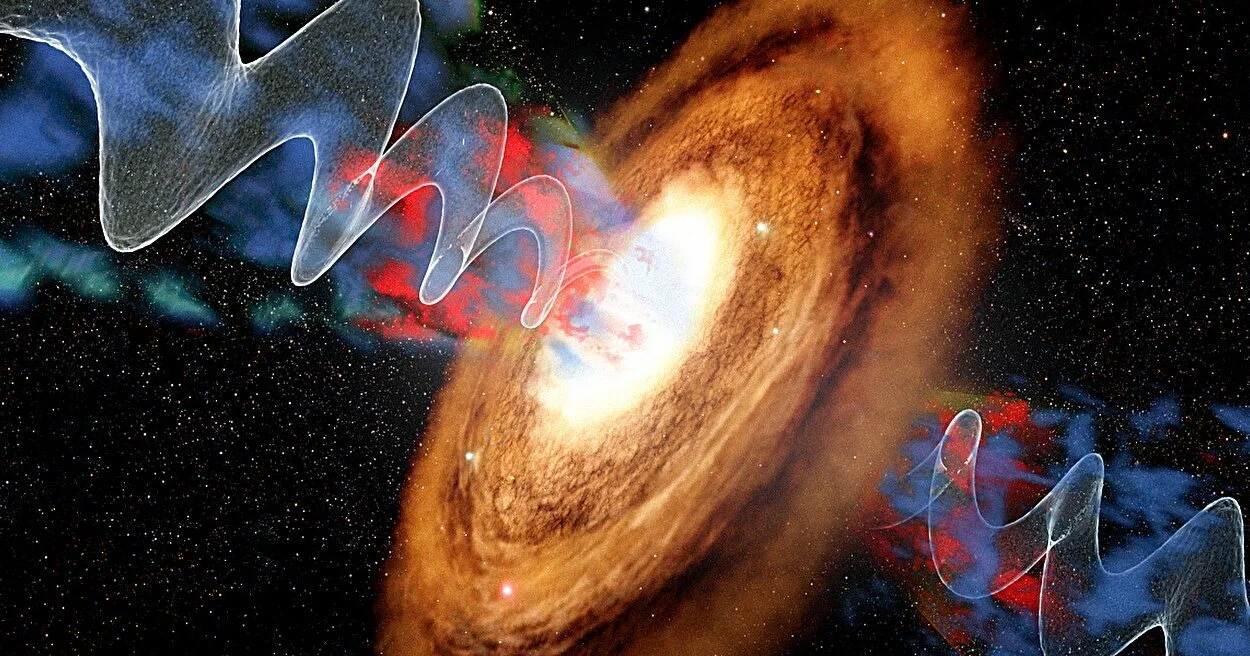
In the saturation picture, gluons become extremely dense within a region and begin interacting strongly with one another. This interaction limits how many gluons can occupy a given region.
The distinction between these explanations is central to the new measurement. The researchers were not simply measuring how many J/ψ particles were produced. By examining production across both energy and momentum transfer, they could test how the result changed as the measurement reached smaller spatial scales.
Evidence for collective gluon behavior
The measurements provide evidence that gluons begin to behave collectively at the smallest scales examined.
Daniel Tapia Takaki, a physicist at the University of Kansas and a member of the ALICE collaboration, played a leading role in the research and in theoretical work involving localized regions of high gluon density, sometimes described as “hot spots.”
In an energy-dependent hot-spot model, these regions can change with collision energy and provide signatures of behavior in the strong interaction.
The new results are consistent with the idea that gluon saturation contributes to what the experiment observes. At sufficiently high gluon density, the gluons interact strongly enough that their number within a region becomes limited.
The measurement therefore provides an experimental way to distinguish between two competing descriptions of gluon behavior inside nuclei. Nuclear shadowing had successfully described previous measurements, but the new multidimensional data indicate that it does not fully explain the suppression seen at the smallest spatial scales.
The study was published in Physical Review Letters.