Thin layers of sand and silt surrounding the famous mammoth bones at The Mammoth Site in Hot Springs, South Dakota, have turned out to be far older than the site’s long-accepted radiocarbon ages. New luminescence dating places most of the sampled bone-bed sediments between about 232,000 and 160,000 years ago, shifting the main period of deposition from the later Pleistocene to much earlier stages of the ice age.
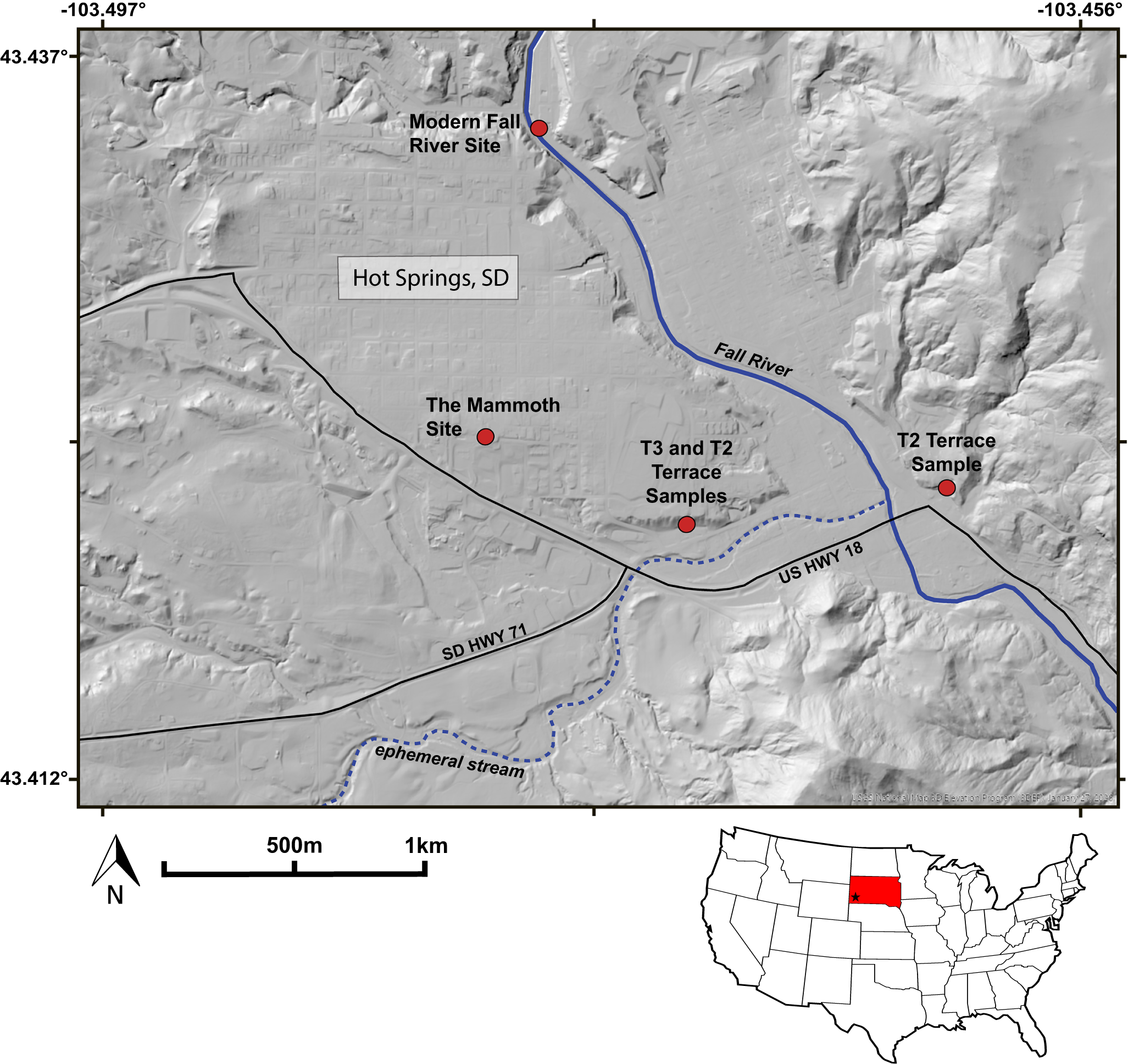
The Mammoth Site is a filled sinkhole in the Black Hills, about 1,088 meters above sea level and roughly 70 meters above the present-day Fall River. More than 60 mammoths have been identified at the site, along with remains of several other mammals. The deposit is unusual because the animals were trapped while alive, and much of the bone bed and its surrounding sediments remain preserved in place inside the museum built over the sinkhole.
The problem was the site’s age.
Six previous radiocarbon measurements from the Mammoth Site ranged from about 42,100 to 23,250 calibrated years ago. Five were made on bone apatite and one on bone carbonate, and most came from the Phase II sediments that contain much of the bone bed. But the bones lacked collagen, a problem because bone apatite can be altered after burial and produce ages younger than the actual age of the material.
Other dating attempts had pointed much farther back in time. A uranium-series measurement on mammoth tooth enamel gave an age of about 129,000 years, while another reported U-series age was 150,000 ± 10,000 years. An earlier thermoluminescence measurement on Phase II sediment was 101,000 ± 10,000 years. Those results were themselves uncertain because the available information did not fully establish that the U-series samples had remained in the conditions required for reliable dating.
That left a striking gap between the roughly 42,000-to-23,000-year radiocarbon chronology and the much older U-series and thermoluminescence results.
The new work was designed to test that discrepancy by dating the sediment itself rather than relying primarily on the bones.
The sediment carried its own clock
The researchers collected six samples from a roughly 6-meter exposure of Phase II sediment in the bone bed. The samples came from different depths, including sediment near mammoth tusks and skulls as well as deeper blocks of the laminated material. They also collected four samples from Fall River terraces, including a modern river sample, to test whether the sedimentary environment could produce reliable luminescence ages.
Luminescence dating works by measuring energy stored in mineral grains. Natural radiation gradually builds up trapped electrons in the grains. Exposure to sunlight releases electrons from light-sensitive traps, effectively resetting the signal. If the grains are sufficiently exposed before burial, the remaining stored signal can be used to estimate how long they have been buried.
That presented an immediate technical problem at the Mammoth Site. The researchers initially tried optically stimulated luminescence, or OSL, on quartz, but the quartz signals were saturated. They therefore turned to potassium feldspar and used a post-infrared infrared-stimulated luminescence, or pIRIR, procedure designed for older sediments and intended to reduce the effect of anomalous fading.
The resulting feldspar ages were strikingly old.
The six Mammoth Site samples produced ages of 172 ± 24.9, 159 ± 20.7, 196 ± 16.7, 205 ± 10.3, 131 ± 13.1, 170 ± 10.2, and 232 ± 23.0 thousand years, with the two measurements of sample MS-16-3 coming from separate laboratory analyses of splits from the same sampling location. The researchers excluded the 131,000-year result from their main age range because it was anomalously young relative to the surrounding stratigraphy.
The remaining sequence generally followed the expected order of the sediment layers. The youngest accepted sample was near the top of the deposit at about 159,000 years, while the deepest sampled sediment produced an age of about 232,000 years. The authors therefore place the sampled Phase II sediments between approximately 232,000 and 160,000 years ago.
That chronology does not overlap any of the site’s previously published radiocarbon ages.
Several checks supported the older chronology
Because luminescence dating can be affected by incomplete exposure to sunlight, water content, radioactive disequilibrium and sediment disturbance, the researchers tested those potential problems rather than treating the first set of ages as definitive.
One important check involved the modern Fall River.
A modern sediment sample collected during spring runoff produced very young luminescence ages. Quartz measurements included many grains with signals near background, while feldspar measurements showed a mixture of well-bleached grains and grains with some remaining signal. The modern feldspar sample had an overdispersion of 31%, while quartz reached 146%. The researchers interpreted the results as evidence that the transported sediment was moderately well bleached.
That matters because incomplete bleaching can make luminescence ages appear too old. The modern comparison suggested to the authors that sediment entering the Mammoth Site through similar transport conditions could receive enough sunlight exposure to reset much of its luminescence signal before burial.
The Mammoth Site sediments themselves also showed relatively narrow distributions of equivalent-dose measurements. Most samples had overdispersion values of 0% to 13%, while the researchers noted that values above 30% are considered indicative of poorly bleached or mixed sediments. Two independent laboratories also produced closely similar ages from separate splits of the same sample.
The researchers therefore judged the pIRIR chronology to be robust for most of the sampled sequence.
The one young sample remains unexplained
The strongest complication is sample MS-16-4.
It was collected from near the middle of the stratigraphic sequence and returned an age of 131 ± 13 thousand years. Because it lies deeper than younger samples that produced substantially older ages, it breaks the otherwise orderly age sequence.
The researchers considered several possible explanations. The result could reflect an undetected problem with the environmental dose rate, the sample’s relatively high potassium content, a sensitivity correction that was not modeled, an underestimated water content, or the introduction of younger grains after deposition through bioturbation or another process such as collapse of the sinkhole wall.
Mammoths themselves could have mixed sediment after it was deposited. Deep mammoth footprints become increasingly common in the transition between the site’s sedimentary phases. To reduce that risk, the researchers selected visibly intact bedding for their samples. A nearby sample, MS-16-5, did not show the same problem and produced an age consistent with the expected stratigraphic sequence.
Because the researchers could not determine which explanation was responsible for MS-16-4, they did not use that age when defining the main age range of the Mammoth Site sediments. The discrepancy remains unresolved.
Warm groundwater created another dating challenge
The sinkhole was not an ordinary dry sedimentary environment. Warm spring water moved through the breccia pipe beneath the site, and the researchers had to account for the possibility that water had altered the uranium decay system used to calculate the environmental radiation dose received by the buried grains.
Measurements showed that uranium-series disequilibrium was strongest near the spring conduit. A sample taken within about 2 meters of the conduit showed daughter products roughly three times the measured parent uranium concentration. By contrast, the disequilibrium declined rapidly farther from the conduit.
The researchers therefore modeled possible open-system behavior. For samples between 2 and 4 meters from the conduit, they applied a 30% adjustment under an assumed U/Th ratio of about 0.35. They found that samples more than 5 meters from the conduit required no such correction. For most of the Mammoth Site samples, adjusting for both fading and uranium disequilibrium changed the ages only within their original uncertainties.
The water content of the sediments was another uncertainty. The researchers assumed the sinkhole sediments remained saturated while the sinkhole was being filled and then gradually dried as the deposit became compacted and the site changed. They assigned a long-term moisture content of 50% to the mainly Phase II samples. They estimated that the assumed moisture would have to vary by more than 10% to substantially affect the ages, and considered that less important than potential uranium disequilibrium.
These tests did not eliminate every uncertainty, but they led the authors to conclude that open-system behavior was not an insurmountable problem for the main Mammoth Site samples.
The surrounding terraces helped test the clock
The researchers also looked outside the sinkhole.
A previously dated Fall River terrace deposit produced luminescence ages broadly consistent with its earlier radiocarbon chronology. At the Morrison locality, for example, a quartz OSL measurement produced an unadjusted age of about 32 thousand years, while feldspar pIRIR gave about 36 thousand years. After adjustments for fading and uranium disequilibrium, the preferred ages were about 27 thousand years for quartz and 32 thousand years for feldspar. Those ages were older than the roughly 25,000-year radiocarbon age, but the two dating approaches were close enough to provide a useful test of the luminescence behavior in a similar setting.
Two additional terrace samples produced feldspar ages of 67 ± 7 thousand years and 22 ± 3 thousand years. The younger result agreed closely with the other evidence for the lower terrace, while the older sample helped establish a chronology between the Mammoth Site’s higher terrace and the younger Fall River deposits.
The pattern is important to the researchers’ interpretation: luminescence dating produced ages consistent with the younger, independently dated terrace deposits while giving much older results specifically for the Mammoth Site sediment.
The sinkhole appears to have filled slowly
The new chronology also changes the picture of how long sediment accumulated inside the sinkhole.
The Phase II deposit contains numerous thin, alternating sand-and-silt layers. An earlier estimate based on a sedimentation rate of 50 millimeters per year would have filled a 14-meter sinkhole in only about 280 years. The researchers regarded that estimate as unsatisfying because the number of sediment couplets greatly exceeds what would be expected over such a short interval, and because it did not account for the timescale indicated by the new ages.
Using closely spaced dated samples, they obtained estimated sedimentation rates of 35 ± 5 and 62 millimeters per year in different parts of the sampled section, although they noted that there was not enough information to establish whether such rates were typical. Using the full sampled age range and the approximately 6-meter stratigraphic interval, the authors report an overall accumulation rate probably close to 12 millimeters per year. They consider that slower rate more compatible with the large number of sand-silt couplets and the long period represented by the luminescence ages.
The chronology places the main Phase II deposition during Marine Isotope Stage 6 and possibly the latter part of Marine Isotope Stage 7 rather than the much younger interval previously assigned to the site.
The authors also note that the new age range is compatible with aspects of Columbian mammoth morphology that had developed in some populations by roughly 255,000 to 130,000 years ago. They suggest that reassessing the ages of specimens from the Mammoth Site could clarify how those specimens fit into studies of mammoth morphological change.
The younger radiocarbon ages may record a later event
The researchers propose a possible explanation for why radiocarbon ages from the site are so much younger than the luminescence results.
Their hypothesis is that the radiocarbon measurements may have been affected by later chemical changes associated with drying and cementation of the sinkhole sediments. They point to the presence of carbonate, gypsum and anhydrite cement and to gypsum stringers that indicate evaporation processes. In their interpretation, the U-series and luminescence methods were dating earlier sediment deposition, while the radiocarbon measurements may have been reset during later alteration of the deposit.
The chronology of the nearby terrace provides part of the basis for this interpretation. The T3 terrace produced a luminescence age of 67.1 ± 6.7 thousand years, with the authors giving a 73–61 thousand-year range. They argue that changes in groundwater level and temperature around that time could have allowed the sinkhole to dry and the sediments to become cemented. They therefore suggest that the Mammoth Site sinkhole likely dried, cemented and became completely filled around the beginning of Marine Isotope Stage 4.
That explanation is presented as a hypothesis rather than a directly demonstrated sequence. The authors state that some postdepositional process must account for the large discrepancy between the radiocarbon chronology and the older dating methods, but the precise mechanism remains part of their interpretation.
The new chronology itself is the central result: the bone-bearing sediments sampled at The Mammoth Site are placed at approximately 232,000 to 160,000 years old, with one unresolved younger outlier. The researchers conclude that feldspar pIRIR provided reliable ages for most of the sampled sequence, supported by the behavior of the luminescence signals, comparisons between laboratories, tests of bleaching, assessments of uranium disequilibrium and the overall stratigraphic order of the samples.
The study was published in Quaternary Research.