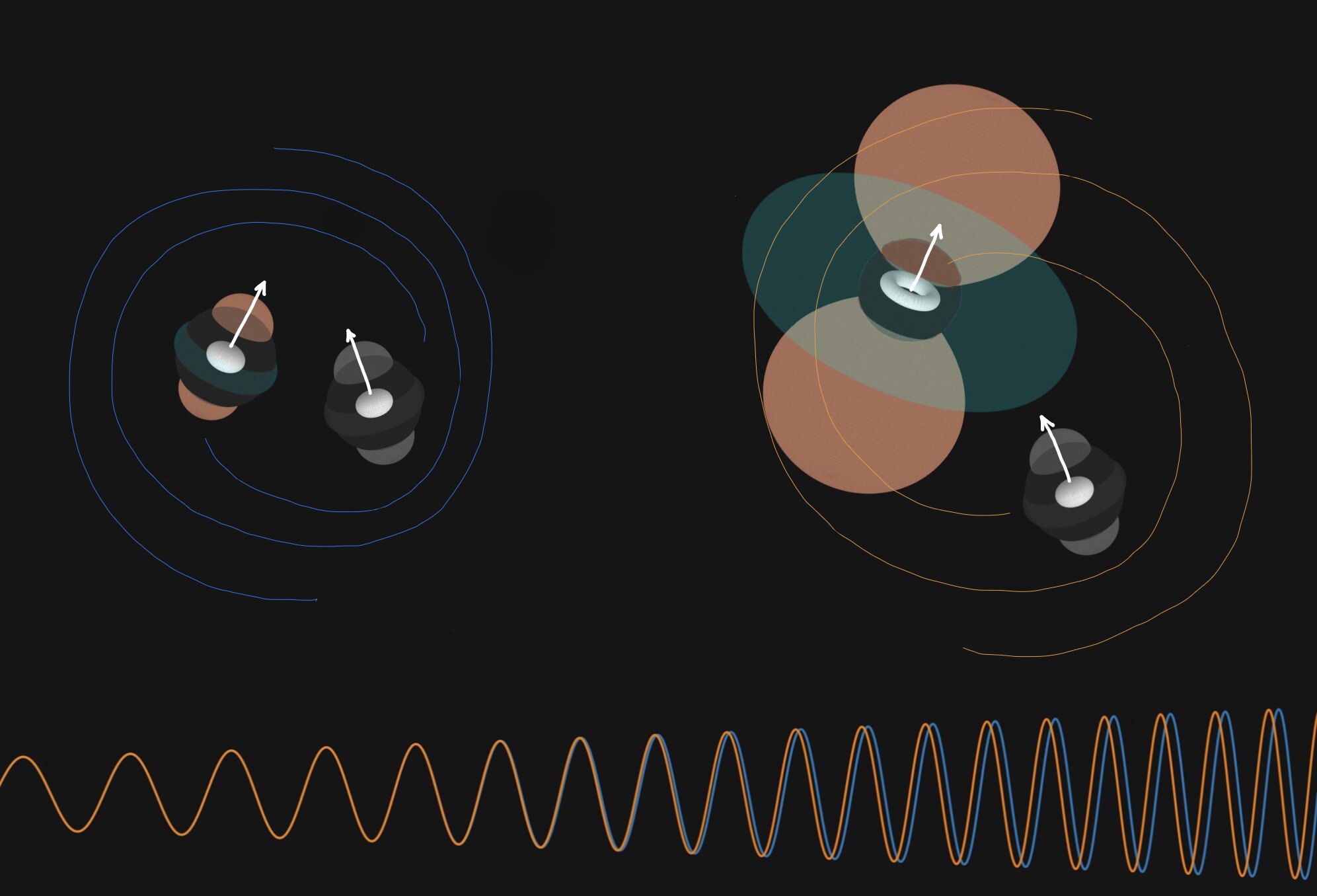
The gravitational-wave signal from GW241011 has left little room for several proposed alternatives to black holes. By using how the primary object’s spin distorted its shape and imprinted that distortion on the gravitational-wave signal, researchers found that rotating boson stars with quartic self-interactions cannot account for the object, while some much more compact exotic objects remain compatible with the measurement.
GW241011 came from a compact binary whose primary was spinning rapidly. Its dimensionless spin was measured at about 0.78, with an uncertainty of 0.09, while the primary had a mass of about 19.6 times the mass of the Sun, with uncertainties of +3.6 and −2.5 solar masses. The primary was roughly three times as massive as its companion, with a mass ratio of about 0.30. The strength of the gravitational-wave signal and the primary’s high spin made the event particularly useful for testing whether compact objects other than ordinary black holes could produce the observed signal.
The objects considered in this work belong to a broad class called exotic compact objects. Some of these proposed objects have no event horizon but can nevertheless produce gravitational-wave signals resembling those of black holes. The possibilities include boson stars, gravastars, exotic fluid stars and other theoretical constructions.
The researchers focused on one property that can distinguish such objects from a Kerr black hole: the spin-induced quadrupole moment.
When a compact object spins, its shape can become deformed. That deformation produces a quadrupole moment, and the resulting effect can alter the gravitational waves emitted during the inspiral of two compact objects. For a Kerr black hole, this quantity is fixed by the object’s mass and spin. Other compact objects can have different values, potentially leaving a measurable difference in the gravitational-wave signal.
The quantity used in the analysis was the reduced spin-induced quadrupole, denoted by κ. For a Kerr black hole, κ is 1. The researchers allowed κ to vary in their gravitational-wave analysis rather than assuming the primary was a black hole from the outset.
The gravitational-wave signal provides the constraint
The team incorporated spin-induced quadrupole corrections at the second- and third-post-Newtonian orders into the IMRPhenomXPHM waveform model. That model accounts for effects including double-spin precession, higher harmonics and the inspiral, merger and ringdown of binary black holes. Because the waveform model does not readily handle spins greater than 1, the analysis was restricted to subextremal spins between 0 and 0.99.
The resulting posterior distribution for the primary’s κ provided the central observational constraint. The researchers also tested different maximum frequencies at which the likelihood calculation was stopped. Lowering that cutoff widened the posterior because less of the signal was being used, but its qualitative behavior remained unchanged. The authors therefore regarded the κ constraint as robust to those changes.
The companion object did not provide a comparable constraint. Its spin-induced quadrupole parameter, κ₂, remained consistent with its prior, so the analysis concentrated on the primary. The resulting limits therefore apply specifically to the primary object in GW241011 and cannot be used to rule out exotic compact objects elsewhere in the universe.
The researchers then compared that measured κ–spin region with theoretical predictions for different exotic compact objects. They constructed families of rotating models, removed configurations considered dynamically unstable, and asked which models could simultaneously accommodate the observed spin, mass and spin-induced quadrupole measurement.
Quartic boson stars fail the test
The clearest exclusion came from one of the most commonly studied classes of boson stars.
The researchers considered scalar boson stars described by three different self-interaction potentials: repulsive, solitonic and axionic. In these models, the scalar field has a mass parameter and additional coupling parameters that determine the strength and form of its self-interactions. The calculations produced families of rotating boson-star solutions and their predicted spin-induced quadrupole moments.
Not every mathematical solution was treated as a viable physical candidate. The researchers excluded configurations identified as unstable using turning-point arguments and results from numerical simulations. They also restricted the rotating boson-star calculations to azimuthal number m = 1 because dynamically stable configurations with higher m had not yet been obtained.
For the repulsive boson-star model, the self-interaction takes the form of a quartic term. The researchers examined couplings ranging from λ/μ² = 150 to 1000.
The problem for these objects was their predicted quadrupole moment. For the range of boson masses compatible with the measured spin, the boson mass would have to fall between 7.32 × 10⁻¹² and 10.6 × 10⁻¹² electron volts per c². Yet the smallest theoretically allowed κ consistent with the primary’s measured spin was about 3. That is substantially larger than the range allowed by the gravitational-wave measurement.
The result is a direct exclusion within the model space examined: the researchers conclude that the primary of GW241011 cannot be explained by a repulsive boson star and exclude λ/μ² ≥ 150 over that boson-mass range.
The models also faced a separate problem at high coupling. For λ/μ² ≳ 450, configurations compatible with the observed spin had relatively large radii and maximum compactness no greater than about 0.08. For λ/μ² ≤ 250, the maximum compactness was about 0.11–0.17, but these configurations rotated more slowly. The authors report that additional analysis of the gravitational-wave signal showed significant coherent power beyond the nominal cutoff frequencies for these low-compactness configurations, further suggesting that such models are ruled out.
The authors also mapped the constraints into the boson-mass and coupling parameter space. Within the boson-mass range probed by GW241011, they found that couplings corresponding to self-interaction cross sections below an upper limit of about 0.1 cm² per gram were excluded for the primary. Again, the authors emphasize that these exclusions apply only to the primary object in this particular gravitational-wave event.
More compact boson stars survive
The result changes when the researchers move to solitonic boson stars.
For weaker self-interactions, with σ greater than 0.1, they found no solutions consistent with the measured primary spin. Those configurations were also likely to be dynamically unstable. Stronger self-interactions, with σ ≤ 0.1, produced stable solutions that could agree with both the measured spin and the spin-induced quadrupole.
The difference comes with compactness. The solitonic configurations that remain compatible with GW241011 have compactness of about 0.26 or greater. The allowed region even overlaps with some ultracompact models containing light rings.
Overall, apart from some high-spin models with σ = 0.05 and 0.04, the researchers find that solitonic stars with strong self-interactions, σ ≲ 0.1, and boson masses between 1.4 × 10⁻¹¹ and 4.5 × 10⁻¹¹ electron volts per c² are generally consistent with GW241011.
Axionic boson stars show a similar pattern.
With strong self-interactions, f ≤ 0.01, these models can become highly compact, with compactness of about 0.3 or greater. They can then remain consistent with the measured spin and quadrupole. Their allowed boson masses fall between 2.6 × 10⁻¹¹ and 5.0 × 10⁻¹¹ electron volts per c².
The less strongly interacting axionic models fare much worse. For f ≥ 0.05, models compatible with the observed spin are ruled out by the κ measurement. Those configurations have compactness of 0.17 or less and boson masses between 7.1 × 10⁻¹² and 9.5 × 10⁻¹² electron volts per c². Models with f > 0.1 are also considered more likely to suffer from dynamical instabilities, although the authors note that they do not have enough simulation data to draw concrete stability conclusions for axionic stars in the same way they can for the other models.
A different kind of exotic object faces a compactness threshold
The researchers also tested exotic fluid stars as a more general toy model for exotic compact objects.
They used an equation of state at the causal limit of stiffness, meaning the model has a sound speed equal to the speed of light. The model contains a critical energy density that sets the scale of its dimensionful quantities. Rather than focusing on those quantities directly, the researchers used dimensionless properties such as compactness when comparing the models with GW241011.
They constructed uniformly rotating stars with different ratios between their polar and equatorial radii. Smaller axis ratios generally produced more rapidly spinning and more compact configurations.
Models with spins compatible with GW241011 required an axis ratio of about 0.55 or greater. After excluding unstable configurations beyond the maximum-mass turning point, the researchers found that the surviving exotic fluid stars must have compactness of at least about 0.24. For more spherical stars, with an axis ratio around 0.7, that lower limit rises to about 0.34.
This compactness threshold is reflected in the paper’s overall result. Among the exotic compact-object models examined, the objects that remain compatible with the primary of GW241011 have compactness above roughly 0.24, while the less compact configurations are excluded within the assumptions of the analysis.
Several other proposals remain harder to test
Not every exotic compact-object model could be meaningfully constrained by this event.
For anti-de Sitter black shells, the available calculations were considered reliable only up to a spin of 0.45, below the measured spin of GW241011’s primary. Slowly rotating thin-shell gravastars, meanwhile, have been constructed with spins extending beyond the Kerr range, but the stability of gravastars and anti-de Sitter black shells remains an open question. The authors also note an argument that certain gravastar membranes satisfying the weak energy condition are unstable to high-frequency oscillations.
Scalarized black-hole solutions provide another case. These arise in modified theories of gravity and can have spin-induced quadrupoles different from those of Kerr black holes. But over the coupling ranges in which the relevant solutions are known to exist, their differences in κ from the Kerr value are generally no more than about 10 percent, which is smaller than the range excluded by GW241011.
The researchers also examined Proca stars, which are vector-field counterparts of boson stars. For rotating m = 1 models without self-interactions, they found no configurations satisfying the χ < 1 restriction used in their analysis. The models they constructed, including less compact ones, had κ of order 1. The authors therefore found that the spin-induced quadrupole of these Proca stars is only weakly correlated with compactness.
The constraint has important limits
The researchers stress that the result is not a general exclusion of exotic compact objects.
The analysis tests one particular finite-size property, the spin-induced quadrupole moment. It does not include other possible effects, including tidal deformability or short-range interactions specific to boson stars that can affect binary boson-star dynamics.
The waveform model also does not include super-extremal spins greater than 1, even though such spins are possible in many rotating boson-star and gravastar models. The authors say future analyses should incorporate those effects, along with higher post-Newtonian orders and additional multipole moments such as the spin-induced octupole.
Most importantly, the exclusions are tied to the specific models examined and to the primary of GW241011. They should not be interpreted as ruling out every possible exotic compact object. The researchers say their approach can instead be extended to other constructions, including boson-star potentials with higher-order self-interactions.
For a fuller program of testing compact objects, the authors describe the need for numerical and phenomenological gravitational-wave template banks, consistency checks across different tests of general relativity and the standard model, population-level studies, and complementary observations through other channels. They also point to the possibility of using approximate universal relations for exotic compact objects to constrain quantities that cannot otherwise be measured directly.
The study was published in Physical Review Letters.