At pressures above 200 gigapascals and temperatures reaching 2,630 kelvin, water ice takes on a structure that had not previously been unambiguously observed: an oxygen lattice arranged in a hexagonal close-packed pattern. Synchrotron X-ray diffraction experiments show that this hcp form of ice can coexist with the previously observed face-centered cubic form and, under some conditions, become the dominant structure in the superionic regime.
Water ice can exist in several crystal structures when subjected to extreme pressure and temperature. At pressures above roughly 60–80 GPa, ice X has a body-centered cubic arrangement of oxygen atoms. At higher temperatures, water can enter a superionic state, in which the oxygen atoms remain organized in a lattice while hydrogen nuclei move through it.
Experiments have already established a face-centered cubic, or fcc, form of superionic ice, known as ice XVIII. The new measurements provide evidence for another close-packed arrangement, in which the oxygen atoms form a hexagonal close-packed, or hcp, lattice.
The distinction between the two structures is mainly the way the dense oxygen layers are stacked. In the fcc structure, the layers follow an ABCABC sequence. In the hcp structure, they follow an ABAB sequence.
The researchers identified the hcp structure from five classes of diffraction peaks. The observations also revealed that the hcp and fcc structures can occur together rather than being separated by a sharp boundary.
Cooling an fcc crystal produced the clearest transition
The first experiment was carried out at about 80 GPa. The researchers heated the water sample to 1,950 K, producing high-quality single crystals of fcc ice.
They then collected X-ray diffraction data while cooling the crystal from 1,956 K to 1,086 K.
Below about 1,400 K, the diffraction peaks associated with the fcc structure began to deform, while diffuse scattering developed between the fcc 111 and 200 reflections. This diffuse signal is associated with stacking faults, defects in the regular sequence of crystal layers.
As cooling continued, distinct new diffraction peaks appeared along those diffuse features. The new peaks could be indexed as the hcp 100, 002 and 101 reflections.
At 1,086 K, however, the transformation was not complete. Domains of fcc, hcp and bcc ice were present simultaneously. The same general sequence occurred in two separate cooling sequences.
The close relationship between the fcc and hcp structures was also apparent from their measured spacings. The fcc 111 and hcp 002 reflections had closely matching d-spacings, consistent with the two structures differing mainly in the stacking sequence of their dense oxygen planes.
The hcp lattice measured at 80 GPa and 1,086 K had lattice parameters of 2.383 Å and 3.882 Å. Their ratio, c/a = 1.629, was consistent with an hcp structure derived from the parent fcc lattice.
The researchers interpret the observations as evidence that hcp ice can develop as fcc ice transforms toward the bcc structure during cooling. In this experiment, they describe hcp ice as a transient phase rather than evidence that it is thermodynamically stable in that pressure-temperature region.
Heating at higher pressure favored hcp ice
A second experiment followed a different path. The sample was first compressed to 155 GPa and thermally annealed around 1,350 K to reduce non-hydrostatic stresses while keeping the sample within the stability field of bcc ice X.
When the sample was heated to 2,000 K at 155 GPa, new diffraction peaks appeared that were consistent with hcp and fcc ice coexisting.
The sample was then compressed to 197 GPa and heated to 2,250 K. The hcp reflections became stronger relative to the fcc reflections.
Finally, at 219 GPa and 2,630 K, the fcc peaks nearly disappeared while the hcp diffraction peaks clearly dominated.
These observations indicate that the relative stability of the hcp oxygen lattice increases above 200 GPa in the superionic regime and eventually exceeds that of the fcc structure.
The experiments also showed diffuse scattering associated with hcp and fcc domains at 197 GPa. The researchers compare this behavior with that of compressed noble gases, where fcc and hcp structures can coexist over broad pressure ranges because of stacking disorder and martensitic transformation mechanisms.
The authors note that calculations have found the free enthalpies of fcc and hcp, or nearly hcp, ice oxygen lattices to be similar over a broad range of pressure and temperature. The proportions of the two structures observed experimentally can also depend on the thermodynamic path, kinetic effects, non-hydrostatic stresses and preferred crystal orientation.
The hcp phase also enters the superionic regime
The researchers examined how the hcp lattice changed with temperature at about 197 GPa.
Most of the thermal expansion occurred along the crystal’s c-axis. Its temperature dependence showed an unusual S-shaped pattern similar to the behavior previously identified in fcc ice as a signature of the transition into the type-II superionic state.
The hcp phase appears to enter the superionic regime near 1,700 K, when expansion along the c-axis begins to increase.
The researchers suggest that the excess volume associated with hydrogen diffusion is accommodated mainly through expansion along this axis. They note that this could be related to anisotropic ionic conductivity, although the present observations do not establish that mechanism directly.
The temperature at which hcp ice appears to become superionic is similar to that reported for fcc ice.
The new phase helps revise the high-pressure picture of ice
Taken together, the two experiments suggest a broad fcc-hcp transition within the high-temperature superionic region rather than a simple boundary separating two phases.
In the first experiment, hcp ice appeared during cooling as fcc ice transformed toward bcc ice. In the second, hcp ice became increasingly prominent at high temperatures as pressure increased from 155 to 219 GPa.
The researchers also revisited their earlier X-ray diffraction measurements of fcc ice. A diffraction peak previously left unidentified in that work is now considered likely to be the hcp 101 reflection. That peak had been observed above 130 GPa, suggesting that hcp ice was already present in the earlier experiment but had not been recognized.
The combined evidence leads the authors to propose that the fcc-to-hcp transition proceeds through a martensitic mechanism across a broad pressure range within the superionic domain. The relative amounts of fcc and hcp ice can vary depending on how the sample reaches a particular pressure and temperature.
An independent shock experiment had previously reported mixed fcc-hcp close-packed ice at 150–180 GPa and 2,500 K, identified through a broad diffraction signal around the fcc 111 reflection. The authors say that observation is consistent with the phase behavior described by their measurements.
At 219 GPa, the dominance of the hcp diffraction peaks suggests that the hcp structure becomes increasingly favored beyond 200 GPa.
Hcp ice can survive after pressure and heat are removed
The hcp phase was also recovered at ambient temperature from the second experiment, similar to the previously reported recovery of fcc ice.
Calculations cited by the authors predict that hcp ice has an enthalpy excess of 0.3 eV relative to ice X at 0 K. The experimentally measured density of the recovered hcp phase was higher than the density calculated in the cited work, a difference the authors say may enhance its stability.
The experiments were performed using laser-heated diamond anvil cells. The ice sample was enclosed between cup-shaped boron-doped diamond laser absorbers, which allowed indirect laser heating while reducing temperature gradients. X-ray diffraction measurements used a sub-micrometer beam at the ID27 beamline of the European Synchrotron Radiation Facility. At the highest pressures, the ice sample was only about 12 micrometers across.
The measurements covered pressures up to 230 GPa and temperatures as high as 2,630 K.
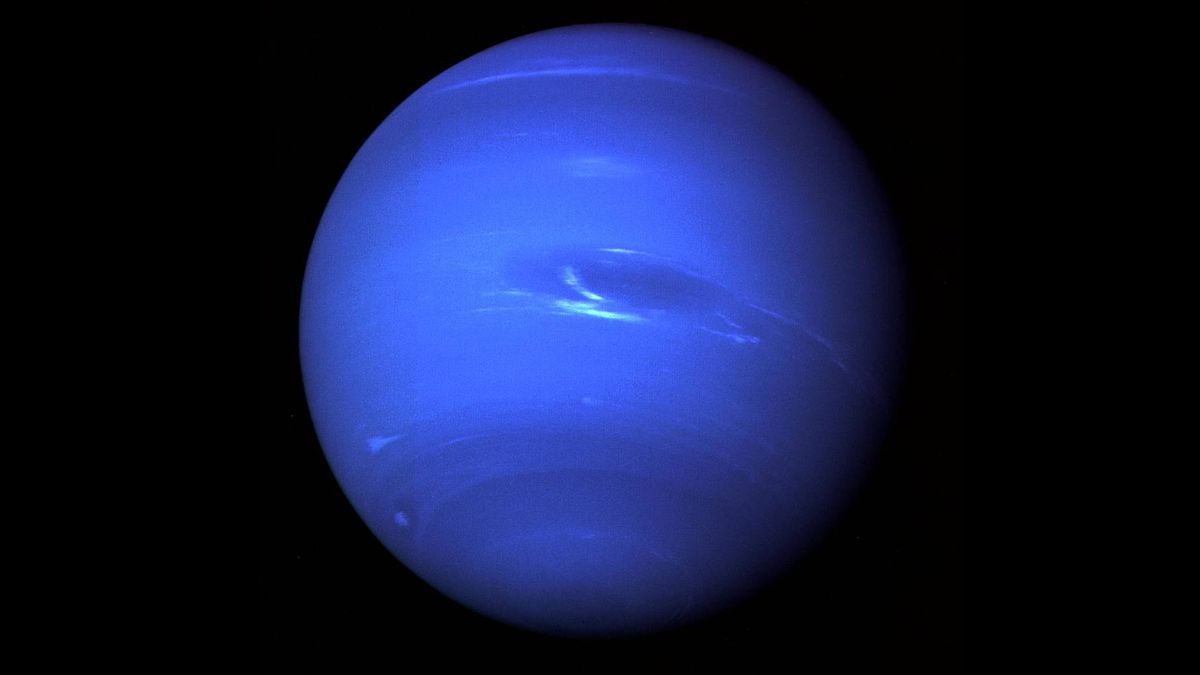
The authors conclude that the hcp form of superionic ice may exist deeper within the interiors of Uranus and Neptune than commonly assumed fcc ice. They say this could affect models of the stratification and dynamics of the planets’ superionic mantles because hcp ice may have mechanical and electrical transport properties different from those of fcc ice.
They emphasize that those properties remain to be established. In particular, they call for further theoretical work on the mechanical plasticity and electrical conductivity of hcp ice, along with additional experiments to determine more completely the pressure-temperature stability ranges of the hcp and fcc phases.
The study was published in Physical Review Letters.