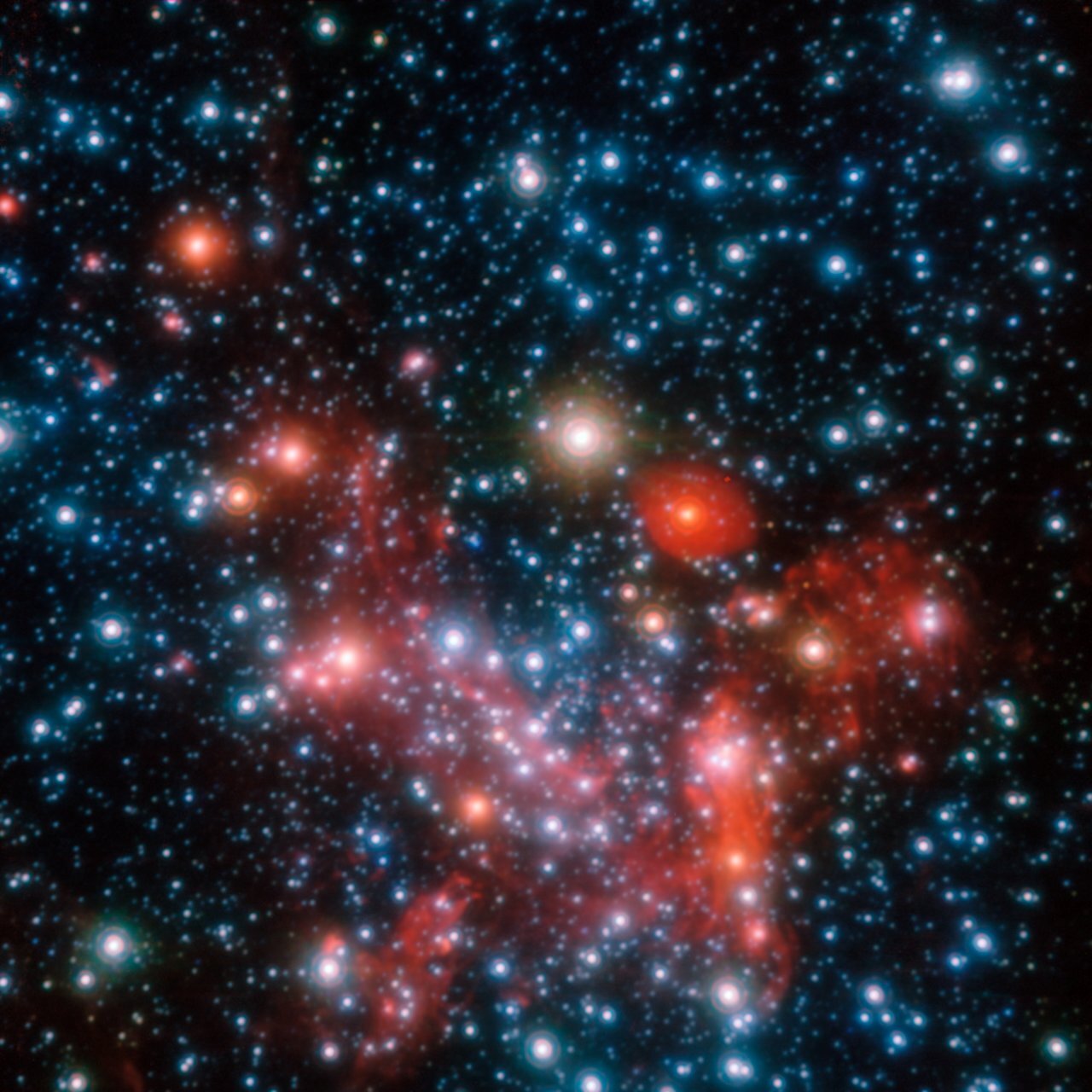
Deep in the Milky Way’s center, young stars orbit the supermassive black hole Sagittarius A in a population known as the S cluster. Many of those stars are B-type stars only a few million years old, yet they have a noticeably lower binary fraction than massive stars elsewhere in the Galaxy. New dynamical modeling suggests that the difference can arise naturally if the stars formed where they are now: repeated gravitational encounters with Sagittarius A would have destroyed or merged many of their original binary systems.
The S cluster occupies the central roughly 0.04 parsec of the Milky Way, surrounding Sagittarius A*, the Galaxy’s supermassive black hole. Its young population is dominated by B-type stars, with individual ages below about 15 million years and a mean age of roughly 6 million years. Their orbits have a thermal distribution of eccentricities and randomly oriented angular momentum vectors.
Their youth creates what astronomers have called the “paradox of youth.” The intense tidal environment close to Sagittarius A* makes ordinary star formation difficult because molecular clouds are prevented from fragmenting under typical conditions. Yet the young S stars are there.
One proposed explanation is that the stars formed in place from a gas shell compressed by a brief outflow from Sagittarius A* about 6 million years ago. In this scenario, the compressed shell fragmented to produce the S stars, while the nearby clockwise disk formed through molecular-disk fragmentation. The model can account for the similar ages of these populations as well as the distinctive orbital properties of the S stars.
But the binary stars in the S cluster present another clue.
Massive stars in the Galactic field have a binary fraction of about 69%, while previous observations placed the S-cluster fraction substantially lower. That difference raises a straightforward question: if the S stars formed in place with a binary population resembling massive stars elsewhere, what happened to the missing binaries?
The new analysis proposes that Sagittarius A* itself can provide the answer.
The observed binary fraction
The researchers first reassessed the observational constraint on S-cluster binaries using radial-velocity semi-amplitudes, known as K amplitudes. A binary system can produce detectable changes in a star’s radial velocity as the two stars orbit each other, while a single star was represented in the simulations by a K amplitude of zero.
They followed the Monte Carlo approach used in earlier work but made two important changes. The simulations excluded binary systems that were not initially stable against either the Roche limit or the Hill sphere, because such systems would be expected to merge or become unbound. They also added D9, a recently identified binary system in the S cluster.
D9 was particularly useful because its estimated age of about 3 million years is comparable to the ages of the young S-cluster stars. The researchers calculated a radial-velocity semi-amplitude of about 9 kilometers per second for D9 and incorporated it into the existing observational constraints.
The resulting simulations allowed a binary fraction between 34% and 52%, giving an observational estimate of
fobs = 0.43 ± 0.09
at the 2σ confidence level.
That leaves a substantial population of binaries. Any explanation for the S cluster therefore has to account not only for the low overall fraction but also for the fact that some binaries clearly survived.
Simulating binaries around Sagittarius A*
To test whether the black hole could reduce the binary population to the observed level, the researchers modeled 105 binary systems orbiting Sagittarius A*. The systems were generated using the observed orbital distributions of S-cluster stars and the measured distributions of massive binaries. Each system was then evolved for 1 million years with an N-body code that includes first post-Newtonian corrections and uses an adaptive time step for close encounters.
Three outcomes emerged. Some binaries were disrupted by tidal interactions with Sagittarius A*, some merged through the Lidov-Kozai mechanism, and others remained intact throughout the simulations.
The result was a clear division among the simulated systems: about 20% were disrupted, 18% merged and 62% survived. The strongest disruption occurred when binaries passed closest to Sagittarius A*, where the black hole’s tidal forces were greatest.
The merger process was linked to the Lidov-Kozai mechanism, in which gravitational perturbations from the central black hole can cause the inclination and eccentricity of a binary’s orbit to exchange over time. This can drive the inner orbit toward unstable configurations and facilitate mergers.
Starting with ordinary massive-star binarity
The researchers then asked what would happen if the S stars had initially possessed the same binary fraction measured for massive stars in the Galactic field.
Using the field value of 69% ± 9%, they considered a population of 100 stars containing 69 binaries and 31 single stars. After the simulated evolution, 62% of the original binaries survived, 20% were disrupted and 18% merged.
That leaves 43 surviving binary systems. Disruptions produce 28 single stars, while mergers produce another 12 single stars. The resulting population therefore contains 43 binaries and 71 single stars, corresponding to a theoretical binary fraction of
ftheo = 0.38 ± 0.10
at 2σ.
That theoretical value is consistent with the observational estimate of 0.43 ± 0.09. The agreement is the central result of the analysis: the lower binary fraction does not require the S cluster to have formed with an unusually low number of binaries. Under the model, interactions with Sagittarius A* can reduce an initially field-like binary population to a fraction consistent with observations.
The binary fraction changes with distance
The simulations also produced a spatial pattern. Binaries were least common closest to Sagittarius A*, where tidal forces are strongest, while the binary fraction increased with distance from the black hole.
The researchers described this behavior with a cumulative Weibull distribution. Their best-fit parameters were k = 0.57 ± 0.02 and λ = 0.028 ± 0.001 parsec, with the uncertainties given at 2σ. The model uses the Galactic-field binary fraction as its asymptotic value and includes the tidal limit of Sagittarius A*.
When extended to larger distances, the modeled profile remained below the upper limit reported at roughly 0.02 parsec. At about 0.04 parsec, where the researchers derived their updated observational limits, the predicted fraction falls within those limits. It is also consistent with the lower limit reported at roughly 0.4 parsec by another observational study.
The spatial agreement supports the authors’ interpretation that the declining binary fraction toward Sagittarius A* is primarily produced by the increasingly strong tidal field rather than requiring separate formation mechanisms for the stellar populations in the region.
The effect of binary evaporation
The 1-million-year simulations do not cover the full estimated age of the young S-star population, which is about 6 million years. The researchers therefore also considered another process that could remove binaries over the additional 5 million years: evaporation caused by interactions with other stars in the cluster.
Their calculation found that about 8% of the binaries surviving the first million years would evaporate during the following 5 million years. Applying that correction reduces the surviving-binary fraction from 62% to 57%. The corresponding theoretical binary fraction at 6 million years becomes 0.34 ± 0.09, still consistent with the observational constraint and with the theoretical fraction obtained from the main simulations.
What this says about the S cluster’s origin
The authors interpret the combined observational and dynamical results as support for an in situ origin of the S cluster, such as formation through gas-shell fragmentation. In that picture, massive binaries form near Sagittarius A* rather than arriving there later through migration or relaxation. Their subsequent interactions with the black hole alter the binary population, leaving fewer systems close to the center while allowing more binaries to remain farther out.
The scenario also fits the authors’ treatment of the S cluster’s stellar composition. Their model considers O- and B-type stars forming close to Sagittarius A*. The authors note that O-type stars are efficiently depleted through direct collisions with the black-hole population within about 5 million years, whereas B-type stars can survive for up to about 55 million years. They argue that this provides a natural explanation for why the currently observed young S-cluster population is dominated by B-type stars.
The simulations therefore do not eliminate the “paradox of youth” by changing where the young stars are found. Instead, they offer a way for the unusual binary population to arise after stars have formed in the immediate vicinity of Sagittarius A*. The authors conclude that the observed decline in binarity toward the black hole can be produced primarily by the increasingly strong tidal environment there.
The study was published in Astronomy & Astrophysics.