Preparing a quantum state that once required thousands of driving periods could instead take just a single period, according to a new Floquet-control method. Using quantum lattice gates, the method directly constructs the unitary operation needed to transform an initial state into a chosen bosonic state. Numerical simulations show that the approach can prepare binomial, cat and GKP quantum-error-correction codes with infidelities below 10⁻⁵, while logical single-qubit gates can reach errors on the order of 10⁻⁴.
Bosonic codes encode quantum information in the states of a harmonic oscillator rather than distributing it among large numbers of physical qubits. The approach can provide redundancy for protecting quantum information, but useful bosonic error-correction codes require carefully engineered states inside the oscillator’s otherwise infinite-dimensional Hilbert space.
One existing route uses Floquet engineering, in which a system is driven periodically so that its behavior over each cycle can be described by an effective, time-independent Hamiltonian. Quantum lattice gates, or QLGs, have provided an analytical framework for preparing and manipulating bosonic codes with this approach. The problem is that earlier protocols rely on slow adiabatic ramps and can require thousands of driving periods.
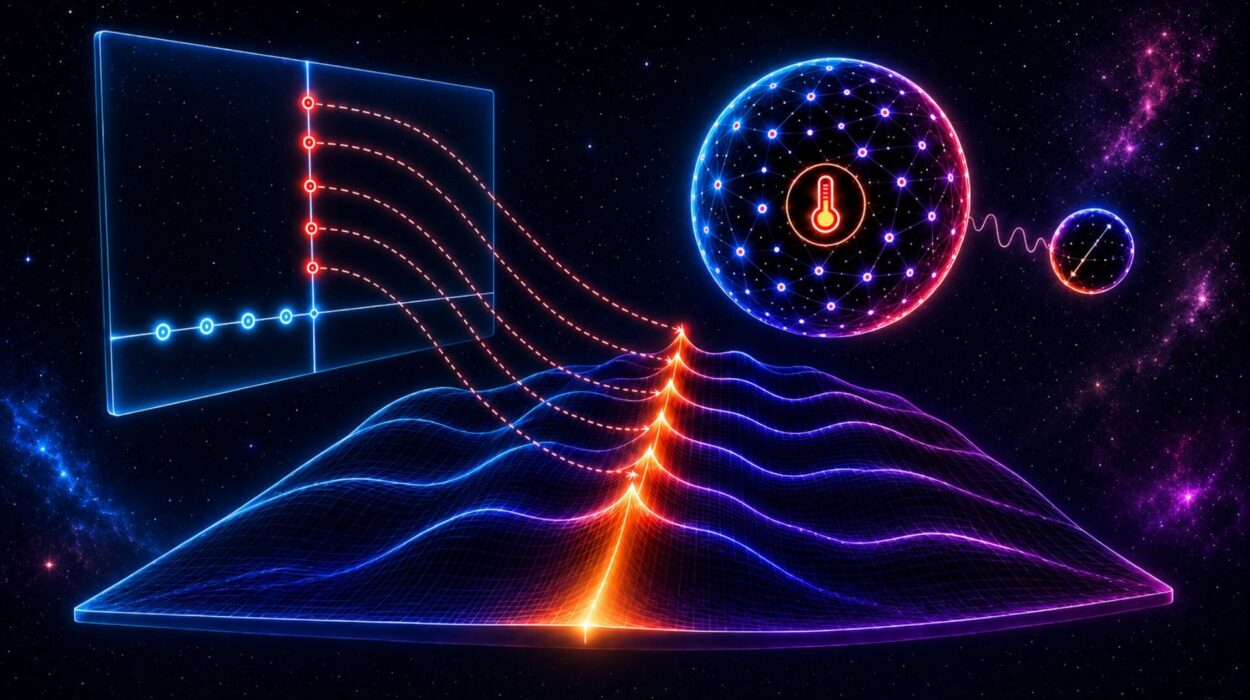
The new approach abandons that adiabatic step. Instead of slowly steering the oscillator toward a desired state, the researchers construct a unitary operation that takes a known starting state directly to the chosen target state. The entire transformation is designed to fit inside one Floquet period.
The key mathematical step uses a Householder construction. Given an initial state and a target state, the construction produces a closed-form unitary that maps one onto the other without requiring an adiabatic process. The resulting unitary is then converted into a target Hamiltonian and decomposed into elementary QLG operations.
Turning an arbitrary unitary into physical driving pulses
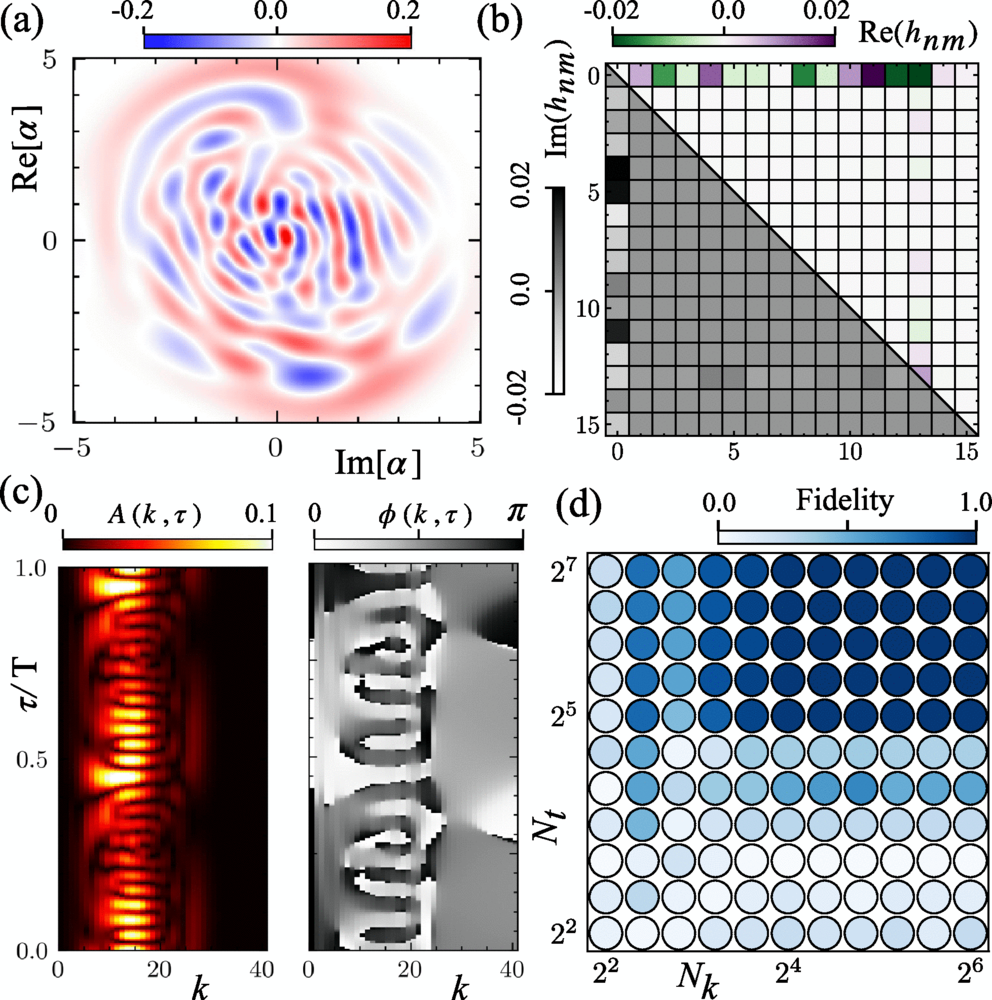
The method begins by considering a target unitary acting on a truncated, finite-dimensional portion of the oscillator’s Fock space. The researchers represent its corresponding Hamiltonian in phase space using a noncommutative Fourier transformation.
That representation expresses the target Hamiltonian as a superposition of cosine-type potentials. Each component has a wave number, amplitude and phase that vary during the Floquet cycle. In principle, these cosine components can be implemented physically using optical lattices in ultracold-atom systems or Josephson-junction potentials in superconducting circuits.
The continuous driving potential is then approximated through a Trotter-Suzuki decomposition. This produces a sequence of QLG operations, with separate discretization steps controlling the sampling of time and wave number. Higher-order Trotter-Suzuki expansions and adaptive optimization can further suppress the associated approximation errors.
In a numerical example, the procedure starts with the vacuum state and targets a randomly selected nonclassical state. With a 15-dimensional truncated Hilbert space, 26 time slices and 40 wave-number slices, the simulated preparation reaches a fidelity of at least 0.99. The simulations also show that the error from slicing the evolution in time is more pronounced than the error associated with the wave-number discretization for that example.
The preparation is completed within one Floquet period. The authors compare this timescale with the thousands of periods required by the earlier adiabatic-ramping approaches and report that the single-period protocol is at least three orders of magnitude faster in the comparison presented.
The same control also reproduces random quantum-state statistics
The researchers next tested whether the method could produce more than carefully selected individual states. They used Haar-random states as a benchmark for controllability in high-dimensional quantum spaces.
A Haar-random state is sampled uniformly from the unit sphere of a finite-dimensional Hilbert space. For such states, the fidelity with a fixed reference Haar state follows a known probability distribution, with an average fidelity of 1/d for a d-dimensional space.
The researchers generated Haar-random target states, constructed a corresponding single-period unitary for each one, and then approximated those unitaries using QLG sequences. The required Trotter depth grows approximately linearly with the Hilbert-space dimension. Choosing a time-slicing depth of twice the dimension produced preparation fidelities above 0.98 for dimensions of 2, 8, 32 and 128 in the reported simulations.
The resulting states also retained the expected Haar statistics. Fidelity distributions generated by the QLG protocol agreed with the analytical Haar distribution, while their mean fidelities approached the theoretical value of 1/d. The authors therefore identify the protocol as a practical generator of pseudorandom states in continuous-variable systems.
Preparing three different bosonic code families
The researchers then applied the control method to three representative bosonic error-correction codes: binomial, cat and Gottesman-Kitaev-Preskill, or GKP, codes. They focused on preparing the logical-zero codeword for each type, starting from vacuum.
For the binomial code, the logical-zero state used in the simulations is a superposition of the vacuum and the four-photon Fock state. For the cat code, the researchers used a four-component superposition of coherent states and selected a coherent-state amplitude of 2.3447, described in the paper as the second sweet spot satisfying the Knill-Laflamme condition. The finite-energy GKP state was represented using a discrete phase-space grid with a Gaussian envelope.
The basic analytical QLG protocol can prepare these target states, but the researchers also developed an optimal pulse engineering procedure to reduce errors further.
Instead of keeping the driving strength constant throughout the Floquet period, they allow its envelope to vary across the time slices. A gradient-based optimization adjusts those amplitudes within a hardware-constrained range. The objective is to minimize state-preparation error for codewords or logical-gate error for operations on the encoded qubit.
For the three bosonic codes, the simulated state-preparation infidelity falls rapidly as the number of time slices increases and eventually saturates around 10⁻⁶ in the reported calculations. Relaxing the control bound also improves the optimized results. With the specified control range, optimal pulse engineering reduces the infidelity from about 10⁻² to below about 10⁻⁵.
Logical gates reach errors near 10⁻⁴
The same framework can operate directly on the two-dimensional logical spaces formed by the bosonic codewords. The researchers tested randomly selected single-qubit unitaries as well as the standard Hadamard, phase and π/8 gates.
For 100 randomly sampled logical gates, the simulated gate-error distributions for the binomial, cat and GKP codes were all unimodal, with medians ranging from roughly 10⁻² to 10⁻³. With optimal control, the three elementary gates had errors of approximately 10⁻⁴ or less across all three codes.
The authors compare those simulated errors with reported state-of-the-art performance for superconducting single-qubit gates. The comparison is presented as a numerical benchmark rather than an experimental demonstration of the QLG protocol.
Shorter control also changes the noise comparison
The paper includes a numerical comparison between the new single-period method and earlier adiabatic-ramping approaches under identical noisy conditions.
The adiabatic-ramping protocol requires roughly 10³ Floquet periods in the comparison and has a reported infidelity of 10⁻², with a robustness measure of 10⁻³. A machine-learning-assisted version requires roughly 10² periods and has the same reported infidelity, while the single-period method takes order-one Floquet periods. Without optimal pulse engineering, its reported infidelity is 10⁻² and its robustness is 10⁻². With optimal pulse engineering, the single-period method retains the order-one timescale while reaching an infidelity of 10⁻⁵ and a robustness of 10⁻¹ under the specified noise model.
The shorter operation time is therefore accompanied, in these simulations, by greater tolerance to the noise considered in the benchmark. The authors emphasize that the robustness values are defined within their particular numerical noise model as the maximum noise strength that still permits code-state preparation above 0.99 fidelity.
Fewer adjustable parameters than a SNAP-based approach
The researchers also compared QLG control with a commonly used continuous-variable approach based on displacement and SNAP gates.
In the SNAP construction used for the comparison, each circuit layer contains parameters associated with number-dependent phases as well as a complex displacement. For a Hilbert space of dimension d and L layers, that gives L × (d + 2) trainable real parameters. The QLG circuit, by contrast, contains Nt trainable parameters in the optimization scheme used for the benchmark.
For a target infidelity of about 10⁻⁴, the simulations give a minimum resource scaling of approximately 2d trainable parameters for the QLG Ansatz, compared with approximately 5d for the SNAP Ansatz. The authors attribute the difference to the analytical construction used to initialize the QLG controls, which reduces the optimization burden. They also report faster convergence for QLG under the same optimization setup.
The central result is therefore not simply that a particular bosonic state can be prepared quickly. The researchers construct a general procedure that starts from an arbitrary initial state, determines a unitary connecting it to a chosen target, translates that unitary into a periodically driven Hamiltonian and implements the resulting control with quantum lattice gates, all within one Floquet period.
The work remains numerical. The authors describe possible extensions to two-qubit logical gates through two-mode noncommutative Floquet engineering and identify quantum communication, quantum reservoir computing and continuous-variable quantum designs among possible applications of the framework.
The study was published in Physical Review Letters.