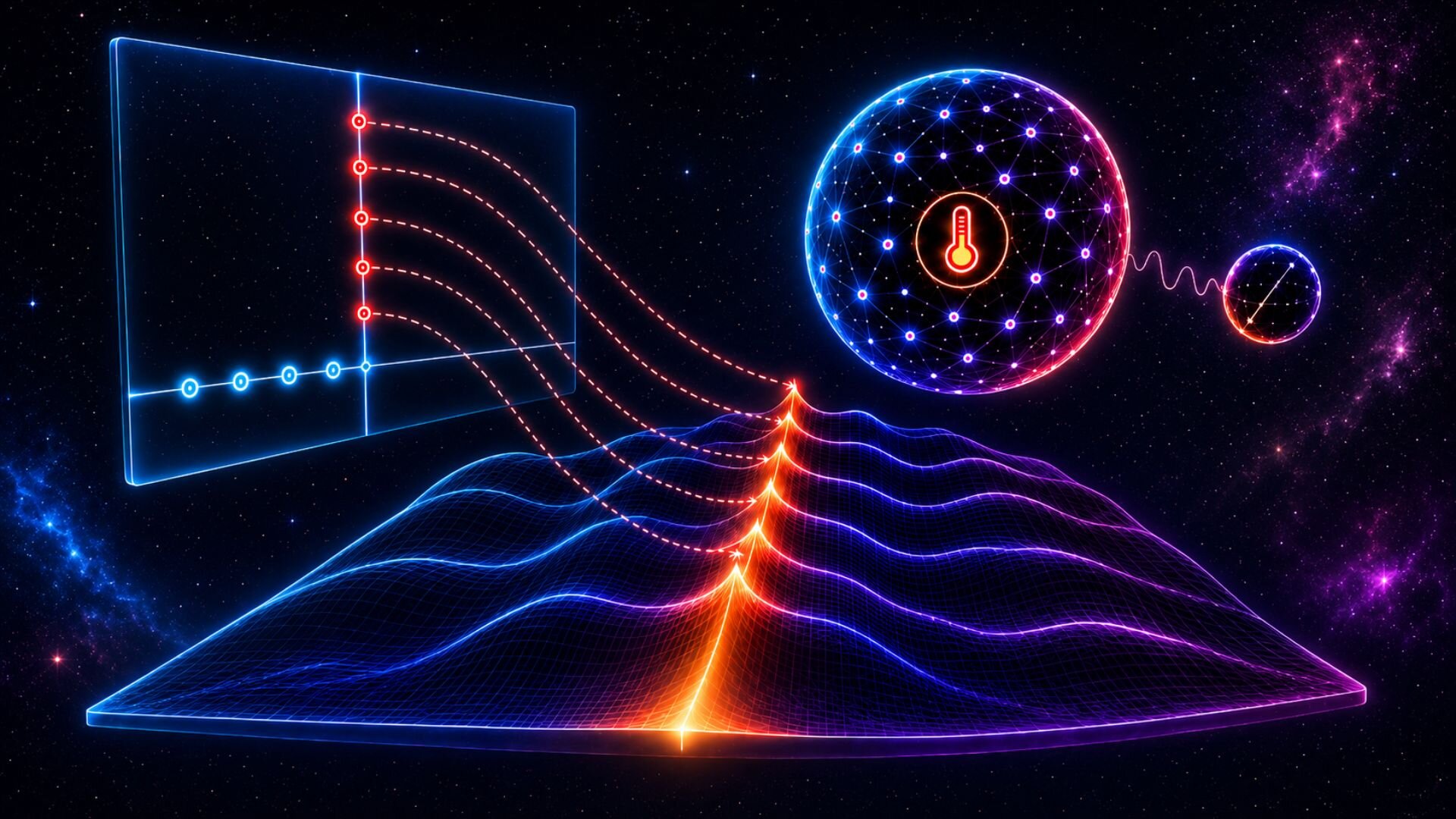
A carefully prepared quantum system settled into thermal equilibrium, was abruptly driven out of balance, and then repeatedly lost and regained quantum coherence at precise moments. Those recurring collapses matched the famous nontrivial zeros of the Riemann zeta function, allowing one of mathematics’ most enduring unsolved problems to be reformulated as the appearance of dynamical quantum phase transitions at a single special temperature inside an engineered quantum system.
For more than a century, mathematicians and physicists have searched for a deeper physical meaning behind the Riemann hypothesis, a famous conjecture about the nontrivial zeros of the Riemann zeta function. Those zeros play a central role in number theory, and understanding them has remained one of mathematics’ greatest unsolved challenges.
Rather than approaching the problem purely through mathematics, the authors of the new study constructed two engineered quantum many-body systems whose measurable behavior mirrors the zeta function itself. In their framework, the mysterious zeros do not merely resemble features of a quantum system—they become the exact moments when that system undergoes dynamical quantum phase transitions, abrupt changes that occur during nonequilibrium quantum evolution.
The researchers argue that this correspondence creates a direct bridge between number theory and quantum physics while offering a new way to investigate the hypothesis experimentally and computationally.
Turning the zeta function into quantum dynamics
The work begins with a specially designed quantum system whose energy levels follow a logarithmic pattern. After preparing the system in thermal equilibrium, the researchers suddenly drive it out of equilibrium using carefully engineered interaction Hamiltonians.
As the system evolves, they monitor two different quantum observables in two complementary implementations.
In the first system, they measure what they call the average accumulated phase factor. In the second, they track the Loschmidt amplitude, a quantity commonly used to study dynamical quantum phase transitions.
Both observables are constructed so that, in their respective limits, they reproduce the mathematical behavior of the Riemann zeta function.
The remarkable consequence is that whenever the zeta function reaches one of its nontrivial zeros, the corresponding quantum observable vanishes. Those vanishing points coincide with dynamical quantum phase transitions.
According to the paper, this establishes a one-to-one correspondence between the nontrivial zeros and these nonequilibrium quantum critical events.
Recasting the Riemann hypothesis as a physical statement
The authors’ central conceptual result is not simply that the zeta function appears in a quantum system.
Instead, they show that if the Riemann hypothesis is correct, these dynamical phase transitions occur only when the system is prepared at one specific inverse temperature, β = 1/2, known mathematically as the critical line.
In other words, the hypothesis can be reformulated as a statement about quantum matter.
Rather than saying that every nontrivial zero lies on the critical line, the hypothesis becomes equivalent to saying that a particular engineered quantum many-body system experiences these dynamical phase transitions only at that unique temperature.
The correspondence also works in reverse.
The paper argues that the Riemann hypothesis identifies what the authors describe as a previously unknown mechanism capable of generating dynamical quantum phase transitions.
The researchers further calculate the system’s free-energy density and entropy density. At the nontrivial zeros, the free energy becomes nonanalytic, while the entropy exhibits discontinuous jumps.
According to the authors, these jumps reflect changes in information flow within the quantum system. Slightly below a zero, increasing entropy corresponds to reduced quantum coherence and information flowing into internal degrees of freedom. Slightly above the zero, decreasing entropy reflects information flowing back and a partial recovery of coherence.
The paper interprets each nontrivial zero as a nonequilibrium critical point where the direction of information flow reverses.
Building a proof-of-principle experiment
To test the first quantum construction experimentally, the researchers used a five-qubit nuclear magnetic resonance quantum processor.
The platform consisted of nuclear spins inside a partially aligned 1-bromo-2,4,5-trifluorobenzene molecule dissolved in a liquid crystal solvent. Three fluorine nuclei and two hydrogen nuclei served as the five qubits, with one acting as a probe and the remaining four forming a 16-dimensional working system.
Preparing the desired quantum state required overcoming two major experimental challenges.
First, the researchers had to create thermal states with carefully engineered population distributions corresponding to the mathematical form required by the zeta function.
Second, they had to implement precisely controlled quantum evolutions that encoded the logarithmic energy spectrum.
The experimental protocol relied on analytically designed shaped radio-frequency pulses, pulsed magnetic-field gradients, SWAP operations, and control sequences optimized using gradient ascent pulse engineering.
According to the paper, these coherent operations achieved numerical simulation fidelities exceeding 99.5%.
Watching quantum coherence disappear exactly where mathematics predicts
The experimental program examined three situations.
In one, the inverse temperature was fixed at β = 0.5, corresponding to the critical line of the Riemann hypothesis, while the evolution time varied.
In another, the system was prepared at β = 0.3, away from the critical line.
A third experiment fixed the evolution time at the imaginary part of the first nontrivial zero while scanning across different β values.
The results differed dramatically between these cases.
When β = 0.5, the probe qubit repeatedly lost and recovered coherence over time. The moments when both the real and imaginary parts of the measured coherence approached zero aligned closely with known nontrivial zeros of the zeta function.
The experiment extracted coherence zeros near evolution times of 14.12, 20.96, 25.09, 30.44, and 32.93. These closely matched the theoretical zero locations of approximately 14.13, 21.02, 25.01, 30.43, and 32.94, respectively.
When the system instead operated at β = 0.3, the recurring vanishing-and-revival behavior disappeared, and the researchers observed no significant coherence zeros.
Scanning β while keeping the evolution time fixed produced another key result. The measured coherence displayed a clear minimum at β = 0.5, consistent with the proposed correspondence between the critical line and the occurrence of dynamical quantum phase transitions.
The calculated free-energy density likewise became singular when crossing the critical line as system size increased, matching the theoretical framework developed in the paper.
The researchers also observed another sequence of singularities along β = 1, which they attribute not to the Riemann hypothesis itself but to poles arising from the Dirichlet-series representation of the zeta function.
A second quantum construction reaches far larger zeros
While the nuclear magnetic resonance experiment demonstrated the basic idea, the paper introduces a second quantum construction designed to investigate much larger nontrivial zeros.
Instead of monitoring probe coherence, this approach uses the Loschmidt amplitude.
Numerical simulations showed that relatively small quantum systems already reproduce zeros with much larger imaginary parts.
A three-spin simulation captured zeros between imaginary values of 420 and 450.
Expanding to ten spins reached zeros with imaginary parts around 6.595 × 10⁶, corresponding to the 13,502,344th through 13,502,366th nontrivial zeros.
An eighteen-spin simulation extended the correspondence to the vicinity of the 10¹²th zero.
The paper reports that the agreement between estimated and exact zero locations improves as the evolution time increases, making the correspondence increasingly accurate for higher-order zeros.
Designing a scalable quantum algorithm
The study also introduces a gate-based quantum computing framework intended to implement both quantum constructions efficiently.
Rather than directly building many-body Hamiltonians containing exponentially many interaction terms, the algorithm reduces the task to two fundamental operations.
The first prepares the required thermal state, which encodes the real part of the complex argument of the zeta function.
The second simulates time evolution under a logarithmic Hamiltonian, encoding the imaginary part.
The authors show theoretically that both operations can be carried out with polynomial resources on a universal gate-based quantum computer.
Building on this framework, they analyze the computational cost of evaluating the zeta function using quantum methods.
According to the paper, locating and verifying nontrivial zeros within the relevant region of the complex plane can be achieved with computational complexity that scales with |t|^(1−β)/2, together with polynomial factors involving the desired precision and logarithms of relevant parameters.
The authors state that this reduces the dependence on |t| from the square-root scaling associated with direct Riemann–Siegel evaluation to at most |t|^1/4, yielding at least a quadratic speedup over the classical verification approach considered in their analysis.
What the work does—and does not—claim
The study does not claim to prove the Riemann hypothesis.
Instead, it establishes a mathematical correspondence between the hypothesis and engineered quantum dynamics.
Within that framework, the authors experimentally demonstrate the first quantum construction using a five-qubit processor and numerically investigate the second construction across extremely large nontrivial zeros.
They argue that this correspondence opens a new physical route for probing one of mathematics’ oldest open questions.
The discussion also points toward broader possibilities. Because the same framework naturally extends to other mathematical series and special functions, including Dirichlet L-functions, the researchers suggest it could become a foundation for new quantum benchmarks and future investigations connecting number theory, quantum information, and quantum many-body physics.
At the same time, they acknowledge that highly efficient classical methods already exist for evaluating the zeta function on the critical line. Their ongoing work, they write, aims to determine whether the quantum framework can accelerate the most computationally demanding components of those classical approaches rather than replace them outright.
Publication details
Shijie Wei et al, The Riemann Hypothesis manifested in dynamical quantum phase transitions, Nature Communications (2026). DOI: 10.1038/s41467-026-74935-8. On arXiv: arxiv.org/abs/2511.11199