Stellar streams around the Milky Way may carry irregularities that have nothing to do with dark matter. A new simulation suggests that the gravitational structure of a galaxy alone can bend, break and reshape these thin bands of stars, making it harder to identify which features might actually point to dark matter.
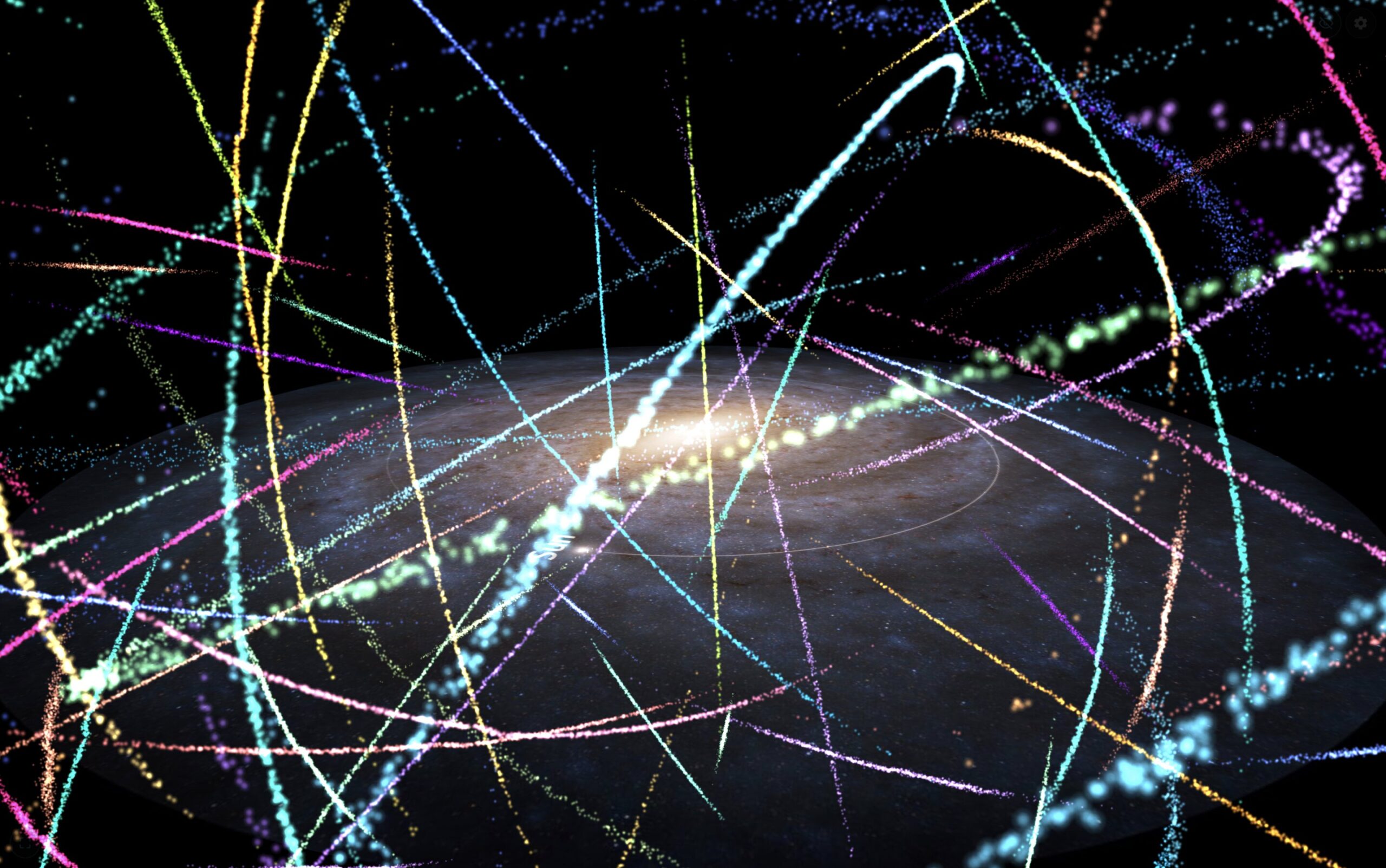
Stellar streams form when groups of stars encounter a galaxy and become trapped by its gravity. As the stars continue orbiting, the galaxy stretches the group into a long, narrow stream.
Astronomers have focused on these streams because many of those visible around the Milky Way are not smooth. They contain gaps, kinks and other changes in structure. One explanation is that small concentrations of dark matter, known as subhalos, could be pulling on the streams gravitationally.
That possibility makes stellar streams a potential way to investigate dark matter, which does not interact with light or ordinary matter except through gravity.
But before astronomers can identify irregularities caused by dark matter, they need to know how many irregularities a galaxy can produce on its own.
The galaxy itself can disrupt the streams
To investigate that question, astronomers created simulations of four galaxies roughly the size of the Milky Way. They deliberately left out dark matter clumps and placed about 15,000 stellar streams around the simulated galaxies.
They then allowed the simulations to evolve for five billion years.
The result was striking: irregularities appeared in nearly every stream.
The simulated galaxies had uneven distributions of stars across their disks, producing regions with different densities. As streams moved through those regions, the changing gravitational forces bent and disrupted them.
The simulations produced wiggles, kinks, spurs, branches, gaps and clumps. Some streams were completely torn apart. Streams closer to the centers of the simulated galaxies encountered dense, clumpy regions more often and developed more irregularities.
Only 70 of the roughly 15,000 streams remained perfectly smooth after five billion years.
That changes how stream irregularities can be interpreted
The finding does not rule out dark matter as a cause of unusual features in stellar streams. Instead, it identifies another source that needs to be separated from any dark-matter signal.
Lead author Arpit Arora said the researchers expected the host galaxies to create some irregularities, but were surprised by how widespread they were. The simulations indicated that streams are not necessarily born as or remain as perfectly thin, smooth structures.
That means an irregular stream cannot automatically be treated as evidence of a dark matter clump. The gravitational effects produced by the host galaxy itself have to be accounted for first.
The next step is to add dark matter clumps to the simulations. The researchers want to determine whether those clumps create patterns in stellar streams that can be distinguished from the irregularities produced by the host galaxy alone.
More observations could provide a test
Future observations may give astronomers many more streams to study. The Simonyi Survey Telescope at the NSF-DOE Vera C. Rubin Observatory is expected to find additional stellar streams in the Milky Way.
Those observations could help astronomers classify the different kinds of structures found in streams and look for features that could serve as fingerprints of dark matter.
The study was published in The Astrophysical Journal.