After brightening by more than 20 times in a short period, the galaxy SDSS J110546.07+145202.4 has continued emitting extraordinarily powerful radio waves for more than eight years, making it the first known example of a long-lasting radio transient of its kind. The unusual behavior is giving astronomers a rare opportunity to investigate how rapidly growing black holes launch powerful jets and evolve under extreme conditions.
Most radio outbursts from the centers of galaxies are fleeting. They flare for days or weeks before fading away. But one distant spiral galaxy has broken that pattern in dramatic fashion, remaining intensely bright in radio wavelengths for years and challenging astronomers’ understanding of how these energetic events unfold.
An international research team led by Stefanie Komossa from the Max Planck Institute for Radio Astronomy investigated the remarkable object using both newly collected observations and archival data spanning the electromagnetic spectrum, from radio waves to high-energy X-rays. Their findings have now been published in The Astrophysical Journal.
An Unusual Radio Outburst That Refuses to Fade
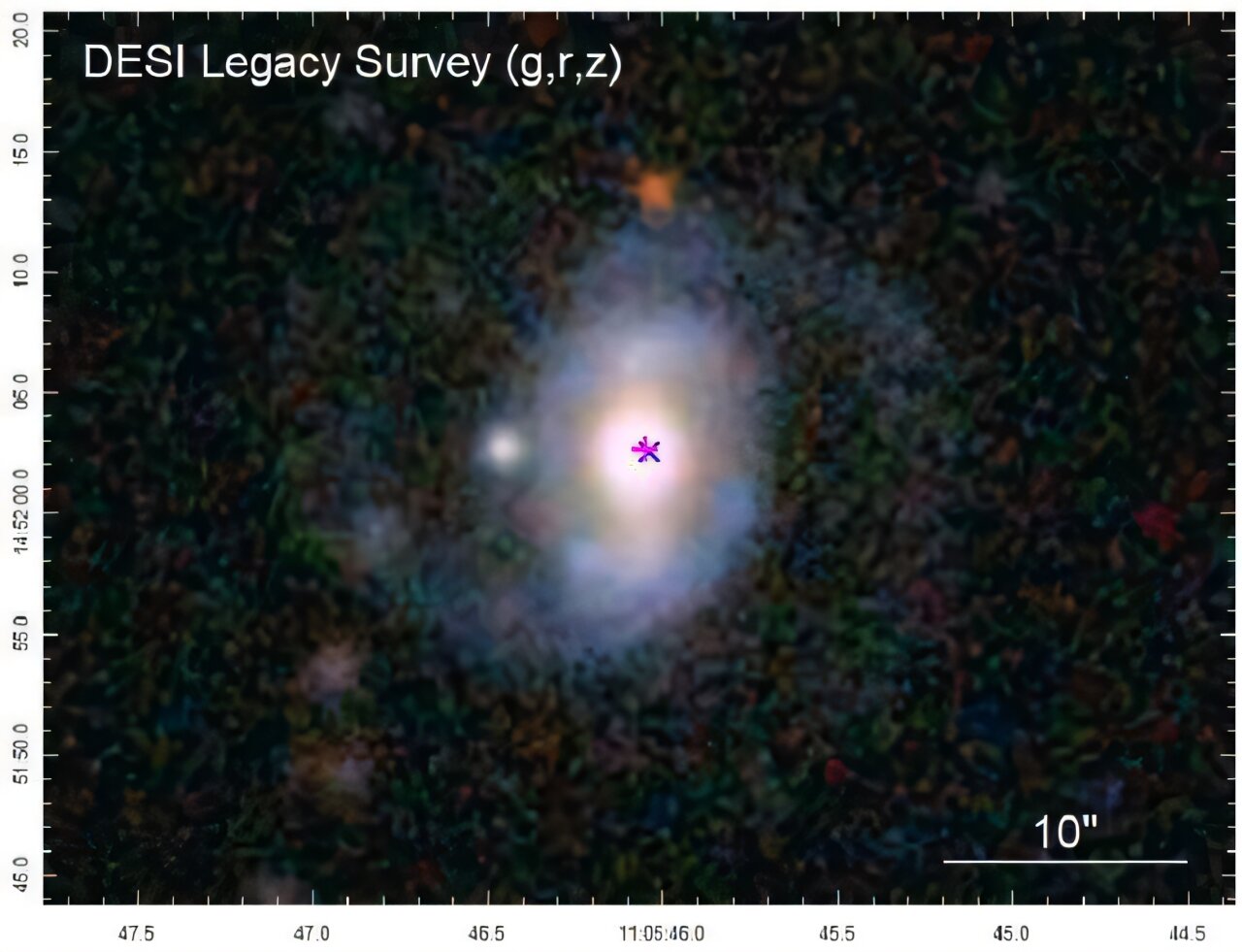
The spiral galaxy SDSS J110546.07+145202.4 lies approximately 1.8 billion light-years from Earth in the constellation Leo. What immediately caught astronomers’ attention was the dramatic increase in its radio emission.
The galaxy’s radio brightness rose by more than 20-fold within a relatively short time. Even more surprising, the emission has shown no indication of weakening, continuing to shine at an extraordinary level for over eight years.
Its radio output is estimated to be roughly 10 quadrillion (10¹⁶) times brighter than the Sun in the radio part of the electromagnetic spectrum, making it unlike previously observed radio transients associated with galactic centers.
According to co-author Phil Edwards from Australia’s national science agency, CSIRO, the object appears to represent the prototype of an entirely new class of galaxies capable of undergoing rapid yet long-lasting changes in radio emission.
A Rapidly Growing Black Hole Appears to Be Driving the Event
The powerful radio emission originates near the galaxy’s central supermassive black hole.
Unlike many of the enormous black holes found in galactic centers, this one has a comparatively low mass. However, researchers found evidence that it is currently growing at an exceptionally rapid rate by drawing in surrounding matter through accretion.
Lead author Stefanie Komossa noted that luminous radio emission from lightweight black holes experiencing rapid growth is already uncommon. Observing one transition into a sustained radio-bright state that lasts for years has never been seen before.
To better understand the phenomenon, the research team combined observations from multiple ground-based and space-based facilities. These included the 100-meter Effelsberg radio telescope, CSIRO’s Australia Telescope Compact Array, and several space observatories capable of detecting high-energy X-rays.
The follow-up observations consistently confirmed that the source possesses highly unusual characteristics.
A Powerful Jet May Have Been Switched On
After analyzing the extensive collection of observations, the researchers suspect that the prolonged radio emission is linked to a sustained increase in material falling toward the central black hole.
As more matter spirals inward, it may have triggered the formation of a jet—a narrow beam of particles traveling at nearly the speed of light that produces intense radio emission.
Although this explanation fits the available data, important questions remain unanswered. Scientists still do not know exactly why the inflow of matter increased or why the resulting outburst has continued for such an unusually long period without fading.
Those mysteries make the galaxy especially valuable for future study.
A Nearby Window Into Conditions Similar to the Early Universe
One reason this galaxy is particularly important is that its central black hole combines two unusual characteristics: low mass and rapid growth.
These are precisely the kinds of properties astronomers expect to find in galaxies that existed in the early universe. However, those distant systems are far more difficult to observe in detail.
By comparison, SDSS J110546.07+145202.4 resides in what researchers describe as our cosmic neighborhood, allowing astronomers to collect much richer observations than would be possible for similarly evolving galaxies located much farther away.
That makes the galaxy an exceptional natural laboratory for studying how black holes evolve and how energetic jets are formed under extreme physical conditions.
Co-author Kovi Rose from the University of Sydney’s Sydney Institute for Astronomy explained that energetic events like these offer valuable opportunities to investigate some of the universe’s most extreme environments. Careful observations of the jets and their outbursts can reveal the physical processes that govern their formation and evolution.
Future Observations Could Reveal Even More
The researchers are not finished studying this remarkable object.
Future observations with the Very Long Baseline Array (VLBA) are expected to produce highly detailed maps of the jet’s structure while allowing astronomers to monitor how the radio emission changes over the coming years.
Looking further ahead, the team also expects next-generation facilities such as the SKA telescopes to transform the search for similar objects across the sky.
With their increased sensitivity, these instruments should be capable of discovering additional long-lived radio transients, helping scientists determine whether SDSS J110546.07+145202.4 is truly unique or simply the first known member of a previously overlooked population.
Why This Matters
The discovery of SDSS J110546.07+145202.4 challenges the long-standing expectation that radio transients near galactic centers are only short-lived events. Its more than eight-year radio outburst, driven by what appears to be a rapidly growing, relatively lightweight black hole, points to the possibility of an entirely new category of black hole activity.
Because the galaxy can be observed in far greater detail than similar systems from the early universe, it provides an invaluable opportunity to investigate how black holes accumulate matter, launch powerful jets, and shape their surrounding environments. As future observatories identify more examples like this one, astronomers hope to close important gaps in our understanding of black hole evolution and the physical conditions that existed during the universe’s earliest stages.