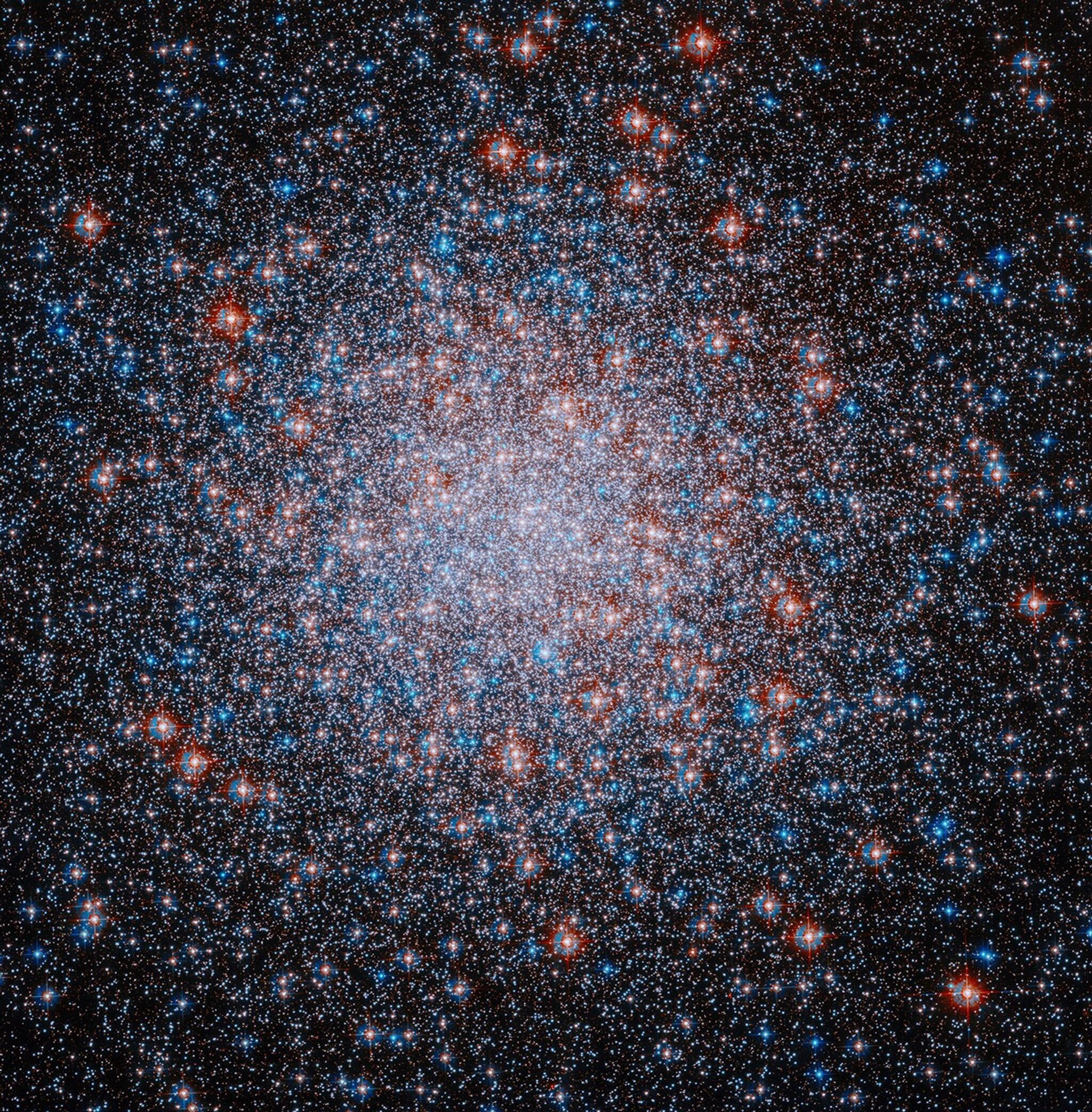
More than 500,000 stars light up a spectacular new image from NASA’s Hubble Space Telescope, released to celebrate the United States’ 250th anniversary. The dazzling view highlights Messier 3 (M3)—one of the Milky Way’s most massive globular clusters—and showcases unusual stellar populations that are helping astronomers piece together how our galaxy formed.
The latest Hubble image is far more than a striking cosmic portrait. Packed with hundreds of thousands of stars glowing in shades of red, white, and blue, it captures one of the Milky Way’s oldest and most intriguing stellar systems.
Known as Messier 3 (M3), or NGC 5272, this massive globular cluster stands out not only because of its enormous population of stars but also because of its remarkable collection of rare stellar objects. Together, these features make M3 an important target for astronomers seeking to understand the history of the Milky Way.
An Ancient Stellar City on the Outskirts of the Milky Way
Globular clusters are dense, spherical collections of stars held together by gravity. Unlike many other stellar groupings, the stars within a globular cluster generally formed at roughly the same time from the same cloud of gas. As a result, they share similar ages, making these clusters valuable records of the early universe.
Around 150 known globular clusters are scattered throughout the outer regions of the Milky Way, and M3 ranks among the galaxy’s most massive examples.
What makes M3 especially unusual is its location. It lies relatively far from the center of the Milky Way, setting it apart from many other globular clusters. Yet its most distinctive characteristics go well beyond where it resides.
Home to the Milky Way’s Largest Collection of RR Lyrae Variable Stars
One of M3’s most remarkable features is its extraordinary population of more than 240 RR Lyrae variable stars—the largest number found in any known globular cluster within the Milky Way.
These ancient stars are especially valuable because their brightness changes over time in a predictable way. By observing these fluctuations, astronomers can determine each star’s intrinsic brightness.
Once that true brightness is known, it becomes possible to estimate how far away the star is. The principle is similar to judging the distance of an approaching car by comparing the apparent brightness of its headlights with how bright they are known to be.
Because RR Lyrae stars are among the oldest stars in the galaxy, they also provide an important window into the Milky Way’s distant past.
The Mystery of the Blue Straggler Stars
M3 also contains around 70 identified blue straggler candidates, making it another standout among globular clusters.
These stars appear unexpectedly bright and blue, giving the impression that they are much younger than the older, redder stars surrounding them. Their youthful appearance is surprising because globular clusters are generally composed of stars with similar ages.
M3 holds special significance because it was the first globular cluster where these unusual stars were identified.
Astronomers believe these stars have been “rejuvenated” by pulling mass away from companion stars through gravitational interactions. This added material makes them hotter and brighter, allowing them to appear younger than they actually are despite sharing the same ancient origins as their neighboring stars.
A Possible Collision Between Two Ancient Star Clusters
The unusual mix of stars inside M3 may point to an equally unusual history.
According to astronomers, the cluster contains two distinct populations of stars, suggesting it could have formed through the merger of two globular clusters rather than evolving as a single system.
Those two original clusters are thought to have belonged to the same dwarf galaxy. At some point in the past, that dwarf galaxy was swallowed by the Milky Way, bringing its globular clusters with it. If this scenario is correct, M3 preserves evidence of an ancient galactic event that became part of the Milky Way’s own evolution.
What the Colors in the Hubble Image Reveal
The vivid colors in the new Hubble image are not simply artistic choices. They represent specific wavelengths of light recorded by the telescope.
In this image, blue corresponds to shorter wavelengths of visible light, while red represents longer visible wavelengths along with some near-infrared light.
Hubble’s images are processed using standard techniques that assign colors based on the wavelengths passing through the telescope’s filters. Because a star’s color is directly related to its temperature, the image also provides valuable scientific information.
The blue stars are hotter, while the red stars are cooler, allowing astronomers to better understand the different stellar populations packed within the cluster.
Hubble’s Long-Term Mission to Reconstruct the Milky Way’s Past
This latest view of M3 is part of a Hubble Treasury program that aims to observe approximately half of the Milky Way’s globular clusters.
The goal is to assemble a detailed chronology of how our galaxy formed over time. By studying ancient clusters like M3 and comparing their properties, astronomers can build a clearer picture of the Milky Way’s history.
Hubble has been observing M3 for years, documenting its complex stellar populations and unusual characteristics. After more than 30 years of observations, the telescope continues to play a central role in exploring the universe.
Its work complements that of other NASA observatories, including the infrared-sensitive James Webb Space Telescope and the upcoming Nancy Grace Roman Space Telescope, as scientists combine observations from multiple missions to develop an increasingly complete view of the cosmos.
Why This Matters
The new Hubble image is more than a celebration of a historic milestone—it is a detailed scientific record of one of the Milky Way’s most fascinating stellar systems. With over 500,000 stars, the galaxy’s richest known collection of RR Lyrae variable stars, dozens of mysterious blue stragglers, and evidence that it may have formed through the merger of two ancient clusters, M3 offers astronomers multiple clues about the Milky Way’s earliest history. Every observation adds another piece to the larger effort to understand how our galaxy came together and how its oldest stars continue to preserve the story of its formation.