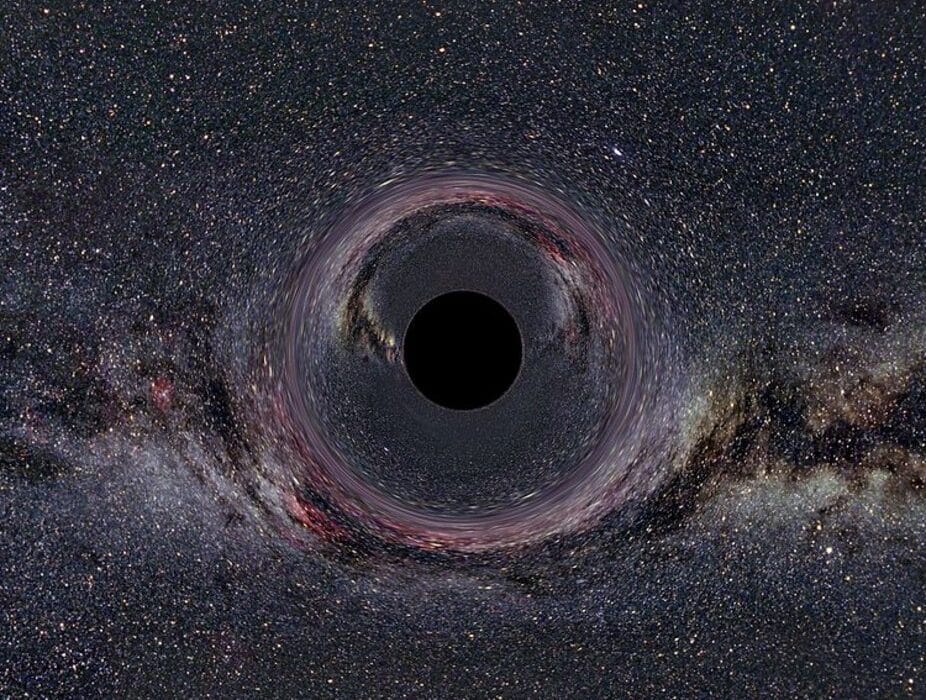
Black holes rarely remain unchanged, yet the standard laws used to describe their thermodynamic behavior were built for idealized, unchanging conditions. New research proposes a different way to define black hole entropy in dynamic situations, offering a framework that could improve how physicists study black holes as they form, merge, and evaporate.
Black holes are among the most extreme objects known in the universe. Their enormous mass is compressed into remarkably small regions, creating gravitational fields so powerful that even light cannot escape. For decades, physicists have relied on ideas connecting Einstein’s theory of general relativity with thermodynamics to understand these mysterious objects. Now, researchers say one of the field’s foundational approaches may need an important update.
Published in Physical Review Letters and highlighted as an editor’s suggestion, the new study introduces an alternative way to measure entropy, a fundamental thermodynamic quantity that, according to the second law of thermodynamics, can never decrease. Unlike previous approaches, the proposed method is designed to work even when black holes are actively changing.
A Longstanding Limitation in Black Hole Physics
For more than 50 years, physicists have relied on the laws of black hole mechanics developed in the early 1970s by Stephen Hawking and other researchers. These laws established striking parallels between the behavior of black holes and familiar thermodynamic systems, linking some of the universe’s most extreme objects to the same principles that describe everyday physical processes.
According to Abhay Ashtekar, leader of the research team at Penn State, those laws have served as the standard framework for decades but come with an important restriction.
They were formulated for black holes that exist in equilibrium, meaning their properties remain unchanged over time. Real black holes, however, do not stay in that state. They are continually evolving as they form, absorb matter, merge with other black holes, and eventually evaporate.
The researchers set out to remove this limitation by extending thermodynamic laws to black holes that are out of equilibrium.
How Hawking Changed the Understanding of Black Holes
Before Hawking’s work, black holes appeared difficult to reconcile with thermodynamics.
As explained by study co-author Daniel E. Paraizo, because nothing inside a black hole can be directly observed, physicists believed there could be infinitely many ways to create one. That implied infinite entropy. At the same time, black holes were thought to absorb energy without emitting anything, suggesting they had a temperature of zero.
Those ideas changed dramatically when Hawking applied quantum mechanics to black holes and showed they can radiate energy and particles.
That breakthrough transformed black hole thermodynamics from a largely mathematical concept into something with direct physical meaning. It also established analogies between black holes and familiar thermodynamic properties such as entropy and temperature.
Hawking proposed that the event horizon—the boundary beyond which light cannot escape—is proportional to a black hole’s entropy. He also related a black hole’s temperature to a combination of its mass and spin.
Why Event Horizons Become a Problem
While Hawking’s framework has been enormously influential, the researchers argue that it does not adequately describe black holes undergoing rapid change.
According to study co-author Jonathan Shu, the difficulty lies in the nature of event horizons themselves.
In dynamic situations, event horizons can form and expand even in otherwise quiet regions of space-time. Their behavior depends not only on what is happening locally but also on events that may occur in the future. Physicists describe this property as teleology.
Because of this future dependence, the researchers argue that the area of an event horizon cannot reliably represent the physical entropy of black holes that are actively growing, evaporating, or merging.
If scientists want to understand these evolving systems, they need a different approach.
Replacing Event Horizons With Dynamical Horizons
The new research proposes using dynamical horizons instead of event horizons when describing changing black holes.
Unlike event horizons, dynamical horizons are defined entirely by a black hole’s properties at a specific moment in time. That means they avoid the teleological problem associated with event horizons.
Using this framework, the researchers developed an alternative measure of entropy that is more directly connected to a black hole’s physical characteristics, including its spin and energy.
Because the new approach depends only on the black hole’s current physical state, it provides a way to extend thermodynamic laws beyond idealized equilibrium conditions.
Extending the Laws of Thermodynamics
The proposed framework allows the first and second laws of thermodynamics to be generalized for black holes that are changing over time.
According to Ashtekar, this overcomes a limitation that has shaped black hole research for more than half a century.
Instead of applying only to static systems, the generalized laws could describe black holes throughout their dynamic evolution, offering physicists a new way to examine some of the universe’s most energetic events.
Opening New Paths for Black Hole Research
The researchers say the new entropy measure could improve studies of several important black hole processes.
One application involves understanding evaporating black holes within quantum theory. Another concerns black hole mergers, including those observed through gravitational waves by the LIGO-Virgo-KAGRA collaboration.
Because dynamical horizons are already used in numerical simulations of black holes, the researchers believe the new framework fits naturally into existing computational methods while providing a more physically meaningful description of evolving systems.
Why This Matters
Black holes are constantly changing, but the traditional thermodynamic framework describing them was built for objects assumed to remain unchanged. This new research challenges that mismatch by proposing an entropy measure tailored to dynamic black holes rather than idealized ones.
If the framework proves useful, it could provide physicists with a stronger foundation for studying how black holes evolve over time, from their formation and evaporation to dramatic mergers detected through gravitational waves. By extending thermodynamic laws beyond equilibrium, the work offers a new way to investigate some of the universe’s most extreme phenomena while building on the legacy of Hawking’s groundbreaking insights.