NASA’s Transiting Exoplanet Survey Satellite (TESS) has identified its first planet through gravitational microlensing, marking the mission’s first discovery using the warping of space-time rather than its traditional transit technique. The finding reveals the super-Jupiter Gaia23bra b and suggests that years of archived TESS observations may contain additional hidden worlds that were previously overlooked.
For nearly eight years, TESS has been known for finding planets by watching stars briefly dim as worlds pass in front of them. Now, the mission has demonstrated that it can do something entirely different.
Instead of detecting a planet through a stellar eclipse, researchers found one because its star and planet briefly bent and magnified the light of a much more distant background star. The result is the first confirmed microlensing planet discovered using TESS data, opening an unexpected new avenue for one of NASA’s most successful exoplanet missions.
A Discovery No One Expected TESS to Make
The newly identified planet, Gaia23bra b, was uncovered after astronomers revisited archived TESS observations following a microlensing alert first detected in 2023 by the European Space Agency’s retired Gaia space telescope.
According to University of New Mexico professor Diana Dragomir, the discovery was not something scientists anticipated when TESS launched.
“When TESS launched, no one expected it to ever be capable of finding this kind of planet,” Dragomir said. She added that the discovery suggests there are likely additional microlensing planets hidden within TESS’s existing observations that researchers had not previously considered searching for.
How the Planet Revealed Itself
Unlike planets discovered through the transit method, Gaia23bra b never passed directly in front of its host star from Earth’s perspective.
Instead, astronomers observed a phenomenon known as gravitational microlensing. During the event, the foreground star and its planet briefly aligned with a much more distant background star. The gravity of the foreground system bent the background star’s light, magnifying it as predicted by the warping of space-time.
The changing pattern of that brightening revealed the presence of the planet and allowed researchers to determine the mass ratio between the planet and its host star.
The event, known as Gaia23bra, was first recognized through Gaia observations. However, Gaia’s measurements alone were too sparse to reveal the planet itself.
Mallory Harris, a University of New Mexico Ph.D. candidate and first author of the study, explained that TESS happened to be observing the same region of the sky during the event.
Because TESS collected observations much more frequently, its data captured subtle features in the light curve that exposed the planet’s presence.
A Massive World Orbiting Far From Its Star
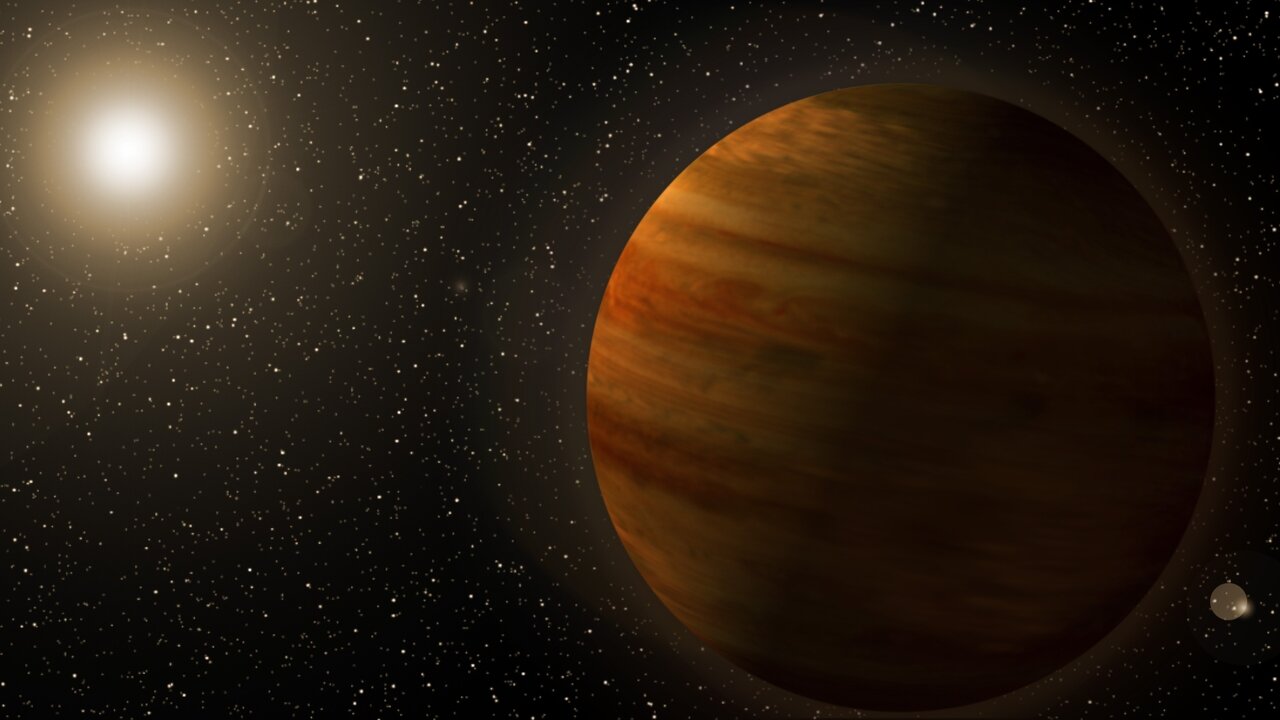
The team’s analysis, published on July 1 in The Astrophysical Journal Letters, showed that Gaia23bra b has a mass of approximately 1.63 times Jupiter’s mass.
The planet orbits an orange dwarf star with about 80% of the Sun’s mass at a distance comparable to Jupiter’s orbit around our own Sun.
That type of planetary system lies outside the strengths of TESS’s primary search method. The transit technique is particularly effective at finding planets that orbit close to their stars because those planets are much more likely to pass across the stellar disk from Earth’s viewpoint.
Gaia23bra b, by contrast, resides much farther away from its host star, making it effectively invisible to the transit approach despite being a massive planet.
Why Microlensing Finds Different Kinds of Planets
More than 6,000 exoplanets have been discovered so far, with roughly three-fourths found using the transit method. In comparison, less than 5% have been discovered through microlensing.
That difference reflects the strengths of each technique rather than their effectiveness.
Transit observations excel at finding planets close to their stars, while microlensing is especially sensitive to planets orbiting at Earth-like distances or even farther away. This makes it particularly valuable for studying planetary systems that resemble our own Solar System more closely.
Harris explained that planets orbiting very near their stars effectively blend with the star’s gravitational signal during microlensing events. Worlds located farther away, however, create distinct signatures that can be detected.
She noted that this allows astronomers to identify smaller planets at wider orbital distances, including planets within a star’s habitable zone and beyond.
Dragomir emphasized that the two detection methods complement each other rather than compete. Transit observations provide a planet’s size and, together with other techniques, can reveal its density. Microlensing instead supplies measurements of planetary masses and orbital distances for worlds that other methods would likely never detect.
A Rare Event Captured at the Right Moment
Microlensing events are fundamentally different from planetary transits because they do not repeat.
Once the alignment between stars ends, the opportunity disappears forever.
Harris noted that astronomers may someday discover an Earth-like planet through microlensing but never have another chance to observe that same event again.
Because of this limitation, each successful detection becomes especially valuable. As more microlensing planets are identified, researchers can begin studying how common wide-orbit planets are across the galaxy and better understand how planetary systems form and evolve.
These discoveries also help address gaps left by transit and radial-velocity surveys, both of which strongly favor planets orbiting close to their stars.
Archived TESS Data May Hold More Hidden Worlds
The discovery suggests Gaia23bra b may not be unique.
TESS has spent nearly eight years repeatedly observing large portions of the sky, including regions along the Galactic Plane where this planetary system is located.
Although Gaia23bra b is the first confirmed microlensing planet found in TESS observations, researchers believe similar events may already exist within the mission’s archive, waiting to be identified.
The success came from combining two different kinds of space-based observations. Gaia provided the long-term monitoring needed to identify the microlensing event, while TESS observed the same field every 200 seconds for nearly 60 days, capturing the fine details that revealed the planet.
Preparing for the Next Generation of Planet Hunting
Researchers also view Gaia23bra b as an important demonstration for the upcoming Nancy Grace Roman Space Telescope.
Harris said the planet is one of only a very small number of microlensing discoveries made using space-based observations, making it an important case study for future missions.
Roman is scheduled to launch in fall 2026 and is expected to discover approximately 1,000 microlensing planets along with around 100,000 transiting planets during one of its primary surveys.
Because Roman will observe with similarly continuous, high-frequency measurements, Gaia23bra b provides an early example of the scientific value such observations can deliver.
Meanwhile, TESS continues expanding its coverage toward the center of the galaxy. Although the crowded stellar environment of the Galactic Bulge presents challenges for TESS, Dragomir noted that the spacecraft naturally observes other regions of the Galactic Plane, allowing it to discover microlensing planets under different galactic conditions.
Why This Matters
The discovery of Gaia23bra b demonstrates that TESS can detect planets in a completely different way than originally intended, greatly expanding the mission’s scientific potential. It also points to the possibility that previously overlooked microlensing events remain hidden within nearly eight years of archived observations.
More importantly, the result reinforces the value of gravitational microlensing as a tool for finding planets at wide orbital distances—worlds that transit surveys often miss. By combining different detection techniques and preparing for future missions like the Nancy Grace Roman Space Telescope, astronomers are building a more complete picture of planetary systems across the galaxy, including those that may resemble our own.