About 430 light years from Earth, a cold and shadowy stretch of space quietly gives birth to stars. This place, known as the Taurus molecular cloud, does not announce itself with explosions or blazing light. Instead, it works patiently, assembling hundreds of young stars inside a vast stellar nursery. For astronomers searching for clues about how stars and planets first come into being, Taurus is more than a location. It is a rare opportunity to watch the universe while it is still learning how to walk.
The Taurus molecular cloud is young by cosmic standards, estimated to be only 1 to 5 million years old. That youth makes it especially valuable. At this age, planets, brown dwarfs, and stars are still forming, still changing, still carrying signatures of their earliest moments. For scientists, it is like opening a time capsule from the universe’s childhood.
It was into this quiet, formative region that a team of astronomers from the University of Hawai’i at Manoa and other institutions turned their attention, hoping to find something new.
Looking Deeper With Sharper Eyes
Led by Samuel A. U. Walker of UH Manoa, the research team set out to examine the Taurus star-forming region with fresh precision. Their goal was simple in spirit but demanding in execution. They wanted to search for new stars and companions hiding in the soft glow of this stellar nursery.
To do this, they relied mainly on the Keck II and Gemini North telescopes, powerful instruments capable of seeing faint objects at great distances. These observations became part of a larger effort known as KOINTREAU, an adaptive optics imaging survey designed to uncover exoplanets and ultracool dwarfs in young star-forming regions.
In their paper, published December 4 on the pre-print server arXiv, the researchers describe the project in their own words. “We present the first discoveries from Keck Observations in the INfrared of Taurus and ρ Oph Exoplanets And Ultracool dwarfs (KOINTREAU), an adaptive optics imaging survey of young stars in the Taurus and ρ Oph star-forming regions using the Keck infrared pyramid wavefront sensor (PyWFS),” they write.
This careful survey did more than just catalog stars. It revealed companions where none had been confirmed before.
Two Small Stars With Unexpected Company
As the astronomers analyzed their observations, two young ultracool dwarf stars in Taurus stood out. Known as XEST 17-036 and XEST 13-010, these faint, cool stars were not alone.
By measuring how nearby objects moved relative to each host star and combining that information with astrometry, the team was able to determine something crucial. The companions they observed were not random background objects drifting by. They were gravitationally bound, locked into orbit around their host stars.
For a region already known for its richness, this discovery added two more intriguing pieces to the puzzle.
A Planetary-Mass Companion in a Wide Orbit
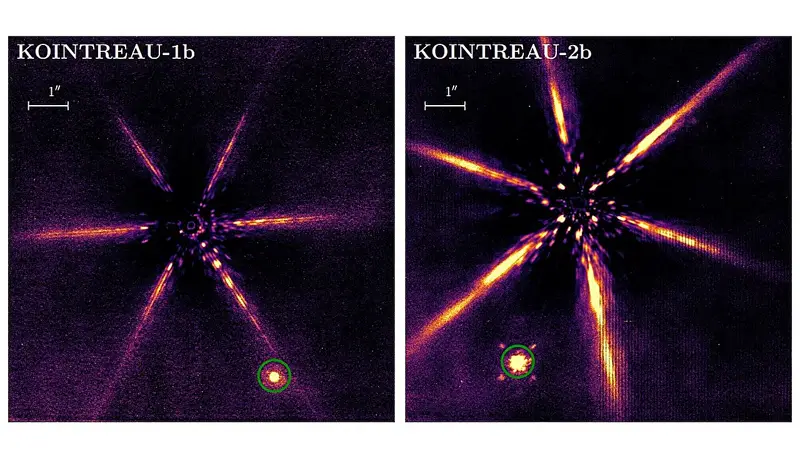
The companion found near XEST 17-036 was given the designation KOINTREAU-1b. It orbits its host star at an enormous distance, about 690 astronomical units away. At that separation, the companion exists far from the central star, offering a rare glimpse into wide-orbit formation.
Based on the collected data, the researchers estimated the mass of KOINTREAU-1b to be around 10.6 Jupiter masses. That places it firmly in the category of planetary-mass objects. With this discovery, KOINTREAU-1b became the fifth planetary-mass companion identified in the Taurus region.
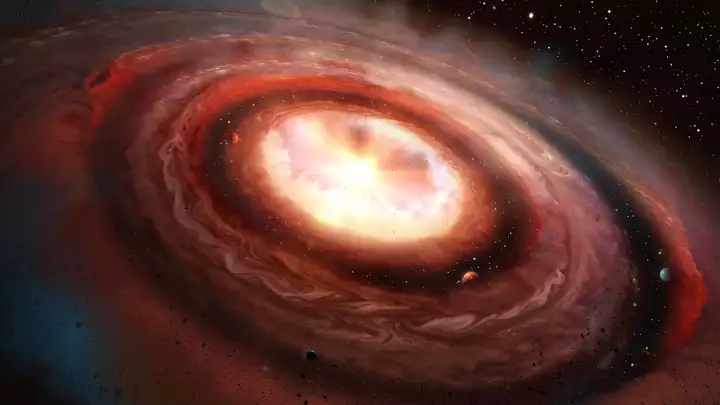
There was something else that caught the researchers’ attention. The slope of KOINTREAU-1b’s spectrum was not consistent across different observations. Instead, it varied between epochs. This change may point to atmospheric clouds moving across the object or possibly a disk surrounding it. Either explanation hints at a complex, evolving environment around a world still in its infancy.
A Faint Star Wrapped in Mystery
The second discovery, KOINTREAU-2b, orbits the ultracool dwarf XEST 13-010 at a projected separation of 560 astronomical units. Unlike its planetary-mass counterpart, KOINTREAU-2b appears to be a stellar object with a spectral type of M4.5.
What makes it remarkable is how faint it is. According to the researchers, it is the faintest object of its spectral class ever identified in Taurus. This alone would make it noteworthy, but its story goes deeper.
The team suggests that KOINTREAU-2b is a young star hidden behind an edge-on disk. Rather than seeing its light directly, astronomers are likely observing light scattered by that surrounding material. Adding to the mystery, hydrogen emission is absent from its spectrum, an unusual characteristic that sets this system apart from others like it.
Together, these details paint a picture of a young star still wrapped in the remnants of its formation, partially concealed and difficult to read, yet full of clues about how stars evolve.
A Growing Family in Taurus
These two discoveries do not stand alone. They join a growing population of planetary-mass and disk-obscured companions found in the Taurus molecular cloud. Each new object adds another data point, another story, another constraint on how stars and substellar objects form and change over time.
The wide separations of KOINTREAU-1b and KOINTREAU-2b are particularly valuable. Objects at such distances challenge and inform existing ideas about how companions form and remain bound to their hosts. They are living tests of theories about gravity, disks, and early evolution.
For the KOINTREAU team, this is only the beginning.
Why These Discoveries Matter
In their conclusion, the researchers emphasize the importance of what they have found and what they hope to find next. “As the KOINTREAU survey continues, we hope to find more planetary-mass companions in both Taurus and Ophiuchus, providing valuable anchors for the earliest stages in the evolution of substellar objects and helping to expand the study of extremely young directly imaged companions,” they write.
These discoveries matter because they offer direct windows into the earliest chapters of cosmic formation. By studying young companions still shaped by disks, clouds, and evolving atmospheres, astronomers can better understand how planets and stars begin their lives.
In a universe that often hides its origins behind billions of years of change, the Taurus molecular cloud offers a rare glimpse of creation still in progress. And with tools like KOINTREAU, astronomers are learning how to listen to those first quiet stories written in starlight.
More information: Samuel A. U. Walker et al, Keck Observations in the INfrared of Taurus and ρ Oph Exoplanets And Ultracool dwarfs (KOINTREAU) I: A Planetary-Mass Companion and a Disk-Obscured Stellar Companion Discovered in Taurus, arXiv (2025). DOI: 10.48550/arxiv.2512.05191