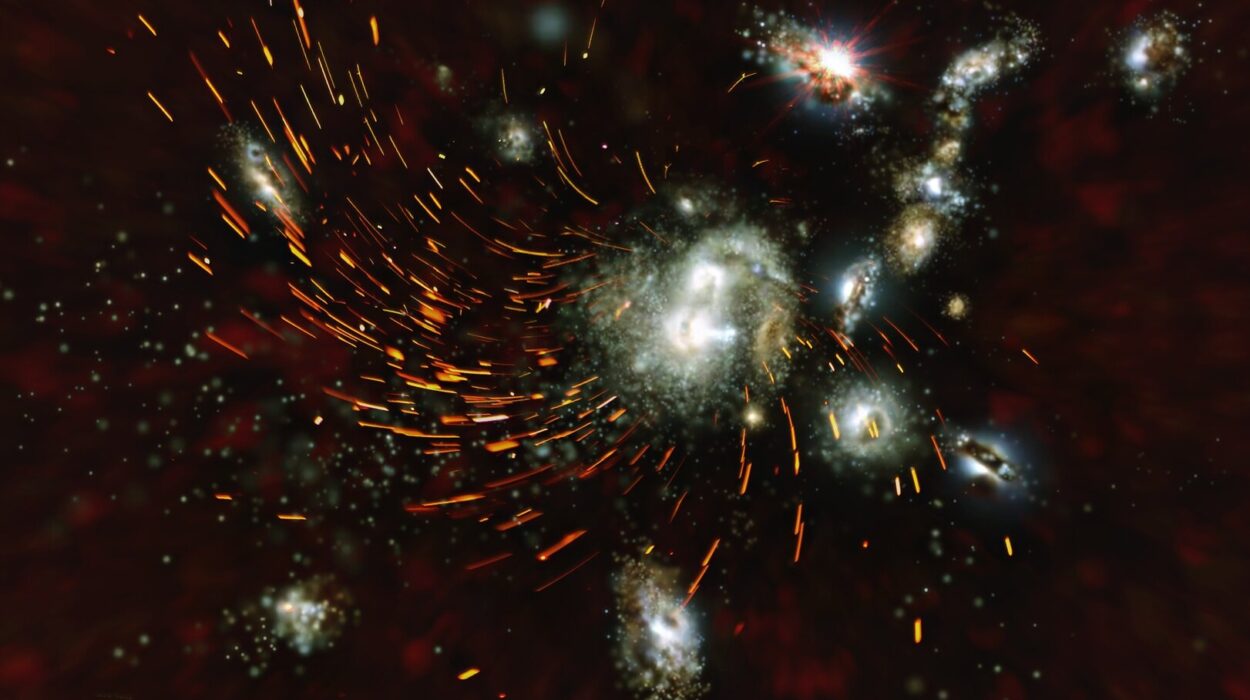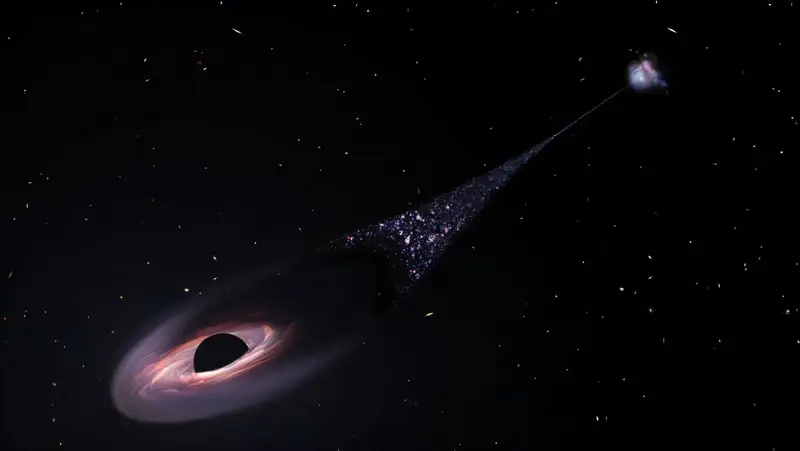
For decades, supermassive black holes were thought to be prisoners of their galaxies. Enormous beyond comprehension, weighing hundreds of millions or even billions of times more than the Sun, they seemed too heavy, too deeply rooted in gravity’s grip, to ever wander far from home. And yet a question lingered, unsettling and persistent. What could possibly force a supermassive black hole out of its host galaxy?
Astronomers had long predicted such an escape could happen, but prediction is one thing and proof is another. The universe does not give up its secrets easily. For fifty years, the idea of runaway supermassive black holes lived mostly in equations and simulations, haunting the edges of astrophysical theory. Now, that long-standing idea has finally stepped into the light.
Far across the cosmos, nearly nine billion light years away, a strange galaxy nicknamed the Cosmic Owl has become the stage for an extraordinary confirmation. In its depths, astronomers believe they have found the first confirmed case of a supermassive black hole that has broken free and is racing through space on its own.
The Cosmic Owl Watches Back
The Cosmic Owl is not a single galaxy but a pair of ring galaxies slowly drawing closer, locked in a cosmic dance that will eventually end in merger. From Earth, the rings resemble wide, staring eyes, giving the system its memorable name. These galaxies sit at a time when the universe was much younger, their light traveling 8.8 billion years before reaching modern telescopes.
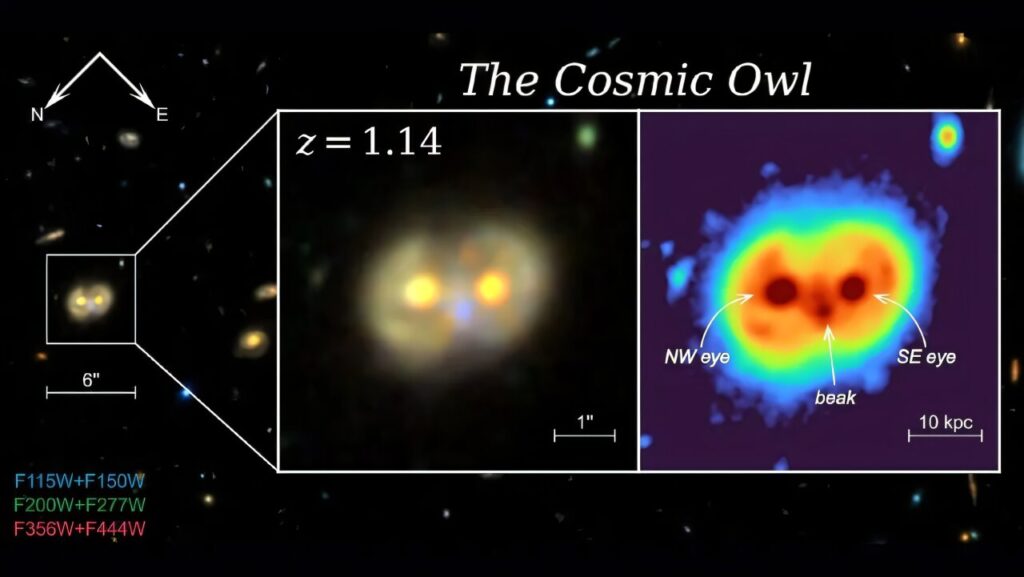
While observing this strange system, astronomers noticed something that did not quite fit. Stretching out from the galaxy was a long, narrow, linear feature, extending far into space like a cosmic scar. It did not look like a typical tidal tail formed by merging galaxies. It was too straight, too focused, too purposeful.
The possibility was startling. Could this be the wake of a supermassive black hole fleeing its home?
At first, the idea was bold but unconfirmed. Now, new research says the answer is yes.
A Prediction Finally Meets Reality
The new study, titled “JWST Confirmation of a Runaway Supermassive Black Hole via its Supersonic Bow Shock,” has been submitted to The Astrophysical Journal Letters. Led by Pieter van Dokkum of Yale’s Astronomy Department, the research builds on years of careful observation and analysis of the Cosmic Owl.
“The occasional escape of supermassive black holes (SMBHs) from their host galaxies is a long-standing prediction of theoretical studies,” van Dokkum and his co-authors write. “We present JWST/NIRSpec IFU observations of a candidate runaway supermassive black hole at the tip of a 62 kpc-long linear feature at z = 0.96.”
Those words mark a turning point. What was once theoretical has now been observed, measured, and confirmed. The runaway black hole, known as Runaway Black Hole 1 or RBH1, appears to sit at the head of an enormous trail stretching roughly 200,000 light years behind it.
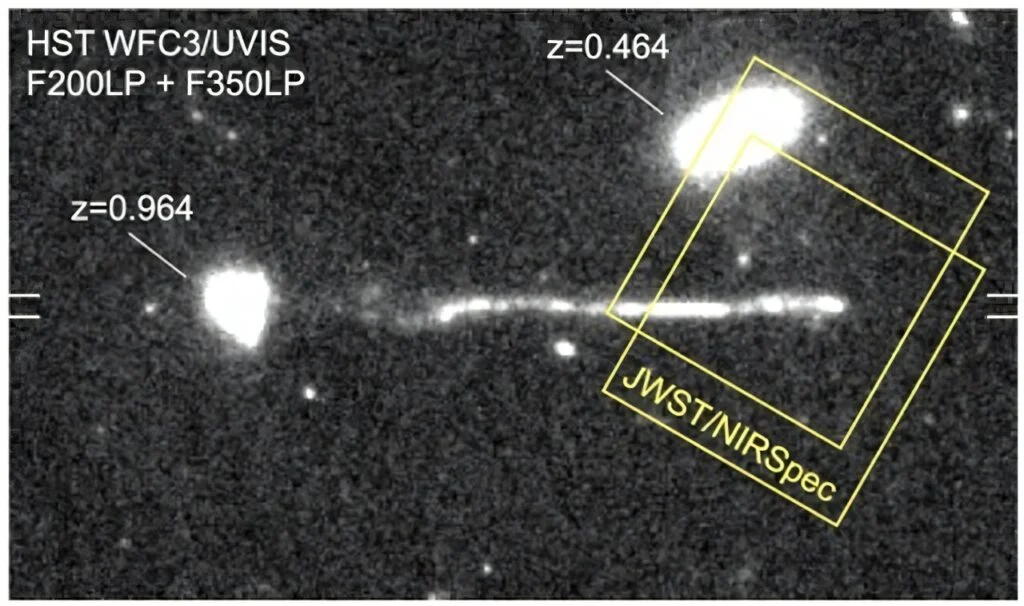
This trail is not random debris. It tells a story of violent motion and cosmic speed.
How a Giant Breaks Free
The researchers explain that there are two natural ways a supermassive black hole can gain enough speed to escape its galaxy. One involves a three-body interaction, where gravitational chaos among massive objects flings one away. The other involves gravitational wave recoil, created when two black holes merge and the resulting energy release kicks the newly formed black hole like a cosmic cannon.
“Both channels occur naturally as a result of galaxy—galaxy mergers, as the black holes of the ancestor galaxies end up in the center of the descendant,” the authors write.
In the Cosmic Owl, everything points to such a violent history. As the two ring galaxies move toward merger, their central black holes would have interacted in complex and extreme ways. Somewhere in that turmoil, one black hole appears to have been hurled outward with tremendous force.
What makes this discovery convincing is not just the black hole itself, but the unmistakable fingerprints of its motion.
The Wake of a Cosmic Bullet
As RBH1 plows through space, it does not travel quietly. Ahead of it forms a bow shock, much like the shockwave in front of a supersonic jet. Behind it trails a long wake of disturbed gas.
Pressure plays a crucial role here. In the bow shock, pressure is high as the black hole compresses material in front of it. In the tail behind, pressure drops, allowing gas to collect. That accumulated gas cools and forms new stars, lighting up the trail like embers in the wake of a firebrand.
The tail and the bow shock together form a unique and powerful signature. Identifying both is essential to confirming a runaway black hole, and this is where the James Webb Space Telescope made the difference.
Webb’s Sharp Eyes Seal the Case
The JWST observed RBH1 using its NIRSpec Integrated Field Unit, an instrument capable of capturing both images and spectra across small regions of the sky. This allowed astronomers not only to see the structure of the feature but to analyze the motion, temperature, and composition of the gas within it.
By examining how gas moves at the tip of the linear feature, the team could test whether it matched expectations for a supersonic bow shock.
“We thus find that the observed kinematics at the tip of RBH-1 are qualitatively consistent with expectations for a strong supersonic bow shock,” the authors explain. They go further, emphasizing the strength of the result. “The evidence for a supersonic bow shock at the head of RBH-1 is very strong, bordering on overwhelming.”
That level of confidence is rare in discoveries of this scale. It transforms a compelling idea into a confirmed phenomenon.
From Hypothesis to Confirmation
This was not the first time the team had suggested the presence of a runaway supermassive black hole in the Cosmic Owl. In earlier work, they identified the linear feature and proposed it was the wake of such an object. What was missing then was the detailed evidence that could remove lingering doubt.
That gap has now been closed.
“The central proposal of Paper I was that the linear feature is the wake behind a runaway supermassive black hole, and this is strongly supported by our analysis,” the authors write. “Using newly obtained HST/UVIS and JWST/NIRSpec data we confirm that the remarkable linear feature reported in Paper I is the wake behind a runaway SMBH.|”
They also confirmed something they had predicted earlier based on models and previous observations.
“We also confirm the presence of a spatially-resolved bow shock at the head of the wake, something that we predicted based on shock models and the luminosity of the [O III] knot in the Keck/LRIS data,” the authors write in their conclusion.
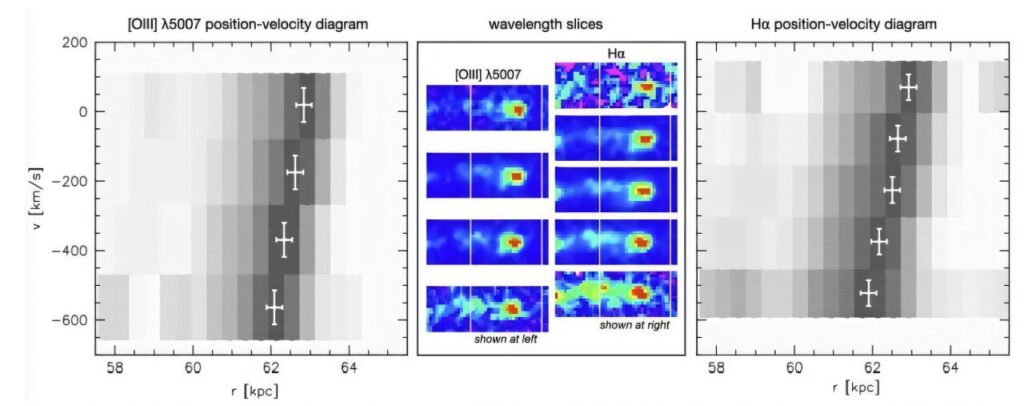
With the tail and bow shock both firmly identified, the case is closed. The universe hosts runaway supermassive black holes, and astronomers have finally caught one in the act.
A Lonely Giant Racing Through Space
There is something deeply unsettling about this discovery. A supermassive black hole, tens of millions of times more massive than the Sun, is not calmly sitting at the center of a galaxy. It is blasting through intergalactic space, compressing everything in its path and leaving behind a glowing trail of gas and newborn stars.
Though Earth is in no danger at all, the image itself is haunting. The universe, already strange and immense, now seems even more dynamic and unpredictable. Giants can be flung loose. Galaxies can lose their hearts.
And yet this violence also creates beauty. In the wake of destruction, new stars are born.
Why This Discovery Matters
This confirmation is more than a single astronomical curiosity. It is a milestone that validates decades of theoretical work. For fifty years, scientists predicted that supermassive black holes could go rogue due to gravitational wave recoil or three-body interactions. Now, the first one has been found.
Finding one strongly suggests there are others. The researchers point to the future, noting that systematic searches will be possible with upcoming wide-field surveys.
“The obvious data sets to look for these features in a systematic way are wide-field surveys with Euclid and Roman,” the authors conclude.
This discovery reshapes how astronomers think about galaxy evolution, black hole dynamics, and the aftermath of cosmic mergers. It shows that galaxies can be altered in dramatic ways, not just by star formation or collisions, but by the sudden loss of their most massive central objects.
The Cosmic Owl has revealed something extraordinary. It has shown that even the heaviest anchors of the universe can be torn free, leaving behind a luminous trail that tells a story billions of years later.
More information: Pieter van Dokkum et al, JWST Confirmation of a Runaway Supermassive Black Hole via its Supersonic Bow Shock, arXiv (2025). DOI: 10.48550/arxiv.2512.04166