The universe has a habit of surprising astronomers just when they think they know what to expect. In August 2025, a distant explosion lit up the sky and, for a brief moment, seemed to repeat a historic cosmic story first witnessed eight years earlier. Then it shifted, changed color, altered its behavior, and left scientists questioning whether they were watching something entirely new unfold.
At the heart of the mystery is a fleeting event known as AT2025ulz, an eruption of light spotted 1.3 billion light-years away. At first glance, it appeared to echo the only kilonova ever confirmed beyond doubt, the famous 2017 event called GW170817. But as days passed, AT2025ulz refused to follow the script. Instead, it blurred the line between two of the universe’s most dramatic deaths, a kilonova and a supernova, hinting at a rare hybrid that astronomers have long imagined but never clearly seen.
The Violent Origins of the Elements Around Us
When massive stars die, they do not go quietly. They end their lives in colossal supernova explosions that scatter elements like carbon and iron across space. These ingredients later become part of new stars, planets, and eventually living worlds.
But supernovae are not the only cosmic forges. When two neutron stars collide, the result is a kilonova, an even rarer and more exotic blast that creates some of the heaviest elements in the universe, including gold and uranium. Neutron stars themselves are extreme objects, the dense remains of stars that have already exploded once. When they crash together, they shake space-time and flood the cosmos with both gravitational waves and light.
Until now, astronomers had only one clear example of such a collision. GW170817, detected in 2017, became a landmark moment when gravitational-wave observatories and telescopes around the world witnessed the same cosmic event together.
That was supposed to be a once-in-a-generation discovery. But then came AT2025ulz.
A Subtle Tremor in Space-Time
The story began quietly, with ripples too faint for human senses but unmistakable to precision instruments. On August 18, 2025, the twin detectors of LIGO in the United States, along with the Virgo detector in Italy, registered a new gravitational-wave signal. The alert went out quickly, notifying astronomers that something massive had collided somewhere in the universe.
This signal stood out. It suggested a merger between two objects, with at least one being unusually small. That alone made the event intriguing.
“While not as highly confident as some of our alerts, this quickly got our attention as a potentially very intriguing event candidate,” says David Reitze, the executive director of LIGO and a research professor at Caltech. “We are continuing to analyze the data, and it’s clear that at least one of the colliding objects is less massive than a typical neutron star.”
A rough sky map accompanied the alert, giving astronomers a place to search. Time mattered. Whatever had happened was already fading.
A Red Glow Appears in the Darkness
Just hours later, the Zwicky Transient Facility at Palomar Observatory spotted something remarkable. A rapidly fading red object appeared exactly where the gravitational-wave signal seemed to originate. The source was initially labeled ZTF 25abjmnps and later officially named AT2025ulz.
Telescopes around the world turned toward the fading glow. Observatories in Hawaiʻi, Germany, and many other locations joined the effort, including a global network once coordinated under the GROWTH program. For a moment, history appeared to be repeating itself.
The light from AT2025ulz dimmed quickly and glowed red, matching the behavior seen in GW170817. In that earlier kilonova, the red color was a signature of newly formed heavy elements. Those atoms absorb blue light and allow red wavelengths to escape, painting the explosion with a deep crimson hue.
For several days, the resemblance was striking.
“At first, for about three days, the eruption looked just like the first kilonova in 2017,” says Caltech’s Mansi Kasliwal (Ph.D. ’11), professor of astronomy and director of Caltech’s Palomar Observatory near San Diego. “Everybody was intensely trying to observe and analyze it, but then it started to look more like a supernova, and some astronomers lost interest. Not us.”
When the Light Changed Its Story
Just as excitement peaked, AT2025ulz took an unexpected turn. Instead of continuing to fade, it began to brighten again. Its color shifted from red to blue. Its spectrum revealed hydrogen.
These are not the fingerprints of a kilonova. They are classic signs of a supernova, specifically a stripped-envelope core-collapse supernova. That change raised doubts across the astronomical community.
Supernovae in distant galaxies are not expected to produce gravitational waves strong enough for detectors like LIGO and Virgo to pick up. Kilonovae are. If AT2025ulz was truly a supernova, then perhaps it had nothing to do with the gravitational-wave signal at all.
Some astronomers concluded just that. The mystery, they felt, was solved. But Kasliwal and her team were not convinced.
A Clue Hidden in an Unusual Mass
The gravitational-wave data refused to be ignored. It suggested that at least one of the merging objects was smaller than the sun, far less massive than a typical neutron star. That detail mattered.
Neutron stars are already extreme, usually packing more mass than the sun into a sphere only about 25 kilometers across. Their known masses range from about 1.2 times the sun’s mass up to roughly three times. A neutron star lighter than the sun would be something entirely different, something not yet observed.
Yet theorists have imagined ways such objects might exist. In one scenario, a rapidly spinning massive star explodes and splits into two tiny neutron stars through fission. In another, called fragmentation, the explosion leaves behind a disk of material that clumps together into a small neutron star, similar to how planets form from disks of dust.
If such sub-solar neutron stars are real, they could form in pairs and eventually spiral together, merging in a kilonova.
A Supernova That Hid a Deeper Explosion
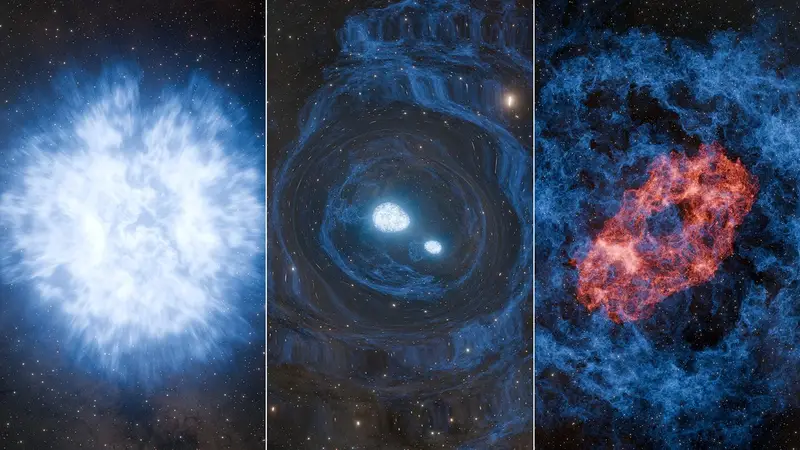
This is where the pieces begin to fit, at least tentatively. According to theories proposed by Brian Metzger of Columbia University, it is possible that a supernova could give birth to two unusually small neutron stars. These newborn objects might then quickly merge, producing a kilonova.
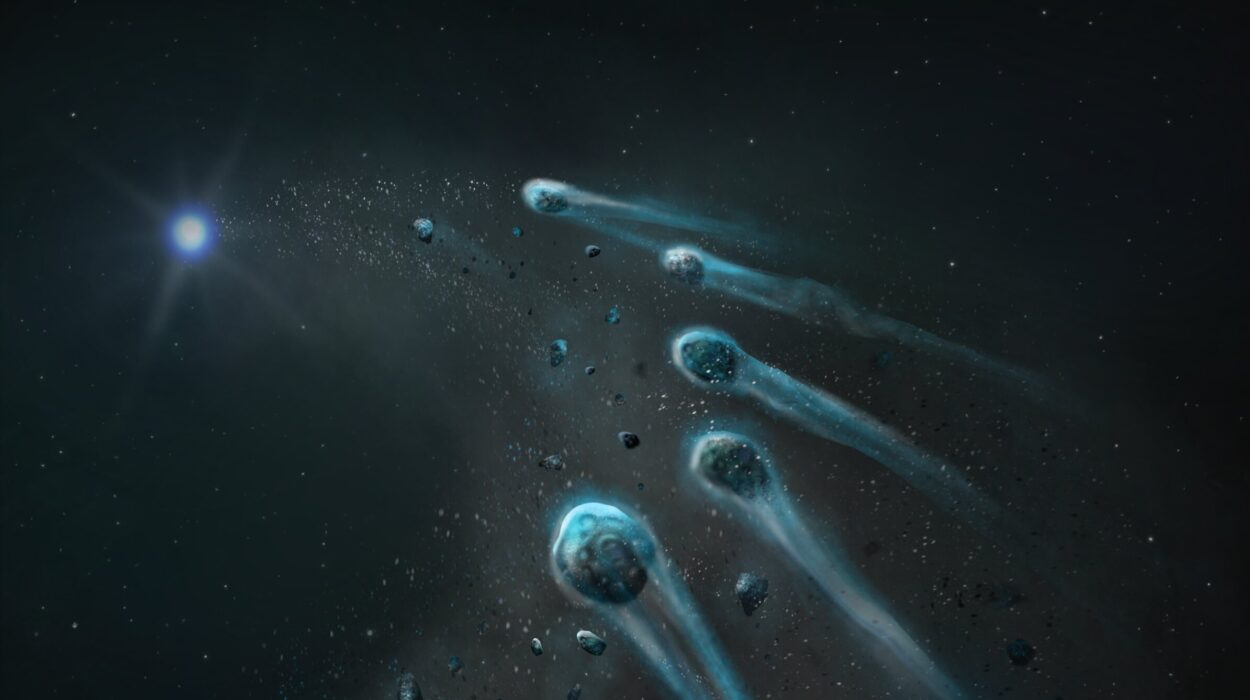
In this scenario, the kilonova would create heavy elements and initially glow red, exactly as observed. But the expanding debris from the original supernova would surround the merger, obscuring it from view. As the supernova light grew stronger and bluer, it would dominate the signal, making the event look more and more like an ordinary stellar explosion.
“The only way theorists have come up with how to birth sub-solar neutron stars is during the collapse of a very rapidly spinning star,” Metzger says. “If these ‘forbidden’ stars pair up and merge by emitting gravitational waves, it is possible that such an event would be accompanied by a supernova rather than be seen as a bare kilonova.”
In simple terms, AT2025ulz might be the first glimpse of a superkilonova, a kilonova triggered by and hidden within a supernova.
Caution at the Edge of Discovery
Despite the excitement, the research team is careful not to overstate their case. The evidence is intriguing but not definitive. There are gaps, uncertainties, and alternative explanations that cannot yet be ruled out.
Astronomy often advances through patterns, and one unusual event is not enough to establish a new category of cosmic explosion. The team emphasizes that stronger claims require more examples.
Still, the possibility has changed how astronomers think about what to look for.
Why This Mystery Matters
If superkilonovae exist, they could be hiding in plain sight, masquerading as ordinary supernovae while quietly forging the universe’s heaviest elements and sending gravitational waves across space. Events like GW170817 may not represent the full diversity of neutron star mergers.
“Future kilonovae events may not look like GW170817 and may be mistaken for supernovae,” Kasliwal says.
New observatories and surveys may help reveal these hidden explosions. By searching data from current and upcoming instruments, astronomers hope to catch more events like AT2025ulz and determine whether it truly represents something new.
“We do not know with certainty that we have found a superkilonova, but the event nevertheless is eye opening.”
If confirmed, this kind of explosion would deepen our understanding of how neutron stars form, how they collide, and how the elements that make up planets and people are created. Even in uncertainty, AT2025ulz has already expanded the boundaries of curiosity, reminding us that the universe still has secrets waiting to be noticed by those willing to keep watching after others look away.
More information: Mansi M. Kasliwal et al, ZTF25abjmnps (AT2025ulz) and S250818k: A Candidate Superkilonova from a Subthreshold Subsolar Gravitational-wave Trigger, The Astrophysical Journal Letters (2025). DOI: 10.3847/2041-8213/ae2000