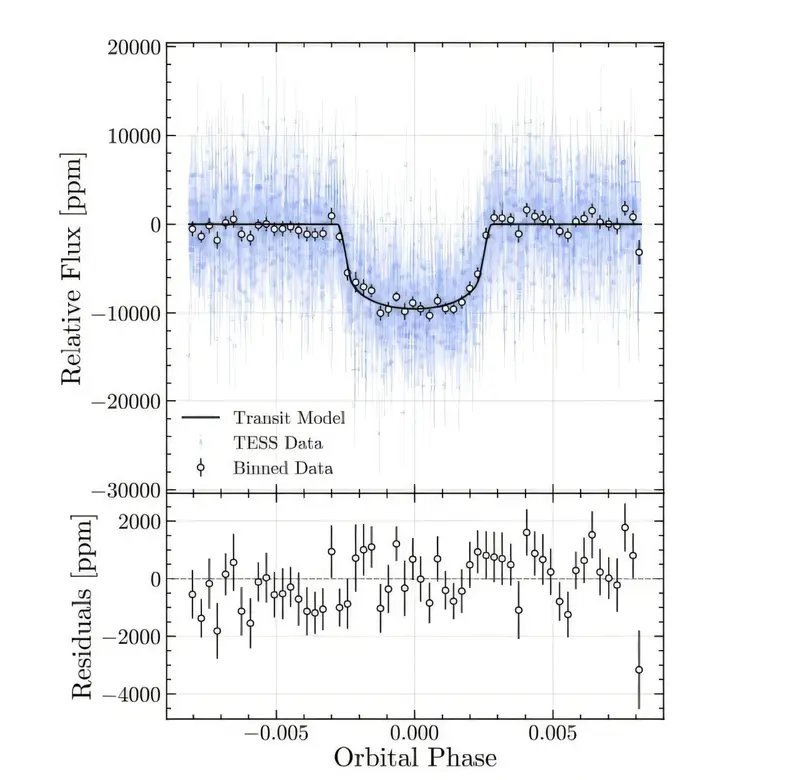
The story began quietly, with a faint, rhythmic dip in the light of a distant star. To most eyes, it would have looked like noise. To astronomers watching data from NASA’s Transiting Exoplanet Survey Satellite, it was a whisper that something unseen was passing in front of a star called TOI-7019. This star itself was already unusual, a survivor from the Milky Way’s distant past, orbiting within the galaxy’s ancient thick disk. When its light dimmed with steady precision, curiosity ignited.
That small flicker set off a chain of observations that would lead to the discovery of something rare and deeply intriguing. Astronomers from the Harvard-Smithsonian Center for Astrophysics and collaborating institutions realized they were not seeing a planet, nor a star, but something caught between the two. The object would eventually be named TOI-7019 b, and its existence would offer a new glimpse into how strange and varied the universe can be.
A World That Is Not Quite a World
Brown dwarfs occupy a strange middle ground in astronomy. They are heavier than planets yet lighter than stars, massive enough to be something more than a giant world but not massive enough to ignite sustained nuclear fusion. They sit in a narrow mass range, between 13 and 80 times the mass of Jupiter, making them cosmic in-betweens.
Although many brown dwarfs drift alone through space, finding one that orbits a star is rare. Finding one that crosses directly in front of its star from our point of view, creating a transit signal, is rarer still. TOI-7019 b belongs to this select group. Its presence was first hinted at when TESS recorded repeated dips in the star’s brightness, suggesting a companion regularly passing across the star’s face.
At first, the signal was only a suspicion. To confirm what was causing it, astronomers needed to look closer and measure more than just light.
Following the Evidence Step by Step
Once the transit signal was identified, the research team turned to follow-up observations. They combined photometry, which tracks changes in brightness, with radial velocity measurements that reveal how a star wobbles under the gravitational pull of an orbiting object. These methods together can uncover an object’s mass, size, and density.
The results were striking. As the researchers explained, “Using follow-up photometry and radial velocity measurements, we determined the physical properties of this companion, which turns out to be a dense brown dwarf.” What had seemed at first like a possible planet was revealed to be something far heavier.
TOI-7019 b is about 61.3 times more massive than Jupiter, yet its radius is only about 0.82 times that of Jupiter. This combination makes it extraordinarily dense, with a calculated density of 141.7 grams per cubic centimeter. It circles its host star every 48.26 days, maintaining a distance of roughly 0.25 astronomical units, and its equilibrium temperature is estimated at 479 kelvin.
This is not a gentle, puffy object. It is compact, massive, and extreme.
An Ancient Star as a Host
The nature of the host star adds another layer of fascination to the discovery. TOI-7019 is a main sequence star, nearly the size of the Sun but slightly less massive, with about 0.78 solar masses. Its surface temperature has been measured at 5,800 kelvin, making it familiar in some ways. Yet its history is anything but ordinary.
With an estimated age of 12 billion years, TOI-7019 is ancient. It is metal-poor, meaning it contains fewer heavy elements than younger stars, and it belongs to the Milky Way’s thick disk, a population of stars formed early in the galaxy’s history. This star was already old when much of the galaxy was still taking shape.
To find a brown dwarf orbiting such an elderly star is remarkable. To find one that transits the star, allowing such precise measurements, is unprecedented.
A First of Its Kind
This is where TOI-7019 b truly steps into the spotlight. It is the first known transiting brown dwarf to orbit a star that is part of the Milky Way’s ancient thick disk. It is also the oldest known brown dwarf transiting a main sequence star for which astronomers can estimate such a precise age.
Age matters deeply in astrophysics. Objects change over time. They cool, contract, and evolve. Having a brown dwarf of known mass, size, and age provides a rare benchmark for testing theoretical models of how such objects behave across billions of years.
Yet TOI-7019 b does not fit perfectly into existing expectations.
When Models and Reality Do Not Quite Match
According to standard evolutionary models for old, metal-poor brown dwarfs, an object like TOI-7019 b should be smaller. Instead, its radius is about 12.3 percent larger than predicted. This discrepancy may seem modest, but in astrophysics it is significant.
The finding suggests that current models may be missing something important. The researchers note that this mismatch highlights the need to incorporate different elemental abundance patterns into substellar models. In other words, the chemical makeup of these objects, shaped by the early galaxy in which they formed, may influence their structure in ways not fully accounted for yet.
TOI-7019 b becomes more than a discovery. It becomes a challenge to theory, a reminder that the universe often refuses to behave exactly as expected.
Looking Ahead to a Deeper Glimpse
The story of TOI-7019 b is not finished. Its characteristics make it a promising target for future observations, particularly of its atmosphere. Because it transits its star, astronomers can study the starlight that filters through its atmosphere during each pass, revealing clues about its composition.
The researchers are already thinking ahead. As they wrote, “Atmospheric characterization with JWST [James Webb Space Telescope] could reveal whether molecular features (H2O, CH4, CO) differ from solar-metallicity brown dwarfs of similar mass and effective temperature, though disentangling metallicity effects from other atmospheric parameters would be challenging.”
These future studies could help determine whether brown dwarfs formed in the early, metal-poor galaxy carry atmospheric signatures distinct from their younger counterparts.
Why This Discovery Matters
TOI-7019 b matters because it sits at the intersection of many important questions in astronomy. It bridges the gap between planets and stars. It orbits an ancient star from the early Milky Way. It challenges theoretical models with its unexpectedly large radius. And it offers a rare opportunity to study the atmosphere of a brown dwarf whose age and environment are well constrained.
Each of these factors alone would be noteworthy. Together, they make TOI-7019 b a powerful laboratory for understanding how substellar objects form, evolve, and survive across cosmic time. By studying this single, dense companion circling an old star, astronomers gain insight into the conditions of the early galaxy and the limits of current theory.
In the end, the discovery reminds us that even in a galaxy billions of years old, there are still new stories hidden in faint dips of starlight, waiting patiently for someone to notice.
More information: Jéa Adams Redai et al, An Ancient Brown Dwarf Transiting a Metal-Poor Thick Disk Star, arXiv (2025). DOI: 10.48550/arxiv.2512.06069