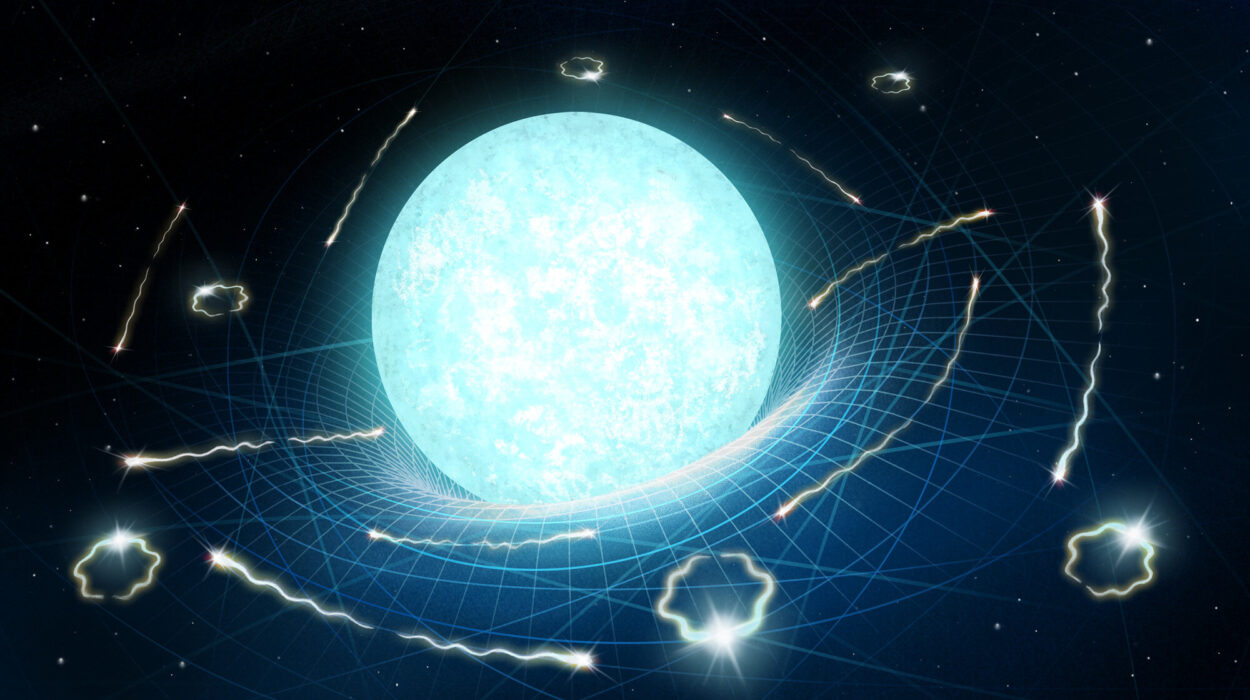
If you could travel back in time to witness the birth of the universe, you would not see stars, planets, galaxies, or even atoms. You would find yourself in an unimaginably hot, incredibly dense, and astonishingly tiny cosmos—a place where the familiar laws of everyday life no longer applied. In the first fraction of a second after the universe came into existence, something extraordinary appears to have happened. Space itself expanded at an almost unimaginable rate, growing from something smaller than an atomic nucleus to something vastly larger in an incredibly short time.
This event is known as cosmic inflation, and it represents one of the most fascinating ideas in modern cosmology. According to the theory, the universe experienced a brief but explosive burst of expansion during its earliest moments. This expansion was so rapid that it dwarfs every other growth event in the history of the cosmos.
Although inflation lasted for only an incredibly tiny fraction of a second, it shaped everything that came afterward. It smoothed out the universe, stretched microscopic quantum fluctuations into enormous cosmic structures, and laid the foundation for the galaxies, stars, planets, and eventually life itself.
Today, scientists continue studying cosmic inflation because it may hold the key to understanding not only how the universe evolved, but why it looks the way it does.
What Is Cosmic Inflation?
Cosmic inflation is a theory proposing that the universe underwent an extremely rapid expansion during the earliest moments after the Big Bang.
Importantly, inflation was not an explosion of matter flying outward through empty space. Instead, it was space itself expanding. Every region of space grew larger simultaneously.
To understand the difference, imagine drawing tiny dots on the surface of a balloon. As the balloon inflates, the dots move farther apart even though they are not moving across the surface themselves. The surface expands beneath them.
The universe behaves in a somewhat similar way.
Galaxies move apart today because space continues to expand. During inflation, however, that expansion happened at an incomprehensibly faster rate.
The universe may have increased in size by an enormous factor in far less than a trillionth of a trillionth of a second.
Although this sounds unbelievable, inflation solves several major puzzles that older Big Bang models could not explain.
Why Scientists Needed Inflation
The original Big Bang theory successfully explained many observations.
It described how the universe expanded.
It predicted the existence of the cosmic microwave background.
It explained the formation of light elements such as hydrogen and helium.
Despite these successes, several important questions remained unanswered.
One puzzle involved the remarkable uniformity of the universe.
When astronomers measured the temperature of the cosmic microwave background, they found that it is almost exactly the same in every direction.
This seems surprising because opposite sides of the observable universe are so far apart that, according to the traditional Big Bang model, they should never have exchanged information.
How did they end up with nearly identical temperatures?
Another mystery involved the geometry of space.
Measurements show that the universe is extraordinarily close to being spatially flat.
Even tiny differences in the early universe should have grown dramatically over billions of years.
Why was the universe balanced so precisely from the beginning?
A third puzzle concerned exotic particles predicted by some theories of high-energy physics.
If those particles were abundant in the early universe, why do we not observe them today?
Cosmic inflation offered elegant solutions to all of these problems.
A Tiny Universe With Enormous Potential
Before inflation began, the observable universe may have been unimaginably small.
It could have been much smaller than a proton.
Trying to imagine such conditions stretches the limits of human imagination.
Temperatures were extraordinarily high.
Energy densities were enormous.
The laws of quantum physics and gravity likely interacted in ways scientists still do not fully understand.
Yet within this tiny cosmic seed lay the potential for hundreds of billions of galaxies.
Everything that exists today—every mountain, every ocean, every living creature, every distant galaxy—was once compressed into a region so small that ordinary intuition completely fails.
Inflation transformed that tiny beginning into the vast universe we see today.
Space Expanded Faster Than Light
One of the most surprising aspects of inflation is that space expanded faster than the speed of light.
At first this sounds impossible.
After all, Einstein showed that nothing can travel through space faster than light.
The important distinction is that inflation involves the expansion of space itself, not objects moving through space.
Special relativity limits how fast objects move through space.
It does not prevent space from expanding.
During inflation, distant regions of space separated so rapidly that the distance between them increased faster than light could travel.
No laws of physics were broken because the galaxies themselves were not racing through space at impossible speeds.
Instead, space between them expanded.
The same phenomenon occurs today on enormous cosmic scales, although much more slowly than during inflation.
When Did Inflation Happen?
Inflation occurred astonishingly early.
Scientists estimate that it began around 10⁻³⁶ seconds after the Big Bang and ended roughly 10⁻³² seconds later.
These numbers are almost impossible to comprehend.
A trillionth of a second already seems unimaginably brief.
Inflation lasted for an interval vastly smaller still.
Yet during that tiny moment, the universe expanded by an enormous factor.
After inflation ended, the universe continued expanding much more gradually according to the standard Big Bang model.
Everything that happened afterward—including the formation of atoms, stars, galaxies, and planets—occurred within the enormous space inflation had created.
The Horizon Problem
One of inflation’s greatest successes is solving what scientists call the horizon problem.
Imagine heating two cups of coffee in different cities without allowing them to exchange any heat.
It would be surprising if both cooled to exactly the same temperature.
Something similar puzzled cosmologists.
The cosmic microwave background has nearly identical temperatures in regions so distant they seemingly never communicated.
Without inflation, there simply was not enough time for heat or information to travel between them.
Inflation changes the picture.
Before inflation, these regions were actually very close together.
They had enough time to reach nearly the same temperature.
Then inflation rapidly stretched them far apart.
Today they appear separated by billions of light-years, yet they preserve the uniform conditions established before inflation.
This elegantly explains why the universe looks so similar in every direction.
The Flatness Problem
Measurements show that the universe is astonishingly close to geometrically flat.
In simple terms, parallel lines remain parallel over enormous distances.
If the universe had even slightly more or less curvature in its earliest moments, billions of years of expansion should have amplified that difference dramatically.
Instead, space appears remarkably balanced.
Inflation naturally explains this.
Imagine standing on Earth’s surface.
From ground level, the planet appears flat even though it is actually spherical.
The larger the sphere becomes, the flatter a small region appears.
Inflation stretched space so enormously that any original curvature became almost impossible to detect.
As a result, the universe today appears extremely flat.
The Monopole Problem
Some theories of particle physics predict heavy particles called magnetic monopoles.
Unlike ordinary magnets, which always have north and south poles together, monopoles would possess only one magnetic pole.
If these particles formed abundantly during the early universe, astronomers should observe many of them today.
None have been found.
Inflation provides a simple explanation.
Even if monopoles were produced, inflation expanded space so dramatically that they became extraordinarily diluted.
Today they would be incredibly rare, making them difficult to detect.
What Drove Inflation?
This remains one of cosmology’s biggest mysteries.
Scientists believe inflation was powered by a special form of energy filling space.
This hypothetical energy produced a strong negative pressure.
Instead of slowing expansion through gravity, it caused space to expand even faster.
Many theories describe this energy using a hypothetical quantum field called the inflaton field.
Unlike familiar fields such as electric or magnetic fields, the inflaton has not yet been directly observed.
It remains a theoretical idea that helps explain inflation mathematically.
Researchers continue searching for evidence revealing exactly what drove this extraordinary expansion.
The Inflaton Field
The inflaton field is one of the central ideas in inflationary cosmology.
According to many models, the field temporarily stored enormous amounts of energy.
While the field remained in a particular state, space expanded exponentially.
Eventually the field became unstable.
Its energy transformed into ordinary particles and radiation.
This process is called reheating.
Reheating filled the universe with the hot plasma that the traditional Big Bang theory begins describing.
In this view, inflation did not replace the Big Bang.
Instead, inflation became an earlier chapter explaining what happened immediately before the familiar hot Big Bang phase.
Quantum Fluctuations Became Galaxies
One of the most beautiful ideas in modern cosmology connects quantum physics with the largest structures in the universe.
Even empty space is not perfectly empty.
Quantum mechanics predicts tiny fluctuations constantly appear.
Normally these fluctuations remain microscopic.
Inflation dramatically changed that.
As space expanded, tiny quantum fluctuations stretched to astronomical sizes.
After inflation ended, gravity slowly amplified these slightly denser regions.
Matter accumulated.
Clouds of gas formed.
Stars ignited.
Galaxies assembled.
Galaxy clusters emerged.
Incredibly, the largest structures in today’s universe may have originated from microscopic quantum fluctuations during inflation.
Every galaxy, including the Milky Way, may owe its existence to quantum events occurring within the universe’s earliest fraction of a second.
The Cosmic Microwave Background
One of the strongest pieces of evidence supporting inflation comes from the cosmic microwave background.
This faint glow fills the entire universe.
It represents light released about 380,000 years after the Big Bang when electrons combined with nuclei to form neutral atoms.
Before that time, the universe was opaque.
Once atoms formed, light could travel freely.
That ancient light continues reaching Earth today.
Space telescopes have measured the cosmic microwave background with extraordinary precision.
Although its temperature is remarkably uniform, tiny fluctuations exist.
These minute variations closely match the patterns predicted by inflation.
Scientists view these fluctuations as fossil records from the earliest universe.
Tiny Ripples With Enormous Consequences
The temperature variations in the cosmic microwave background are incredibly small.
Most differ by only about one part in one hundred thousand.
Yet those tiny differences became the seeds of everything we see today.
Slightly denser regions attracted more matter through gravity.
Over hundreds of millions of years, these regions grew into galaxies and galaxy clusters.
Without those initial ripples, matter might have remained distributed almost perfectly evenly.
Stars might never have formed.
Planets might never have existed.
Life might never have emerged.
The tiny imperfections created during inflation ultimately made cosmic complexity possible.
Inflation Ended, But Expansion Continued
Inflation was only the beginning.
After it ended, the universe remained hot and dense.
Ordinary expansion continued.
As billions of years passed, temperatures fell.
Subatomic particles formed.
Atomic nuclei appeared.
Atoms emerged.
Gravity gathered matter into stars.
Stars produced heavier elements.
Galaxies assembled.
Planetary systems formed.
Eventually, on at least one planet, life appeared.
Inflation was remarkably brief.
Its consequences continue shaping the universe today.
Evidence Supporting Inflation
Inflation is widely accepted because it successfully explains several independent observations.
The universe appears remarkably uniform on large scales.
Space is nearly flat.
The cosmic microwave background contains fluctuations with characteristics predicted by inflation.
Large-scale galaxy distributions also agree with inflationary models.
Although none of these observations prove inflation beyond all doubt, together they create a compelling picture.
Many cosmologists regard inflation as the leading explanation for the universe’s earliest evolution.
What Scientists Still Don’t Know
Despite its success, inflation remains incomplete.
Researchers still seek answers to several major questions.
What exactly was the inflaton field?
What particle or field generated inflation?
Why did inflation begin?
Why did it stop?
Could inflation happen more than once?
Did inflation produce multiple universes?
How does inflation connect with quantum gravity?
These unanswered questions drive ongoing research around the world.
Eternal Inflation
Some versions of inflation lead to an astonishing possibility.
Inflation may never completely stop everywhere.
Instead, while it ends in one region, it continues elsewhere.
Those continuously inflating regions create new expanding universes.
Each becomes a separate cosmic bubble.
This idea is called eternal inflation.
According to this hypothesis, our observable universe might be only one bubble within a much larger multiverse.
This concept remains speculative.
No direct evidence currently confirms the existence of other universes.
Nevertheless, eternal inflation is an active area of theoretical research.
Inflation and the Multiverse
The multiverse idea captures the imagination because it suggests reality may be vastly larger than the observable universe.
Different bubble universes might possess different physical constants.
Some could contain different particles.
Others might never form stars.
Still others might collapse quickly after forming.
Our universe could simply be one region where conditions allowed galaxies and life to emerge.
Although fascinating, these ideas remain hypotheses rather than established scientific facts.
Scientists continue searching for ways to test them observationally.
Inflation and Gravitational Waves
One exciting prediction of some inflation models involves primordial gravitational waves.
These are tiny ripples in spacetime generated during inflation itself.
If detected, they would provide powerful evidence supporting inflation.
Scientists search for their signatures in the polarization patterns of the cosmic microwave background.
Although no definitive detection has yet been made, increasingly sensitive telescopes continue investigating this possibility.
Finding primordial gravitational waves would open an entirely new window into the universe’s earliest moments.
Inflation Versus the Big Bang
People sometimes confuse inflation with the Big Bang.
They are related but not identical.
The traditional Big Bang theory describes the universe after it became extremely hot and dense.
Inflation describes an even earlier stage that likely preceded the hot Big Bang.
Rather than replacing the Big Bang, inflation extends it.
Together they provide a more complete picture of cosmic history.
Inflation explains why the universe began with conditions that allowed the later Big Bang evolution to produce the cosmos we observe today.
Everyday Analogies for Inflation
Inflation is difficult to visualize because nothing similar occurs in everyday life.
Imagine drawing tiny dots on an uninflated balloon.
As the balloon expands rapidly, every dot moves farther from every other dot.
No single dot sits at the center of expansion.
The entire surface expands simultaneously.
Although our universe has three spatial dimensions rather than two, this analogy captures one important feature.
Expansion occurs everywhere.
Every observer sees distant regions moving away.
There is no special central location.
Another analogy involves raisin bread rising in an oven.
As the dough expands, every raisin sees all other raisins moving farther away.
Again, the raisins themselves are not driving the expansion.
The dough between them grows.
Similarly, galaxies are carried apart by expanding space.
Inflation Changed Everything
Without inflation, the universe might look dramatically different.
It might possess strong curvature.
The cosmic microwave background might vary greatly across the sky.
Large-scale structures could differ enormously.
Some cosmologists even wonder whether galaxies would have formed efficiently at all.
Inflation transformed a tiny, nearly featureless universe into one capable of developing astonishing complexity.
The galaxies decorating the night sky owe much of their existence to events occurring within the universe’s first tiny fraction of a second.
How Scientists Study the First Moments
No telescope can directly observe inflation itself.
The universe was opaque during its earliest history.
Instead, scientists study inflation indirectly.
They examine the cosmic microwave background.
They map billions of galaxies.
They analyze gravitational lensing.
They search for primordial gravitational waves.
They develop increasingly sophisticated computer simulations.
Particle accelerators also provide clues by recreating conditions approaching those of the early universe.
Although inflation occurred almost 13.8 billion years ago, its fingerprints remain written across the cosmos.
Why Inflation Matters
Cosmic inflation is much more than an abstract scientific theory.
It represents humanity’s attempt to understand the earliest chapter of existence.
Every person who has ever lived, every mountain, every ocean, every tree, every animal, every planet, every galaxy—all emerged within a universe shaped by inflation.
It explains why the universe is smooth enough for galaxies to form yet contains just enough tiny imperfections to create cosmic structure.
It connects quantum physics with cosmology.
It links the smallest known scales to the largest known structures.
Few scientific ideas span such enormous ranges of size and time.
The Future of Inflation Research
The coming decades promise exciting discoveries.
New space telescopes and ground-based observatories will measure the cosmic microwave background with even greater precision.
Large galaxy surveys will map billions of galaxies across cosmic history.
Improved gravitational-wave detectors may eventually uncover signals originating during inflation.
Theoretical physicists continue developing new models connecting inflation with quantum gravity, string theory, and particle physics.
Some current models may eventually be ruled out.
Others may gain stronger observational support.
The story of inflation is still unfolding.
Every new observation brings scientists closer to understanding what happened during the universe’s earliest moments.
Conclusion
Cosmic inflation is one of the boldest and most influential ideas in modern cosmology. It proposes that in the tiniest fraction of a second after the universe came into existence, space itself expanded at an astonishing rate, transforming an unimaginably small region into the vast foundation of the observable cosmos. Although this dramatic event lasted only an instant, its effects continue to shape everything we see today.
Inflation offers elegant explanations for some of the universe’s deepest mysteries. It helps explain why the cosmos appears remarkably uniform, why space is nearly flat, and how tiny quantum fluctuations eventually became galaxies, stars, planets, and ultimately life. Observations of the cosmic microwave background and the large-scale structure of the universe strongly support many of its predictions, making inflation one of the leading theories of the early universe.
Yet many questions remain. Scientists still do not know exactly what triggered inflation, what field powered it, or whether it connects to even deeper laws of nature. As new telescopes, gravitational-wave observatories, and theoretical advances continue to push the boundaries of knowledge, cosmic inflation remains one of the most exciting frontiers in science.
It reminds us that the greatest growth spurt in history did not happen on Earth or even within a galaxy—it happened to the universe itself. In less than a heartbeat, before stars, before atoms, and before light could travel freely, space expanded with breathtaking speed, setting the stage for everything that would ever exist.