On a clear night far away from city lights, when the sky grows dark enough for the universe to reveal its deeper secrets, a pale glowing band stretches across the heavens. It looks like a river of soft white light flowing silently through the darkness. For thousands of years, people around the world gazed at this mysterious celestial glow and wondered what it was. Ancient storytellers imagined it as the path of gods, a heavenly road, or spilled milk across the sky. Today we know it by a name that carries echoes of those early myths: the Milky Way.
The Milky Way is not simply a glowing streak in the sky. It is our home galaxy, a vast cosmic city of stars, gas, dust, and invisible matter stretching across unimaginable distances. Everything we know—our Sun, our solar system, and Earth itself—exists within this enormous structure. When we look at the Milky Way in the night sky, we are seeing the inner regions of the galaxy from inside it, much like standing within a forest and looking along a dense corridor of trees.
Understanding the Milky Way means understanding our cosmic address. It tells us where we belong in the universe and reveals how galaxies form, evolve, and shape the cosmos. It is both our birthplace and our window into the larger story of the universe.
What Exactly Is the Milky Way?
The Milky Way is a galaxy, a gigantic gravitational system containing hundreds of billions of stars along with planets, nebulae, gas clouds, star clusters, and dark matter. All of these components are bound together by gravity, moving through space as part of a single enormous structure.
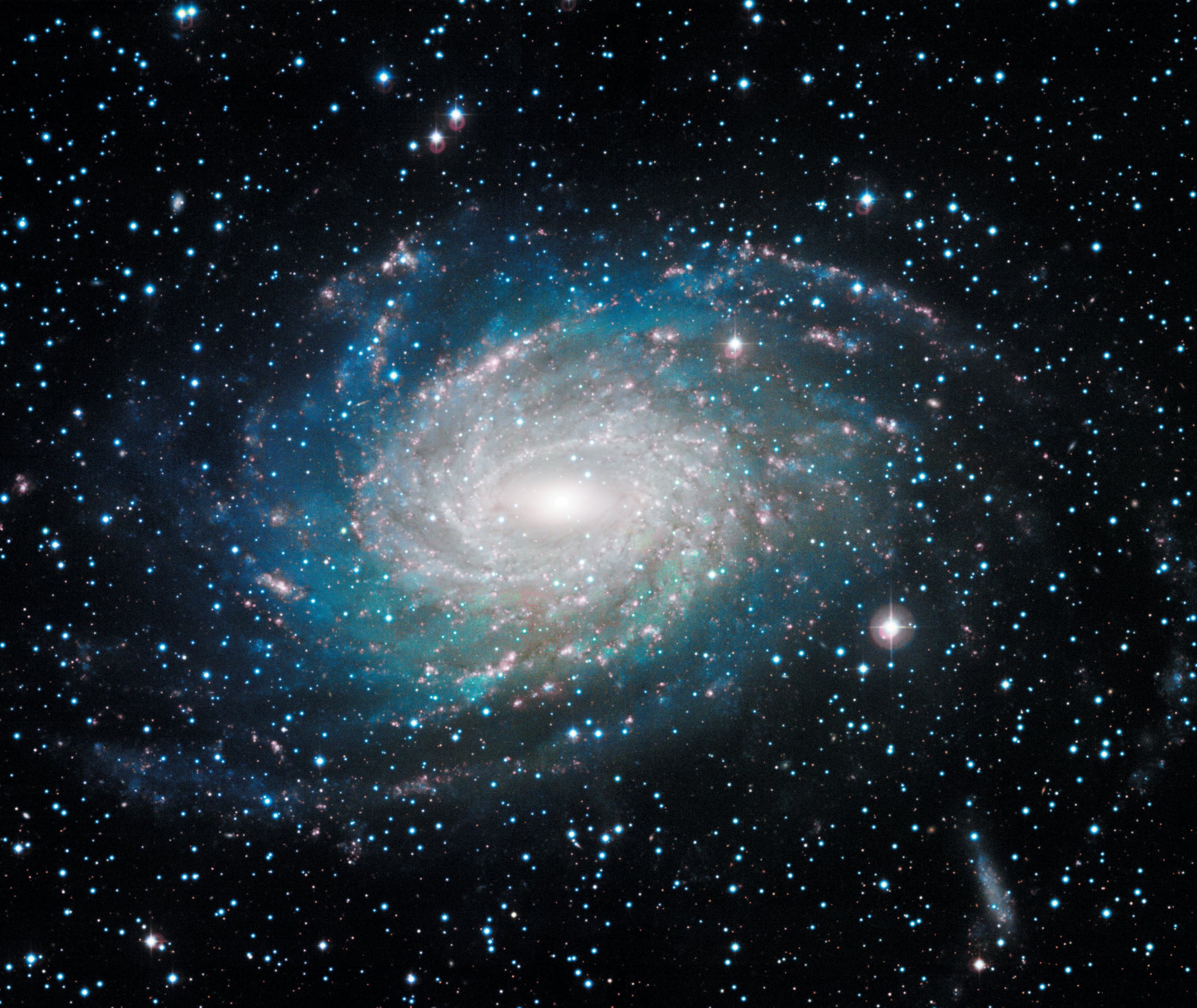
Galaxies come in many shapes and sizes across the universe, but the Milky Way belongs to a category known as spiral galaxies. These galaxies resemble enormous pinwheels of stars with graceful arms winding outward from a bright central region. The Milky Way itself spans roughly one hundred thousand light-years in diameter, meaning that light traveling at the fastest speed in the universe would take about one hundred thousand years to cross it.
Within this immense system reside somewhere between one hundred billion and four hundred billion stars. Many of these stars have their own planetary systems, and countless worlds may orbit them. Vast clouds of gas and dust float between stars, sometimes collapsing under gravity to form new stars and planets.
Despite its immense size, the Milky Way is only one galaxy among hundreds of billions in the observable universe. Yet to us, it is the most important galaxy of all, because it is home.
Why the Galaxy Looks Like a Milky Band
When people observe the Milky Way from Earth, they see it as a faint glowing band stretching across the sky. This appearance puzzled early observers, who could not distinguish individual stars within it.
The reason for this appearance lies in our position inside the galaxy. The Milky Way is shaped like a flattened disk filled with stars. Our solar system sits within this disk, roughly halfway between the center and the outer edge. When we look toward the plane of the galaxy, our line of sight passes through enormous numbers of stars packed together. Their combined light blends into a luminous cloud.
In contrast, when we look away from the galactic plane, we see far fewer stars. This difference creates the striking band that arches across the sky.
With powerful telescopes, astronomers can resolve this glowing band into countless individual stars. What once appeared as misty light reveals itself as an immense population of distant suns.
The Structure of Our Galactic Home
Although the Milky Way may appear as a simple band from Earth, its true structure is complex and fascinating. At its largest scale, the galaxy resembles a flattened rotating disk with spiral arms extending outward from a central region.
At the heart of the galaxy lies the galactic bulge, a dense spherical concentration of stars surrounding the center. This region contains some of the oldest stars in the galaxy and shines brightly due to the sheer number of stars packed into a relatively small space.
Extending outward from the bulge is the galactic disk, a vast rotating plane containing most of the galaxy’s stars, gas, and dust. The disk is where spiral arms form, and it is also where new stars are continually born.
Beyond the disk lies the galactic halo, a much larger spherical region surrounding the galaxy. The halo contains ancient star clusters and enormous amounts of dark matter, a mysterious substance that does not emit light but exerts gravitational influence.
Together, these components form the immense gravitational system we call the Milky Way.
Spiral Arms: The Star-Forming Highways
One of the most striking features of the Milky Way is its spiral arms. These sweeping structures extend outward from the galactic center like enormous curved rivers of stars.
The spiral arms are not rigid structures made of fixed stars. Instead, they are regions where stars and gas become temporarily concentrated as they orbit the galactic center. These density waves move through the disk of the galaxy, compressing clouds of gas and dust as they pass.
This compression triggers the formation of new stars. As gas clouds collapse under gravity, they heat up and ignite nuclear fusion, creating brilliant young stars that illuminate the spiral arms.
Because of this process, spiral arms often glow with clusters of hot, blue stars and colorful nebulae where star formation is actively taking place.
Our solar system lies within one of the smaller spiral arms known as the Orion Arm, positioned between two larger arms of the galaxy.
The Galactic Center: A Hidden Powerhouse
At the very center of the Milky Way lies one of the most mysterious regions in the galaxy. Hidden behind thick clouds of dust that block visible light, the galactic center remained largely invisible to early astronomers.
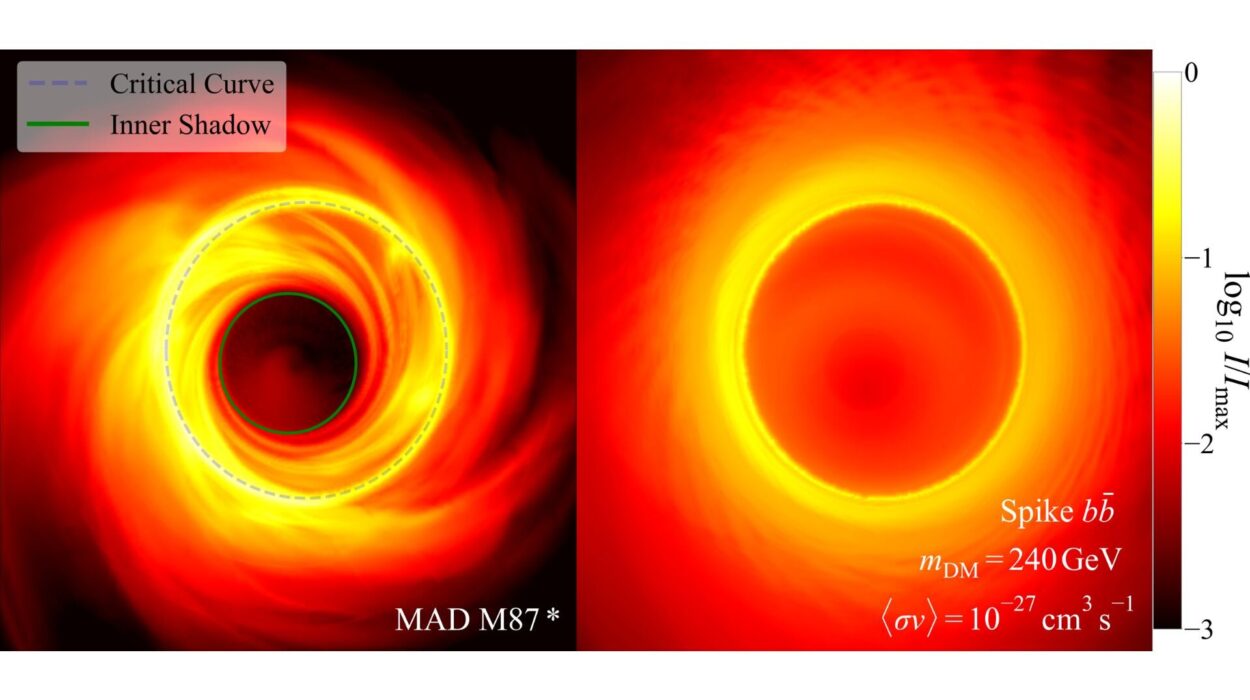
Modern instruments capable of detecting infrared and radio waves have revealed that this region contains an extremely powerful object: a supermassive black hole.
This black hole has a mass millions of times greater than the Sun. Its gravitational pull dominates the central region of the galaxy, influencing the motion of nearby stars.
Despite its immense power, the black hole is relatively quiet compared with those found in some other galaxies. It occasionally consumes gas and dust, releasing bursts of energy, but it does not produce the enormous jets seen in more active galactic nuclei.
Nevertheless, its presence reveals that black holes may play a crucial role in shaping galaxies.
The Sun’s Journey Through the Galaxy
Our solar system is not stationary within the Milky Way. Instead, it travels through the galaxy in a vast cosmic orbit around the galactic center.
The Sun lies about twenty-six thousand light-years from the center of the Milky Way. At this distance, it moves through space at an incredible speed of roughly two hundred kilometers per second.
Even at that tremendous velocity, the galaxy is so large that the Sun takes about 230 million years to complete one orbit around the galactic center. This journey is sometimes called a galactic year.
Since the Sun formed about 4.6 billion years ago, it has completed roughly twenty orbits around the galaxy.
During this time, Earth and the solar system have traveled enormous distances through space, passing through different regions of the Milky Way.
The Birth of the Milky Way
The Milky Way did not appear suddenly in its present form. Like all galaxies, it formed gradually over billions of years.
Astronomers believe the galaxy began forming shortly after the universe itself was born in the event known as the Big Bang. In the early universe, vast clouds of gas and dark matter began collapsing under gravity.
These clouds merged and grew larger over time, forming the earliest galaxies. Through countless collisions and mergers with smaller galaxies, the Milky Way gradually accumulated its current mass.
Evidence of this history can still be seen today. Streams of stars and remnants of dwarf galaxies orbit the Milky Way, showing where smaller galaxies were torn apart and absorbed.
The Milky Way is therefore not a static structure but the product of a long and dynamic cosmic evolution.
Star Birth and Stellar Nurseries
One of the most beautiful processes in the Milky Way is the birth of stars. This occurs within vast clouds of gas and dust known as nebulae.
Inside these clouds, gravity slowly pulls matter together into dense regions. As the material collapses, it heats up and forms a protostar. When the core becomes hot and dense enough, nuclear fusion begins, and a new star is born.
These stellar nurseries can contain hundreds or even thousands of forming stars. Some stars grow much larger than the Sun, while others remain smaller and cooler.
The birth of stars also leads to the formation of planets. Disks of gas and dust surrounding young stars gradually clump together to form planetary systems.
In this way, the Milky Way continually produces new stars and worlds, renewing itself over cosmic time.
The Death of Stars and Cosmic Recycling
Stars do not live forever. Over millions or billions of years, they exhaust the nuclear fuel that powers them. Their deaths play a crucial role in shaping the galaxy.
Small stars like the Sun eventually expand into red giants before shedding their outer layers and leaving behind dense stellar remnants known as white dwarfs.
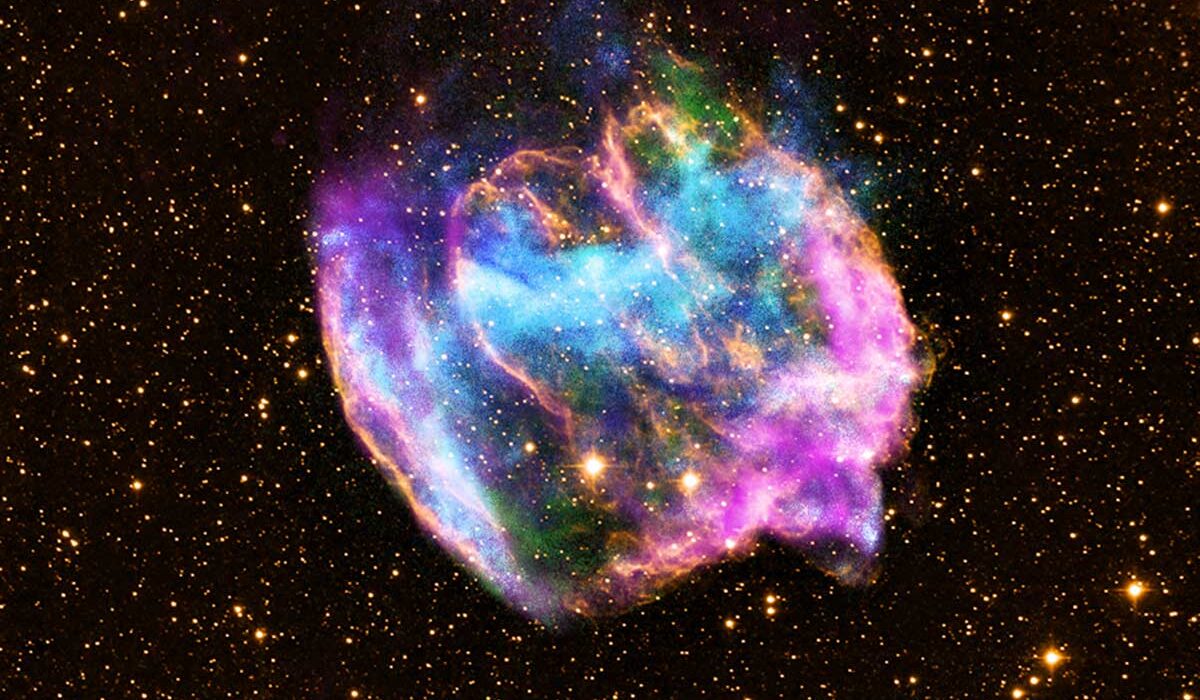
More massive stars end their lives in spectacular explosions called supernovae. These explosions release enormous amounts of energy and scatter heavy elements into space.
These elements—such as carbon, oxygen, iron, and calcium—become part of new gas clouds that will later form stars and planets.
Every atom in the human body was forged in the hearts of ancient stars within the Milky Way. In a very real sense, we are made of stardust.
The Invisible Influence of Dark Matter
Although the Milky Way contains vast numbers of stars and clouds of gas, these visible components account for only a fraction of the galaxy’s total mass.
Astronomical observations reveal that the galaxy rotates in a way that cannot be explained by visible matter alone. Stars far from the galactic center move faster than expected, suggesting the presence of additional unseen mass.
This mysterious substance is known as dark matter.
Dark matter does not emit, absorb, or reflect light, making it invisible to telescopes. However, its gravitational influence is unmistakable.
Scientists believe the Milky Way is surrounded by a massive halo of dark matter that extends far beyond the visible disk of stars.
Understanding dark matter remains one of the greatest challenges in modern astrophysics.
The Milky Way Among Other Galaxies
The Milky Way does not exist alone in the universe. It belongs to a small collection of galaxies known as the Local Group.
This group includes more than fifty galaxies, ranging from large spirals to tiny dwarf galaxies. Among them, one stands out as the Milky Way’s closest large neighbor: the Andromeda Galaxy.
Andromeda lies about 2.5 million light-years away and is roughly similar in size to the Milky Way.
Observations reveal that the two galaxies are slowly moving toward each other. In about four billion years, they will collide and merge to form a single larger galaxy.
Although the word “collision” may sound violent, the vast distances between stars mean that individual stars will rarely crash into one another. Instead, the galaxies will gradually reshape each other through gravitational interactions.
This future event reminds us that galaxies are not permanent structures but evolving systems shaped by cosmic forces.
Humanity’s Discovery of the Milky Way
For much of human history, people did not know that the Milky Way was a galaxy filled with stars. The hazy band in the sky remained a mystery.
The breakthrough came when telescopes became powerful enough to reveal its true nature. Observations showed that the Milky Way was composed of enormous numbers of faint stars.
Later studies mapped the distribution of stars and gas, revealing the galaxy’s spiral structure.
Astronomers gradually realized that the Milky Way was only one galaxy among many. This discovery transformed humanity’s understanding of the universe, expanding it from a single galaxy to a cosmos filled with countless galaxies.
Our Place in the Galactic Story
When we look up at the Milky Way on a dark night, we are seeing our cosmic home from the inside. Each faint point of light represents a distant star, perhaps with its own planets and possibilities.
The galaxy stretches far beyond what the eye can see, filled with wonders we are only beginning to understand.
From the formation of stars to the influence of black holes, from the birth of planets to the mysterious presence of dark matter, the Milky Way contains the ingredients of cosmic history.
Our solar system occupies only a tiny corner of this vast structure, yet through science and exploration, humanity has begun to uncover its secrets.
The Endless Mystery of Our Galaxy
Even after centuries of study, the Milky Way still holds countless mysteries. Astronomers continue mapping its stars, studying its structure, and searching for new insights about its origin and evolution.
New telescopes and space missions are revealing hidden regions of the galaxy in unprecedented detail. Instruments capable of detecting radio waves, infrared light, and high-energy radiation allow scientists to peer through cosmic dust and observe distant regions of the galaxy.
Each discovery adds another piece to the puzzle of our galactic home.
The Milky Way is not merely a distant astronomical object. It is the vast environment in which our planet formed and life emerged. It is the cosmic city that surrounds us, filled with stars beyond counting.
When we gaze into the night sky and see that pale glowing river of light, we are looking at the grand structure that shaped our existence.
And within that river of stars lies an entire universe of stories waiting to be discovered.