Stars have long been thought to dominate the planets that orbit them, but new research suggests the relationship is not entirely one-sided. After analyzing 18 years of observations, researchers found evidence that the giant exoplanet GJ 436 b appears to influence the magnetic activity of its host star, potentially opening a new way to measure the magnetic fields of distant worlds.
For decades, astronomers have viewed stars as the dominant force within planetary systems. Their immense gravity, intense radiation, and powerful magnetic fields shape the evolution of the planets that orbit them. Until now, however, the influence seemed to flow in only one direction.
New findings published in Science challenge that assumption. Researchers report compelling evidence that a giant exoplanet orbiting extremely close to its host star is leaving a detectable magnetic signature on the star itself, suggesting that planets may sometimes play a much more active role in their stellar environments than previously believed.
Stars Usually Control the Relationship
Stars affect their planets in several fundamental ways throughout their lifetimes.
Their gravity can gradually reshape planetary orbits or even lock a planet so that the same side always faces the star. Their radiation and energetic particles can slowly erode planetary atmospheres, stripping away lighter gases over time. Meanwhile, stellar magnetic fields extend throughout the surrounding space, interacting with any magnetic field generated by an orbiting planet.
Because stars are vastly more massive and energetic, scientists have generally assumed that any magnetic influence from a planet would be too weak to noticeably affect the star in return.
The new research suggests that assumption may not always hold true.
A Nearby Red Dwarf and Its Close-Orbiting Planet
The researchers focused on GJ 436, a red dwarf star located about 30 light-years from Earth with roughly half the mass of the Sun.
Orbiting the star is a single known exoplanet, GJ 436 b, a world approximately the size of Neptune with about four times Earth’s mass. What makes the planet especially interesting is its extremely tight orbit. It circles its host star once every 2.6 days, placing it remarkably close to the stellar surface.
That close proximity makes GJ 436 b an ideal system for studying whether an exoplanet can interact directly with its star’s magnetic environment.
Eighteen Years of Observations Revealed a Repeating Pattern
To investigate the system, the research team examined 18 years of high-resolution spectroscopic observations.
They tracked emission signatures from hydrogen and calcium in the star’s outer atmosphere. These spectral features are particularly sensitive to changes in magnetic activity, making them valuable indicators of what is happening within the star’s magnetic environment.
The analysis uncovered an unexpected result.
The researchers detected periodic changes in these emission signals that matched the exoplanet’s 2.6-day orbital period. The repeating pattern suggested that the planet was somehow triggering a rhythmic response in the star rather than simply orbiting passively around it.
The Planet’s Signal Was Visible Only Under Certain Conditions
The magnetic signature did not appear continuously throughout the observational record.
During periods when the star was highly active, its own magnetic behavior overwhelmed the planetary signal, making it difficult to detect. During especially quiet periods, there was too little stellar activity for the planet’s influence to produce a noticeable enhancement.
However, when the star reached intermediate activity levels, the periodic pattern became clearly visible.
That behavior provided another clue that the observed signal was linked to the planet rather than being a random fluctuation within the star itself.
A Magnetic Connection Between Planet and Star
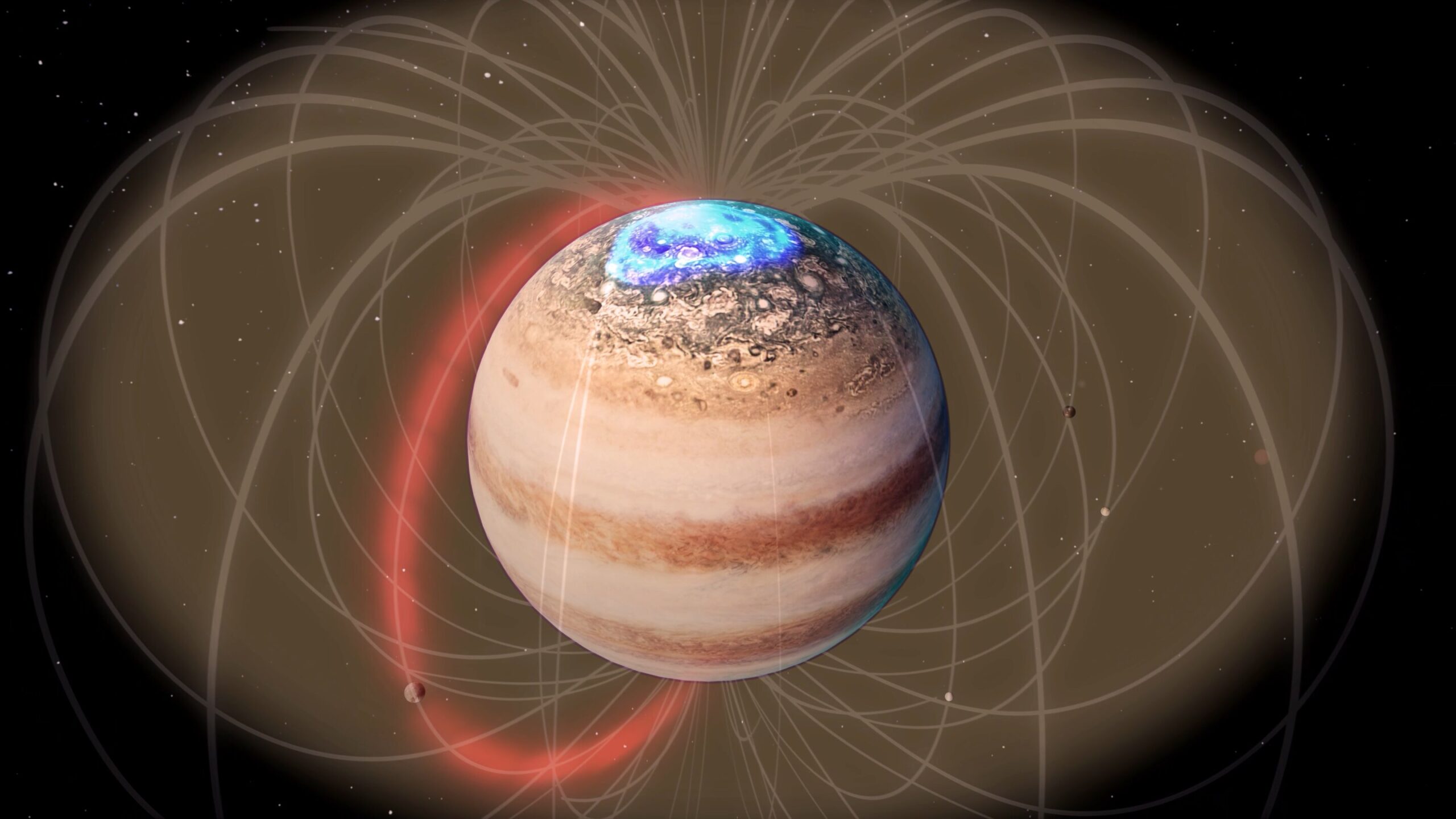
To explain the observations, the researchers developed a model describing a direct magnetic connection between the planet and its host star.
According to the model, magnetic field lines connect the two objects and act as pathways that funnel energy into the star’s outer atmosphere. When the researchers accounted for the star’s rotation along with the planet’s tilted and eccentric orbit, the model successfully reproduced the observed periodic variations.
The modeling also suggested that GJ 436 b’s magnetic field is comparable in strength to Jupiter’s, indicating that the planet possesses a substantial magnetic environment capable of interacting with its nearby star.
A New Way to Study Distant Worlds
The findings point to the possibility that similar magnetic interactions may exist in many other planetary systems.
Hundreds of known exoplanet systems contain giant planets orbiting extremely close to their host stars. If comparable magnetic signatures are found elsewhere, astronomers could gain an entirely new tool for studying planets that are otherwise difficult to investigate directly.
One of the biggest opportunities lies in measuring exoplanet magnetic fields, which have remained notoriously difficult to determine using existing techniques.
Detecting these magnetic interactions could provide valuable information about how distant planets function internally and how they interact with their surrounding environments.
Why This Matters
The discovery suggests that some exoplanets are not merely passive objects shaped by their stars—they may also influence the stars they orbit through magnetic interactions.
If similar star–planet connections are identified in additional systems, astronomers could gain a practical way to measure the magnetic fields of distant exoplanets for the first time. That would improve our understanding of planetary atmospheres, planetary interiors, and how these worlds evolve over billions of years, offering a deeper picture of the complex relationships that exist within planetary systems.