Closer measurements of the nearby exoplanet GJ 3378b have significantly changed scientists’ understanding of the world, reducing its estimated mass from about five Earth masses to 2.3 Earth masses and strengthening the case that it is a rocky planet in its star’s habitable zone. The updated findings make the planet an even more compelling target in the ongoing search for environments that could support life.
The search for life beyond our solar system often begins with a simple question: where could liquid water exist? For astronomers studying planets around nearby stars, that question has now brought renewed attention to GJ 3378b, a world just 25 light-years from Earth that appears more Earth-like than previously believed.
Fresh observations using the Hobby-Eberly Telescope at McDonald Observatory have refined the planet’s properties, revealing that it is likely much lighter than earlier estimates suggested. Those updated measurements increase the likelihood that GJ 3378b is a rocky world rather than one wrapped in a thick, crushing atmosphere, making it a stronger candidate for future studies focused on the possibility of life.
The findings were published in The Astrophysical Journal.
Following the Water in the Search for Life
For scientists searching for potentially habitable planets, water remains the primary guide.
“Our mantra is ‘follow the water,'” explained lead author Paul Robertson, an astronomer at the University of California, Irvine. Because every known form of life on Earth depends on water, researchers first look for planets that orbit within the habitable zone, where temperatures could allow liquid water to exist on the surface.
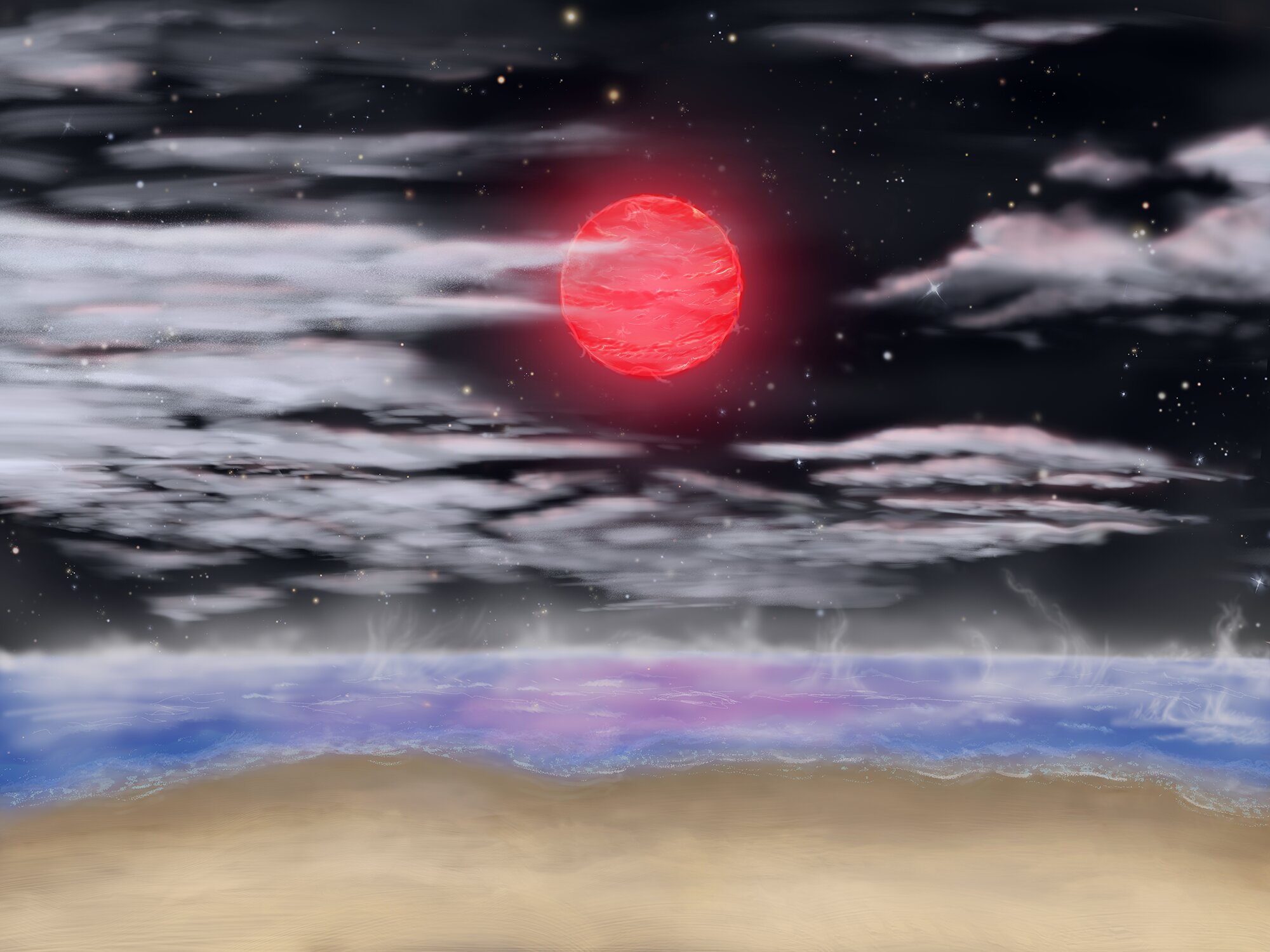
GJ 3378b fits that description. The planet circles a red dwarf star located about 25 light-years away in the northern constellation Camelopardalis. Although the planet completes an orbit far more quickly than Earth, its host star is much cooler and smaller than the Sun, allowing such a close orbit to still place it within the habitable zone.
Why Red Dwarfs Matter
Red dwarfs are the coolest, smallest, and dimmest stars known. Their reddish appearance comes from their relatively low temperatures compared with stars like the Sun.
Despite their faintness, they play an outsized role in the search for life because they dominate the stellar population of the Milky Way.
According to study co-author Michael Endl of the University of Texas at Austin, about 70% of stars in our galaxy are red dwarfs, making them the most common type of star. Understanding the planets that orbit these stars is therefore essential for building a broader picture of potentially habitable worlds across our galaxy.
Detecting a Tiny Planet Around a Faint Star
Studying Earth-sized and super-Earth planets around red dwarfs is especially challenging because both the stars and their planets produce only subtle signals.
To investigate GJ 3378b, the researchers relied on the Habitable-zone Planet Finder, an instrument installed on the Hobby-Eberly Telescope. Rather than observing the planet directly, the instrument measures tiny movements of the host star.
As the planet travels around its star, its gravity creates a slight wobble in the star’s motion. By measuring that wobble with exceptional precision, astronomers can determine the planet’s mass and calculate its orbit.
The Habitable-zone Planet Finder is specifically designed to observe infrared light, which is especially important for studying cool red dwarfs because most of their energy is emitted at infrared wavelengths.
Robertson explained that pairing an infrared spectrometer with a 10-meter (33-foot) telescope provides the light-gathering capability needed to study these faint stars.
Precision is essential throughout the process. Endl emphasized that detecting low-mass planets depends on measuring extremely small signals, making highly accurate instruments indispensable.
A Smaller Mass Changes the Picture
The biggest surprise came from the revised estimate of GJ 3378b’s mass.
When the planet was first identified in 2024, it was believed to have a mass roughly five times that of Earth. The latest analysis reduces that estimate to about 2.3 Earth masses.
That difference has important implications.
Astronomers classify GJ 3378b as a super-Earth, a category describing rocky planets larger than Earth but smaller than gas giants. With the lower mass estimate, researchers say the planet is now more likely to be a rocky world rather than one capable of holding a dense atmosphere that would make surface conditions far less favorable for life.
The team also updated the planet’s orbital period from 25 days to 21 days.
Although that orbit is much shorter than Earth’s 365-day year, the smaller and cooler red dwarf means the planet still occupies the star’s habitable zone. Remaining so close to its host star is necessary to receive enough warmth for liquid water to be possible.
At the same time, the revised orbit introduces another question. The planet’s close proximity may expose it to strong stellar radiation that could gradually strip away any atmosphere it possesses. The researchers say additional observations will be needed to determine whether an atmosphere has survived.
Preparing for the Next Generation of Planet Hunters
Since 2018, the Habitable-zone Planet Finder has helped astronomers identify nearby planets that could become prime targets for future investigations.
GJ 3378b is expected to join a growing catalog of nearby worlds that upcoming observatories will examine in much greater detail.
Future facilities, including the Giant Magellan Telescope, the Extremely Large Telescope, and the Habitable Worlds Observatory, are expected to use their enormous light-collecting mirrors to directly observe planets like GJ 3378b. Those observations could eventually search for biosignatures—chemical indicators that may point to the presence of life.
According to Endl, current efforts remain focused on surveying the solar neighborhood and identifying the nearest planets that offer the best opportunities for future biosignature detection.
Why This Matters
The revised measurements of GJ 3378b show how improved observations can fundamentally change scientists’ understanding of a distant world. By lowering the planet’s estimated mass to 2.3 times Earth’s, the study strengthens the possibility that it is a rocky planet located within its star’s habitable zone rather than a larger world hidden beneath a thick atmosphere.
Although questions remain about whether the planet has retained an atmosphere under the radiation from its nearby red dwarf star, GJ 3378b has become a more promising target for future exploration. As increasingly powerful telescopes come online, planets like this will help scientists move beyond simply discovering distant worlds toward determining which nearby planets might truly offer conditions suitable for life.