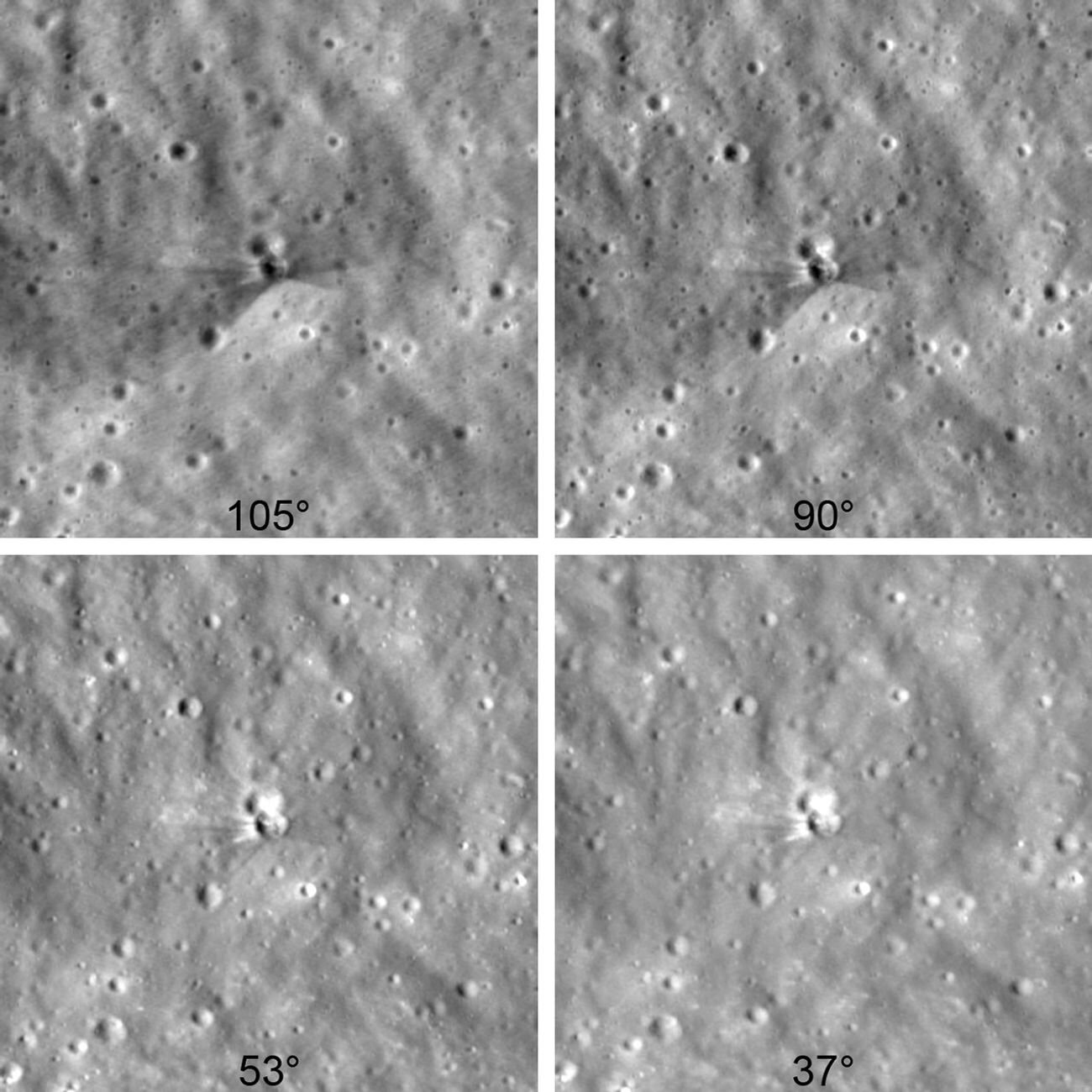
NASA’s Lunar Reconnaissance Orbiter has captured detailed images of a new crater on the moon created when a SpaceX Falcon 9 upper stage struck the lunar surface on Aug. 5, giving scientists a close look at the fresh impact and the material thrown out around it.
LRO had only a narrow chance to photograph the crater
The impact followed the January 2025 launch of the Firefly Blue Ghost 1 mission. NASA’s Lunar Reconnaissance Orbiter, or LRO, photographed the resulting crater between Aug. 11 and 12.
Getting the spacecraft into position required careful planning. LRO passes about 60 miles (97 kilometers) above the moon while traveling roughly 1 mile per second (1.6 kilometers per second). Its orbit carries it from pole to pole every two hours, while the moon slowly rotates beneath it.
That meant the spacecraft could not simply turn toward the impact site whenever it was needed. Engineers had to wait until the moon’s rotation brought the location into view. In this case, that took six days.
The timing was also extremely precise. If LRO’s camera had taken its picture just 10 seconds too early or too late, the target would have shifted about 10 miles (16 kilometers) away from the center of the image.
Engineers tilted the spacecraft during each suitable pass so its cameras could point toward the new crater.
The crater is about 60 feet wide
LRO’s Narrow-Angle Camera was able to resolve features as small as about 3 feet (1 meter) across. Images taken from different viewing angles also exposed the crater to different lighting conditions, helping scientists examine its shape.
The crater’s rim measures about 60 feet (18 meters) across. Its depth is less than 10 feet (3 meters), based on the length of the crater’s shadow.
The images also reveal rays extending outward from the impact site. Some are dark, while others near the rim are brighter.
The darker material consists of lunar dust and rocks that have been altered over long periods by solar wind, galactic cosmic rays and micrometeorite impacts. The impact excavated this weathered material from about 1.5 feet (46 centimeters) below the surface.
The brighter rays consist of fresher material brought up from deeper underground during the collision.
Scientists predicted the impact location before LRO arrived
Locating the crater involved observations and calculations from people and teams working in different places.
Independent astronomers first determined the rocket’s trajectory using publicly available data. NASA’s Center for Near Earth Object Studies then used the event to test and validate tools and techniques for predicting impacts.
The center, based at NASA’s Jet Propulsion Laboratory in Southern California, gradually refined the trajectory until it identified a predicted impact location. That information was provided to the Republic of Korea’s Korea Pathfinder Lunar Orbiter, known as Danuri.
A few hours later, Danuri’s high-resolution LUTI camera photographed the crater. The resulting image showed that the predicted location was accurate to about 0.6 miles (1 kilometer).
The Danuri team then sent the crater’s coordinates to the LRO team. Those measurements helped engineers refine the spacecraft’s follow-up imaging sequence.
By comparing the new crater images with photographs taken before the impact, the LRO team updated the crater’s center coordinates to 19.4759°N, 266.7138°E, at an elevation of 511 meters (1,677 feet).