Astronomers expect the cosmos to surprise them, but every so often it produces an event so strange, so spectacularly out of line with the norm, that even seasoned researchers pause. GRB 250702B was one of those anomalies. What began as a flash of gamma rays detected on July 2 ultimately unraveled into a puzzle unlike anything documented in half a century of watching the sky. A Rutgers astrophysicist, Huei Sears, is among the scientists working to understand why this explosion refused to behave.
Gamma-ray bursts—GRBs—are typically brief and violent finales of massive stars collapsing into black holes. They ignite, blaze for seconds, and vanish. That script has held for decades. But GRB 250702B read none of it. Instead, it continued for hours, sending bewildering signals across multiple wavelengths and forcing astronomers back to the drawing board.
“This object shows extreme properties that are difficult to explain,” Sears said, capturing the bewilderment that has now spread through observatories worldwide. “Usually, these bursts are over in less than a minute, but GRB 250702B lasted for hours and even showed signs of X-ray activity a day prior.”
The universe had thrown a curveball—and researchers are still chasing its arc.
When the Flash Wouldn’t Fade
What first startled astronomers was the duration. Gamma-ray bursts can be long by cosmic standards, but even the outliers end quickly. GRB 250702B, however, unleashed waves of gamma rays for at least seven hours. That alone placed it in a category of one, stretching nearly twice as long as the previous record-holding burst. X-ray activity preceding the explosion made the sequence even more perplexing.
NASA’s Fermi Gamma-ray Space Telescope sounded the alarm, prompting telescopes both in orbit and on Earth to point their sensors toward the unexpected beacon. The outburst was so intense and so sustained that no single instrument could track all of its complexities. Observatories collected gamma rays, X-rays, infrared light, and radio waves in a coordinated global effort—yet none of them saw so much as a flicker in visible light.
“Only through the combined power of instruments on multiple spacecraft could we understand this event,” said Eric Burns of Louisiana State University.
Even with that combined effort, clarity remained elusive. The data told a story of extraordinary violence, but its cause remained blurred.
A Feast, Not a Snack
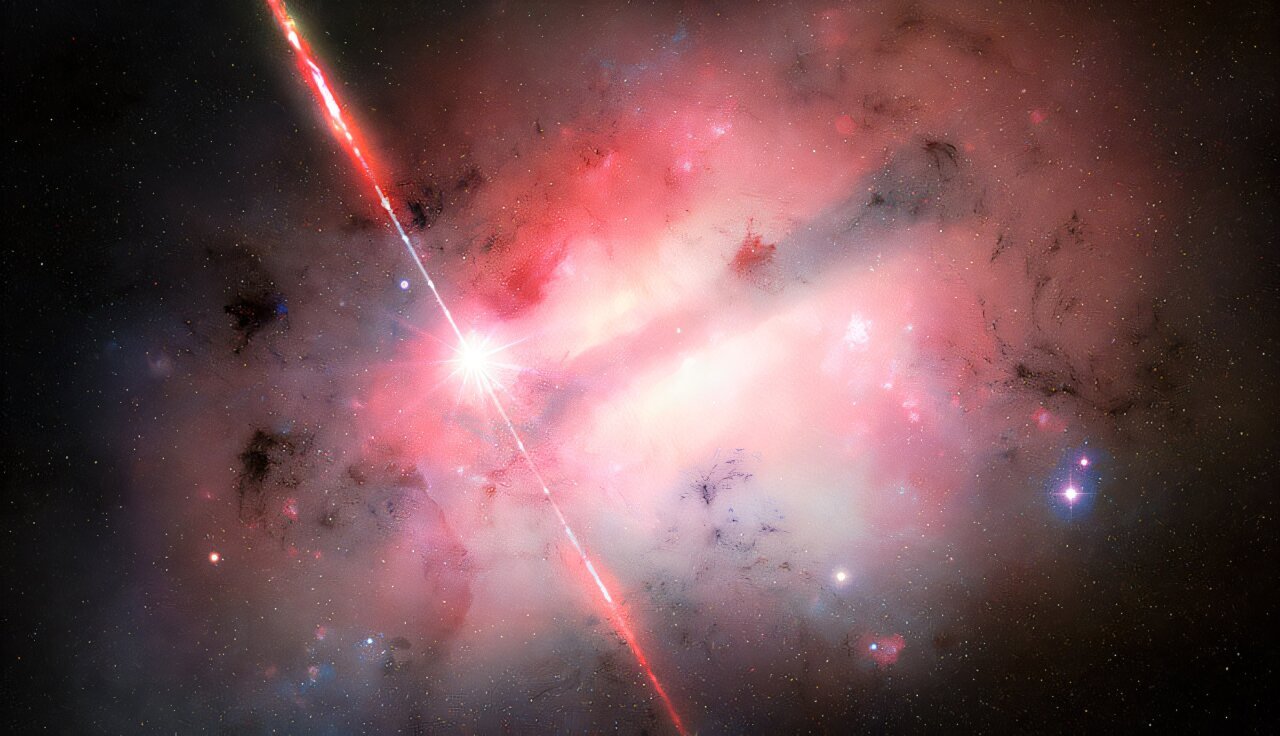
Theorists quickly began proposing explanations, each as dramatic as the burst itself. NASA released an animated scenario suggesting a black hole about three times the mass of the Sun—tiny by cosmic standards, with an event horizon barely 11 miles across—spiraling into and merging with a companion star. Such a collision could unleash torrents of energy for hours.
“This is certainly an outburst unlike any other we have seen in the past 50 years,” said Eliza Neights of NASA’s Goddard Space Flight Center.
Others argued that the event might not be a gamma-ray burst at all. Perhaps a middleweight black hole, thousands of times heavier than the Sun, had torn apart a star that wandered too close—a violent tidal disruption event. Still others floated a more exotic possibility: a smaller black hole might have merged with a stripped-down helium star, devouring it from within.
In every scenario, the black hole was not delicately sipping matter. It was devouring a star in a cosmic feast, powering colossal jets of energy that sliced through space and reached Earth eight billion years later.
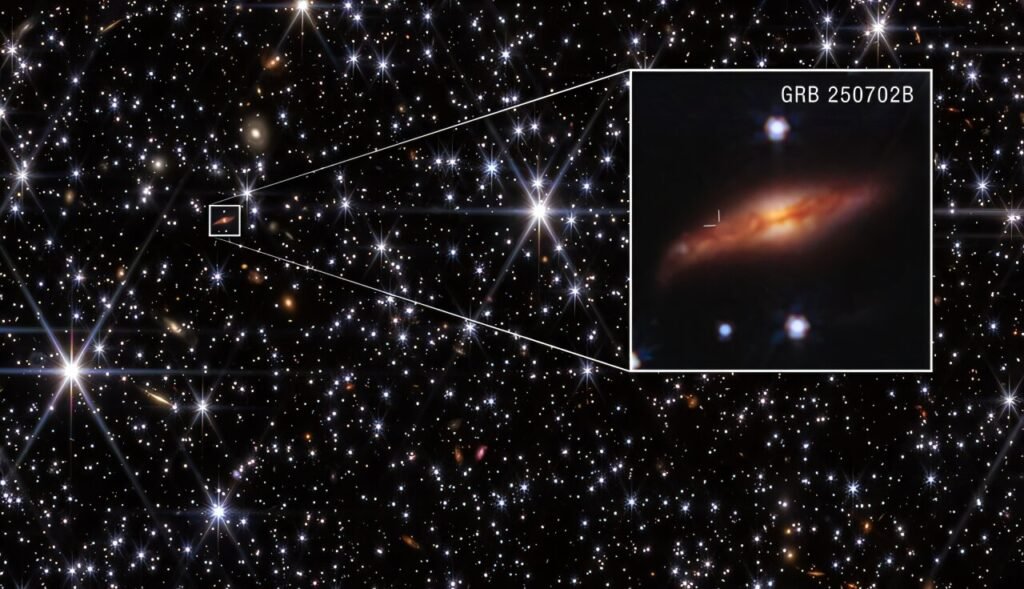
That timeline adds another layer to the wonder of the discovery. Hubble Space Telescope images initially showed what looked like two galaxies merging or a single galaxy cleaved by a streak of dust. Webb’s later spectrum settled the question, revealing a single, massive galaxy about 8 billion light-years away. The burst, then, occurred before Earth existed—long before the Sun formed, long before any planet circled it.
A Galaxy with Secrets of Its Own
To clarify the nature of the galaxy hosting the explosion, Sears led follow-up observations with the James Webb Space Telescope’s NIRCam months after the event. The images revealed a structure both vivid and complex: a single enormous galaxy veined by a dark dust lane, the exact kind of environment that can harbor rare and powerful phenomena.
“In such vibrant and unprecedented detail, we see just one very large galaxy with a dust lane,” she said. “The galaxy has such a complex structure that it’s not 100% clear if there’s anything left to see of the explosion, but if there is, it’s really faint.”
The faintness matters. If the event had been a tidal disruption—a star shredded by a midweight black hole—astronomers might expect lingering emissions that remain visible longer. The near-invisibility of any afterglow points the needle back toward an extraordinary gamma-ray burst. But the case is not closed.
“We have only seen a few tidal disruption events of this type, so we don’t know for sure how they’re supposed to evolve,” Sears said. “A lot of the studies on this explosion provide different, and sometimes contradictory, explanations. It’s still early in our understanding of what really happened.”
In other words, scientists may be witnessing a phenomenon so rare that their existing categories simply do not fit.
On the Edge of the Unknown
As more teams analyze the data, consensus remains slippery. Some evidence points strongly toward a gamma-ray burst, others toward a tidal disruption, and still others hint at the possibility of a completely unclassified type of cosmic explosion. The lack of visible light, the duration, the pre-burst X-rays, the structure of the host galaxy—each clue sharpens one hypothesis while dulling another.
Yet the excitement among researchers is unmistakable. Rare events are the ones that expand scientific frontiers the fastest, precisely because they do not conform to established models. GRB 250702B may be rewriting several of those models at once.
“This gives us a unique chance to study the extremes of how stars and black holes evolve,” Sears said. “GRB 250702B could even be the discovery of something unexpected and new.”
Why This Discovery Matters
GRB 250702B is more than an astronomical curiosity. It offers scientists a rare glimpse into physical processes that are nearly impossible to study under normal circumstances. Whether the event was a record-breaking gamma-ray burst, an exotic tidal disruption, or something never before seen, it taps into profound questions: How do black holes grow? What happens when stars are pushed to their most violent ends? What extreme conditions shaped the early universe?
This explosion, forged billions of years before Earth formed, now serves as a time capsule illuminating the darkest, most energetic corners of cosmic evolution. By unraveling its mysteries, scientists refine their understanding not only of black holes and dying stars but of the broader mechanisms governing galaxies and the universe itself.
Events like GRB 250702B are laboratories the universe builds for us, far beyond our reach yet close enough for our telescopes to witness. In studying them, astronomers inch closer to understanding how the cosmos works at its most extreme—and perhaps, someday, to discovering entirely new categories of cosmic phenomena waiting beyond the limits of current imagination.