In the vast expanse of the universe, stars are often eternal performers, moving in quiet, predictable rhythms for millions or billions of years. But sometimes, a star strays too close to a cosmic predator—a supermassive black hole lurking silently at the heart of a galaxy. In such moments, the star’s life ends in a brilliant, violent spectacle. This is the story of one such celestial drama, revealed in the fleeting light of an event called AT2022zod.
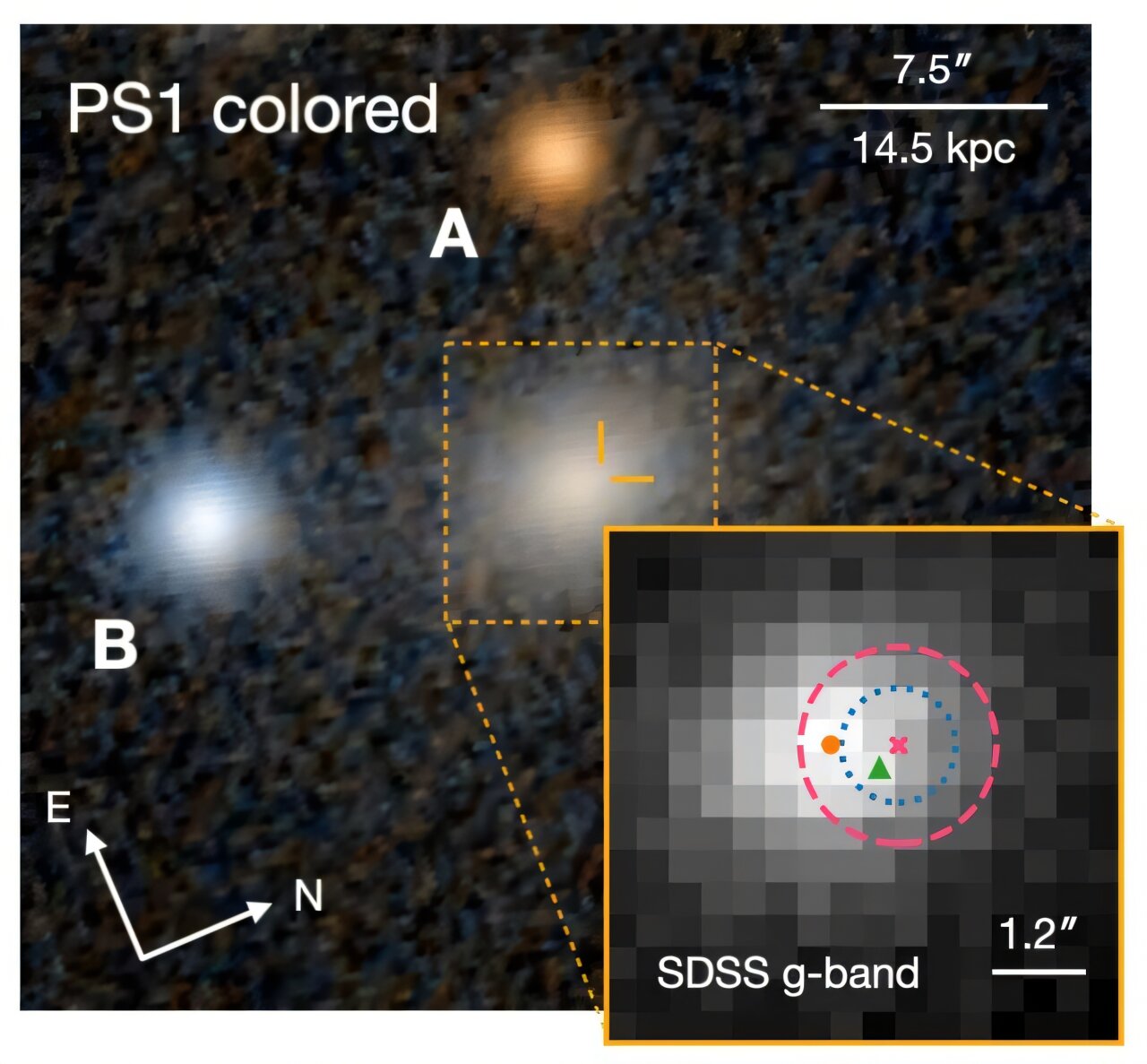
AT2022zod first appeared in the night sky as a subtle optical flare, shining faintly at magnitude 19.2, barely visible against the cosmic backdrop. It emerged in an elliptical galaxy known as SDSS J105602.80+561214.7, situated about 10,000 light-years from the galaxy’s center. The flare lasted just over a month, from October 13 to November 18, 2022, with its light rising steadily over approximately 13.24 days. What initially seemed like a small flicker in the sky soon became the focus of intense scrutiny by astronomers around the world.
The Pursuit of a Cosmic Mystery
A team led by Kristen C. Dage of Curtin University in Perth, Australia, decided to investigate this enigmatic flare. “We examined and systematically constrained several possible origins for the flaring event AT2022zod, including AGN [active galactic nucleus] variability, a supernova explosion, a compact-object merger, and the tidal disruption of a star by a SMBH [supermassive black hole]. We first characterized the photometric and temporal properties of AT2022zod,” the researchers explained.
Their investigation was meticulous. They measured its brightness, tracked its changes over time, and compared it to other known cosmic events. They considered every possibility—could it be a supernova, an explosive death of a star? Could it be a kilonova, a merger of two dense stellar remnants? Perhaps it was just a fluctuation in the galaxy’s central black hole, an active galactic nucleus revealing a brief surge. Each theory was weighed carefully against the observed data.
A Flare Unlike Any Other
What emerged was remarkable. AT2022zod was not a run-of-the-mill flare. It was unusually luminous, reaching a peak brightness far higher than other transient events of similar duration. Its characteristics did not match the expected patterns of known phenomena such as AGN variability, supernovae, or periodic tidal disruptions. The data was telling them something extraordinary was unfolding.
The researchers propose a scenario that challenges conventional understanding: AT2022zod may be a tidal disruption event, but not by the central supermassive black hole. Instead, it could involve a massive black hole in the intermediate-mass range, possibly embedded in an ultra-compact dwarf galaxy within the larger host galaxy.
“We argue that the most likely origin is a UCD embedded in the host galaxy, hosting its own massive black hole,” the team writes. This is a tantalizing hint that the universe may harbor hidden black holes, smaller than the supermassive giants at galactic centers, but still powerful enough to shred a star and create a brilliant flare visible across millions of light-years.
When Stars Meet Their End
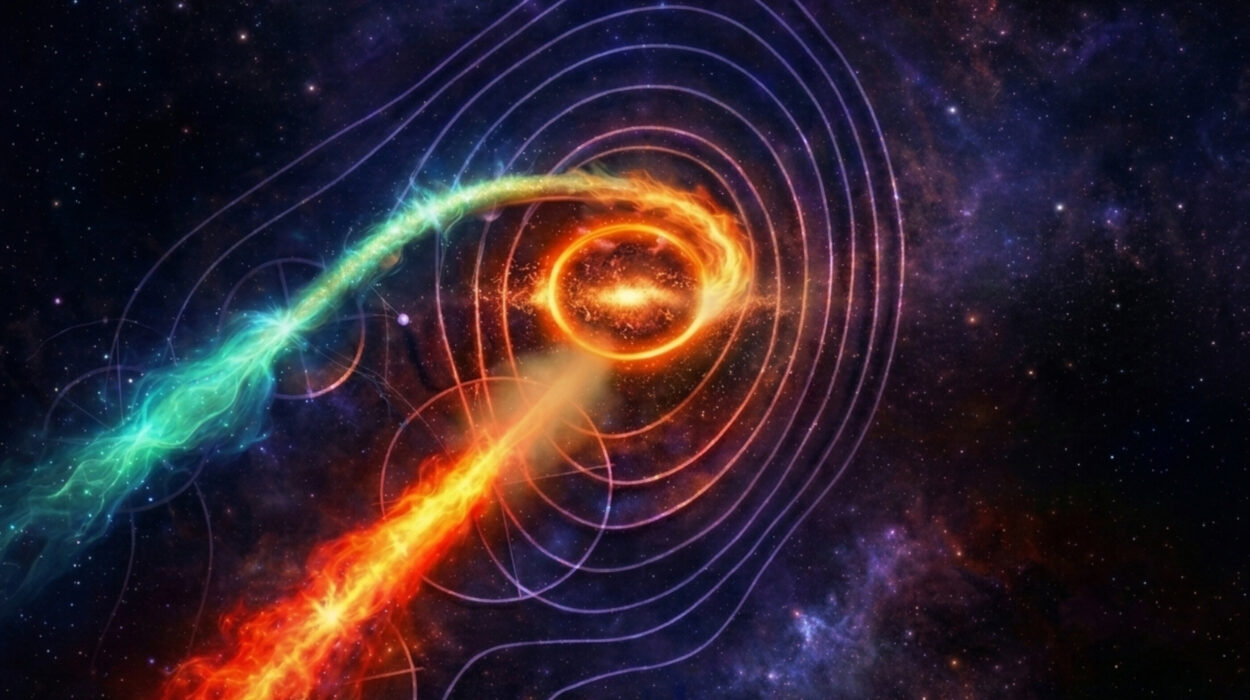
Tidal disruption events occur when a star ventures too close to a black hole and is torn apart by the immense gravitational forces. The stellar debris spirals inward, heating up as it accretes onto the black hole, emitting intense radiation. This process, while violent and destructive, is also illuminating. It allows astronomers to witness phenomena that are otherwise invisible, offering a rare glimpse into the invisible engines of the cosmos.
The case of AT2022zod adds a new twist to this story. Its unusual luminosity and location suggest that stars may not only meet their end near the supermassive black holes at galactic centers. Intermediate-mass black holes, quietly lurking in ultra-compact dwarf galaxies, could also play the role of cosmic predators. The flare becomes a signature, a message carried across the universe, revealing the hidden presence of these elusive objects.
Expanding Our Cosmic Census
Understanding events like AT2022zod is more than an academic exercise. Each tidal disruption event provides a window into the population of massive black holes across the universe. By finding and studying these unusual flares, astronomers can improve the census of black holes, extending our knowledge to higher redshifts and earlier cosmic epochs.
The team highlights the importance of future observations. Instruments like the Vera C. Rubin Observatory will be crucial in detecting more of these rare, luminous flares. Each new discovery will help map the distribution of black holes, shed light on their growth, and illuminate the extreme environments where stars meet their end.
AT2022zod is a reminder that the universe is full of hidden dramas, waiting to be seen. A star, in its final moments, can light up a galaxy and challenge our understanding of the cosmos. The flare tells a story of destruction and illumination, of forces beyond imagination, and of the cosmic detectives who patiently decode the signals sent across space and time.
Why This Discovery Matters
The significance of AT2022zod lies not just in its brilliance but in the secrets it reveals about the hidden population of massive black holes. By studying such events, astronomers can learn how black holes of different sizes influence their surroundings and trace the pathways of stellar evolution in extreme environments. Each tidal disruption event is both an end and a beginning—a death of a star and a revelation about the universe.
AT2022zod shows that even in a universe that seems vast and empty, there are small, dense regions where incredible forces play out, shaping the cosmos in ways we are only beginning to understand. By chasing these fleeting flares, humanity gains not only knowledge but a sense of wonder, reminding us that the universe is alive with drama, waiting patiently for us to notice.
This is the story of a star, a black hole, and a moment of light that traveled across millions of light-years to tell its tale. It is a story that reminds us why we look up at the night sky: because even the briefest flare can reveal the grandest mysteries of all.
More information: Kristen C. Dage et al, AT2022zod: An Unusual Tidal Disruption Event in an Elliptical Galaxy at Redshift 0.11, arXiv (2025). DOI: 10.48550/arxiv.2512.02136