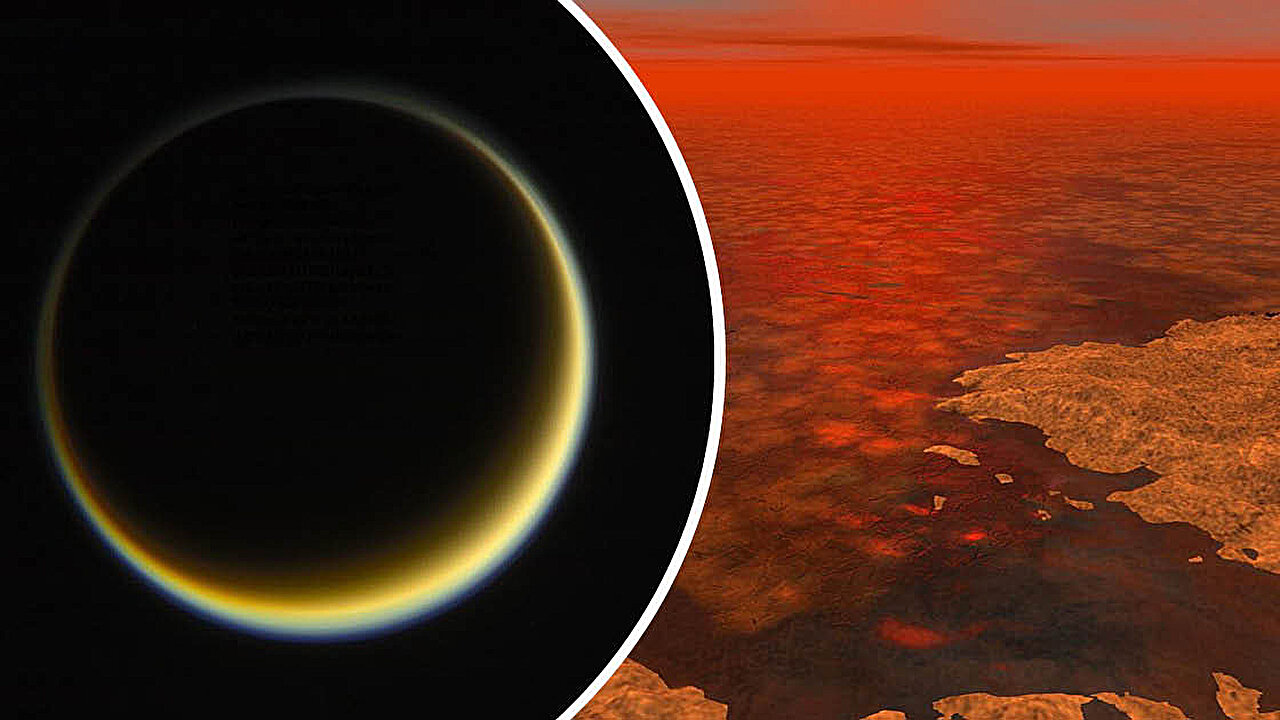
Far beyond our blue planet, orbiting the majestic ringed world of Saturn, lies Titan—an orange-shrouded moon that has fascinated scientists for decades. With its thick, hazy atmosphere and icy surface dotted with methane lakes and dunes, Titan is both alien and strangely familiar. To researchers, it is a time capsule—an echo of what Earth might have looked like billions of years ago, before life took its first breath.
Now, a remarkable new discovery by researchers from Chalmers University of Technology in Sweden and NASA’s Jet Propulsion Laboratory (JPL) has shaken one of chemistry’s most trusted principles. In Titan’s frigid environment, substances that should never mix—polar and nonpolar molecules—appear to unite, forming stable structures that defy conventional wisdom. This revelation doesn’t just rewrite part of chemistry’s playbook—it also deepens our understanding of how life’s building blocks might emerge in the most extreme corners of the cosmos.
Chemistry in a Deep Freeze
On Earth, we know a simple truth from high school chemistry: “like dissolves like.” Polar substances, such as water, tend to mix with other polar molecules, while nonpolar substances like oil remain separate. It’s why oil and water refuse to blend. But on Titan, where temperatures plunge to -180°C and methane rains from the sky, the rules change.
When NASA scientists mixed hydrogen cyanide—a highly polar compound—with nonpolar hydrocarbons like methane and ethane under Titan-like conditions, something astonishing occurred. The molecules didn’t repel one another as expected. Instead, they seemed to come together, forming stable crystalline structures. These were not ordinary crystals, but co-crystals—intricate lattices where molecules of very different natures coexist in harmony.
Such behavior was not supposed to happen. Hydrogen cyanide, methane, and ethane should remain separate, like incompatible worlds. Yet in Titan’s cryogenic environment, chemistry appears to find new pathways, forging bonds once thought impossible.
A Collaboration Across Planets
The discovery began with a question that puzzled planetary scientists for years: what happens to hydrogen cyanide after it forms in Titan’s thick atmosphere? This molecule is believed to be abundant, produced when sunlight and cosmic rays strike the moon’s nitrogen and methane-rich air. But where does it go? Does it accumulate on the surface, forming layers of frozen material, or does it interact with other compounds?
At NASA’s Jet Propulsion Laboratory, a team began experimenting to find out. They cooled mixtures of hydrogen cyanide, methane, and ethane to temperatures near 90 Kelvin—conditions mirroring Titan’s icy world. When they examined the results using laser spectroscopy, they found the molecules remained chemically intact but exhibited strange new spectral patterns. Something had changed, but the exact nature of that change was unclear.
Seeking answers, NASA turned to Martin Rahm, an associate professor of chemistry at Chalmers University in Sweden, whose team specializes in studying hydrogen cyanide’s complex behavior. Together, they launched an international collaboration that combined cutting-edge experiments with powerful computer simulations.
“We asked ourselves a crazy question,” Rahm recalled. “Could methane or ethane actually mix into hydrogen cyanide crystals? That would contradict everything we know about chemistry.”
Breaking Chemistry’s Old Rules
Using large-scale simulations, the Chalmers researchers modeled thousands of possible molecular arrangements, testing how hydrogen cyanide might interact with hydrocarbons at ultralow temperatures. What they found was astonishing: under Titan’s conditions, small hydrocarbon molecules could slip into the rigid crystal lattice of hydrogen cyanide, forming new, stable compounds.
These co-crystals, the simulations showed, would not only remain stable but would also produce the same spectral signatures NASA had observed. It was a perfect match between theory and experiment.
In essence, Titan’s deep cold acts as a chemical equalizer. At such low temperatures, molecular motion slows to a crawl, and forces that normally repel polar and nonpolar molecules lose some of their strength. The result is a fragile but enduring molecular partnership—one that expands the boundaries of what chemistry can be.
“This doesn’t mean we need to rewrite the chemistry textbooks,” Rahm said with a smile. “But it’s a reminder that the universe always has exceptions. Even our most trusted rules have limits.”
Titan’s Hidden Chemistry
Titan has long been a world of mystery and contradiction. Its atmosphere, thick with nitrogen and methane, mirrors that of early Earth. Its surface holds rivers and seas—not of water, but of liquid hydrocarbons. From afar, it looks eerily Earth-like, yet it is a frozen landscape where temperatures make even metals brittle.
Hydrogen cyanide plays a special role in this alien world. On Earth, the molecule is known for its toxicity, but in the cosmic story of life, it is a vital character. Hydrogen cyanide can combine with other simple compounds to form amino acids and nucleobases—the molecular foundations of proteins and DNA. To see it behaving in such unconventional ways on Titan hints that the moon might harbor the right chemical ingredients for prebiotic chemistry, even if it is far too cold for life as we know it.
“The interaction between hydrogen cyanide and hydrocarbons could help explain Titan’s mysterious surface features,” Rahm noted. “Its dunes, lakes, and seas might involve these unexpected mixtures. They could affect the texture of the moon’s sand or the chemical makeup of its crust.”
Echoes of Life Before Life
The discovery has implications that reach far beyond Titan. Hydrogen cyanide is found across the cosmos—in comets, interstellar clouds, and planetary atmospheres. If it can form co-crystals with nonpolar molecules under extreme conditions, then similar chemistry might occur elsewhere in the universe.
This opens an exciting possibility: the first steps toward life’s chemistry could happen in places once considered too cold or hostile. Life, after all, may not require warmth alone—it may begin wherever molecules find a way to connect, even in the frozen silence of space.
“These findings give us new ways to think about how complex chemistry could occur before the emergence of life,” Rahm said. “They suggest that even in icy, distant worlds, molecular creativity can flourish.”
A Mission on the Horizon
In 2028, NASA plans to launch Dragonfly, an ambitious rotorcraft mission that will soar through Titan’s dense skies and land on its surface in 2034. The spacecraft will study Titan’s atmosphere, its lakes of methane and ethane, and its solid terrain—searching for signs of chemical processes that could resemble the early steps toward life.
The discovery from Chalmers and NASA’s JPL adds a new layer of excitement to that mission. If these co-crystals exist on Titan, Dragonfly may be able to detect them, providing direct evidence of chemistry that defies Earth’s rules. That, in turn, could reshape our understanding of how the universe fosters the potential for life.
Until then, Rahm and his team continue their collaboration with NASA, exploring the limits of hydrogen cyanide chemistry. They hope to uncover whether other nonpolar molecules can also merge with hydrogen cyanide—and if so, what new compounds might form in the icy chemistry labs of the cosmos.
When Science Meets Wonder
Every so often, science encounters something that humbles it—a discovery that reminds us nature is far more inventive than our theories. The findings from Titan are one such revelation. They show that even in the harshest environments, molecules can find surprising ways to interact.
It is a quiet but profound reminder that the story of life—and the chemistry that makes it possible—is still being written. Somewhere in the cold shadows of Saturn’s moon, under an orange sky and a drizzle of methane rain, the universe may be whispering the same question that has long haunted humanity: how did life begin?
In those frozen crystals, forming against all odds, we may have found one more clue—a spark of chemistry’s boundless imagination, waiting to be discovered.
More information: Fernando Izquierdo-Ruiz et al, Hydrogen cyanide and hydrocarbons mix on Titan, Proceedings of the National Academy of Sciences (2025). DOI: 10.1073/pnas.2507522122