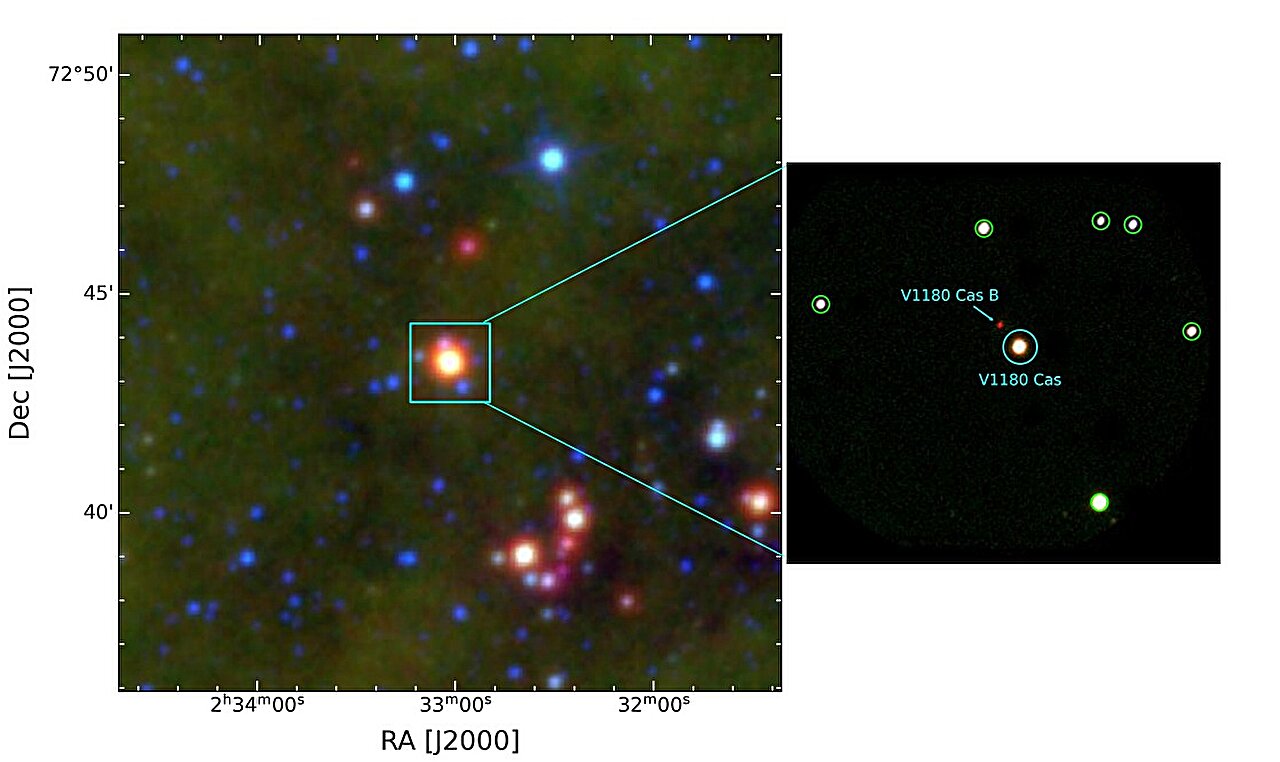
For years, V1180 Cassiopeiae sat quietly in the catalogs of astronomy, a young star behaving much like others of its kind. It flickered and flared, dimmed and brightened, following patterns astronomers thought they understood. But as the years passed and the data piled up, this distant object began to tell a more complicated story, one that refused to fit neatly into a single category.
Now, after a long and careful investigation stretching across more than two decades, astronomers believe they have uncovered the true nature of this enigmatic star. The results, published December 23 on the arXiv preprint server, reveal V1180 Cassiopeiae as something rare: a young stellar object living a double life, shaped by both violent feeding episodes and veils of cosmic dust.
Watching a Star Grow Up in Slow Motion
Young stellar objects are stars in their earliest chapters of life. Still forming, still gathering material, they are often wrapped in thick clouds of gas and dust left over from their birth. These environments are messy and dynamic, and as a result, young stars tend to be restless, changing brightness as they evolve.
V1180 Cassiopeiae is one such star, a pre-main sequence object located about 1,950 light-years away. Early observations led astronomers to classify it as an EXor-type object, a young star known for brief but noticeable outbursts driven by bursts of material falling onto the star. But later studies began to complicate that picture. The star also showed behavior typical of UXor-type objects, whose brightness changes are not caused by feeding frenzies, but by drifting clumps of dust that temporarily block their light.
Faced with these conflicting clues, a team led by Tarak Chand of the Aryabhatta Research Institute of Observational Sciences in India decided to look at the star’s life in full, not just in snapshots. Their approach was simple but demanding: gather every piece of reliable observational data available and let the star reveal its own pattern.
“We combine multiband light curves from 1999 to 2025 with over 30 epochs of optical to near-infrared spectroscopy (0.5-2.5 µm), analyzing variability patterns, color behavior, and emission line diagnostics,” the scientists explained.
Two Decades of Flickers, Fades, and Surprises
When the team laid out more than twenty years of observations, a complex rhythm emerged. V1180 Cassiopeiae did not simply brighten and dim at random. Instead, it went through long and short dips in brightness, each with its own character.
In the earlier years, the dimming events appeared sporadic. These fades matched what astronomers expect when dust drifts in front of a young star, briefly obscuring it from view. But in more recent years, the dips began to change. They became more structured, showing hints of repetition, as if something in the star’s environment was settling into a loose but persistent pattern.
Color played a crucial role in understanding what was happening. When the star dimmed in visible light, its colors reddened, a telltale sign that dust was blocking shorter wavelengths more strongly. Yet during some of these fades, a surprising blueing appeared, a hallmark of UXor-type stars, where scattered light becomes more prominent as direct light is blocked.
In the infrared, the story took another turn. Near-infrared and mid-infrared colors consistently reddened, pointing toward changes in thermal emission rather than simple shadowing. Over time, the mid-infrared brightness slowly increased, suggesting that the structure of the disk surrounding the star was evolving, or that its inner edge was gradually heating up.
Listening to the Star’s Spectral Voice
Brightness alone cannot tell the full story of a young star. To understand what powers its changes, astronomers turn to spectroscopy, breaking starlight into its component colors to reveal chemical fingerprints and physical processes.
The spectra of V1180 Cassiopeiae showed persistent emission lines from hydrogen and calcium, clear indicators of accretion, the process by which material from the surrounding disk falls onto the star. These hydrogen lines grew stronger when the star brightened, linking luminosity directly to how actively the star was feeding.
Alongside these signatures, the team detected forbidden emission lines from oxygen and sulfur. These lines, which arise in low-density regions, are often associated with outflows, streams of material being ejected from the star-disk system. Intriguingly, these forbidden lines became stronger during some of the star’s dimmer phases, hinting at a deep connection between the processes that obscure the star and those that drive material outward.
This interplay suggested that when dust moved into the line of sight, it was not merely blocking light but was part of a broader reconfiguration of the system, affecting both inflow and outflow.
When Dimming Means More Than Dust
As the observations extended into the most recent years, the nature of the dimming events shifted again. The newest brightness dips showed behavior dominated by extinction, but with an important twist. They also reflected a genuine drop in the star’s accretion rate.
The team uncovered a linear correlation between the accretion rate and the star’s brightness in the R-band, a portion of the visible spectrum. This relationship supports a picture in which changes driven by accretion are not acting alone. Instead, they are being modulated by how much dust lies between the star and Earth.
In other words, V1180 Cassiopeiae is not simply switching between feeding and hiding. It is doing both at once, with each process influencing the other.
A Star That Breaks the Mold
Astronomers have long sorted young stellar objects into categories to make sense of their behavior. EXors experience modest, short-lived accretion outbursts. FUors undergo dramatic, long-lasting ones. UXors vary in brightness because of circumstellar dust drifting across our view. But nature, as it often does, resists clean labels.
V1180 Cassiopeiae appears to belong to a growing group of hybrid objects that blend these behaviors. It shows signs of episodic accretion like an EXor, while also exhibiting the dust-driven variability typical of a UXor. Its brightness changes, spectral signatures, and long-term evolution all point to a system where multiple processes are tightly interwoven.
“V1180 Cassiopeiae exhibits a rare hybrid of UXor- and EXor-like behaviors, where extinction, accretion, and outflow processes appear to be tightly coupled and episodic in nature,” the researchers concluded.
Why This Star’s Story Matters
At first glance, the tale of a flickering young star nearly two thousand light-years away may seem distant from everyday concerns. But understanding objects like V1180 Cassiopeiae is essential for grasping how stars, and the planetary systems that often form around them, come into being.
Young stellar objects are laboratories of creation. The balance between accretion and outflow shapes how a star grows and how much material remains in the surrounding disk. Dust structures influence not only what we see, but also where and how planets may eventually form. By observing a system where these elements are clearly linked, astronomers gain insight into processes that are usually hidden or blended together.
The long-term approach taken in this study also highlights the value of patience in astronomy. Only by watching V1180 Cassiopeiae over decades could its dual nature emerge. Shorter studies might have captured only one side of its personality, missing the deeper truth.
In revealing a young star that refuses to be just one thing, this research reminds us that the universe often tells its most important stories slowly. And by listening carefully, across years and wavelengths, scientists can begin to understand not just how stars shine, but how they grow, change, and shape the worlds that may one day surround them.
More information: Tarak Chand et al, Unveiling the Dual Nature of V1180 Cas: UXor-like Dips and EXor-like Bursts Across a Decade, arXiv (2025). DOI: 10.48550/arxiv.2512.20085