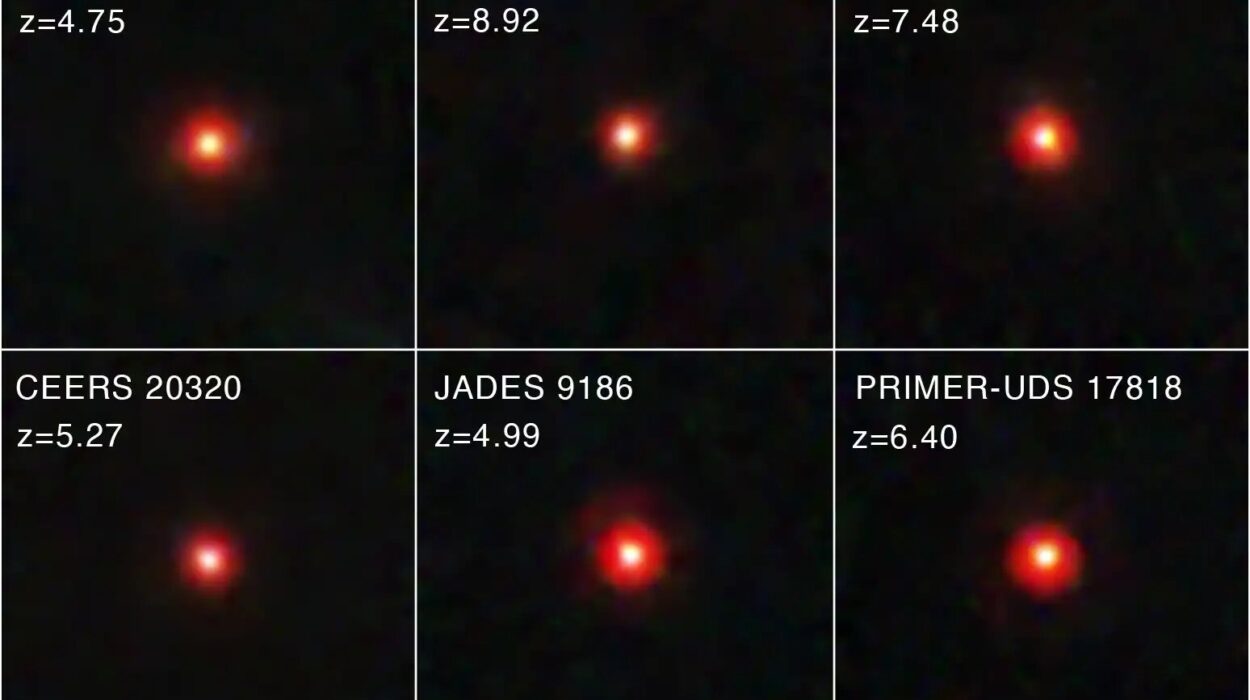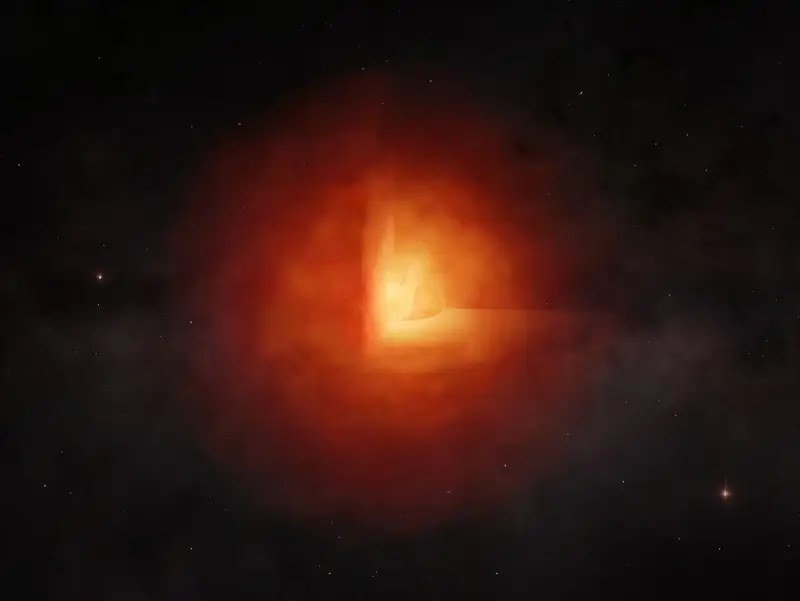
In the vast, silent expanse of the early universe, certain flickers of light have long puzzled the people who study the stars. These tiny, crimson pinpricks, captured in the deepest reaches of space, earned a simple but evocative nickname from the scientific community: little red dots. For years, these objects remained one of the cosmos’s most stubborn mysteries, appearing as compact anomalies that defied easy explanation. However, new insights from the Center for Astrophysics | Harvard & Smithsonian (CfA) are now pulling back the veil, suggesting that these dots are not the complex machines of dust and gravity we once imagined, but are instead the final, glorious gasps of the largest stars to ever exist.
A Crimson Secret Hiding in Plain Sight
The story of the little red dots begins with the nature of light itself. Because our universe is constantly expanding, the light traveling from the most ancient objects must endure a marathon across billions of years of growing space. As it travels, this light stretches, shifting its color toward the redder end of the spectrum. To an observer on Earth, the older and more distant an object is, the redder it appears. This phenomenon meant that for a long time, the earliest chapters of cosmic history were invisible to us.
Earlier generations of space-based observatories, such as the Hubble Space Telescope, were marvels of their time, but they were built primarily to detect shorter wavelengths of light. While Hubble caught glimpses of interesting targets that would later be identified as little red dots, it lacked the specialized “eyes” to see them clearly. They remained blurry, ambiguous shapes on the edge of the map. It wasn’t until 2022, when the James Webb Space Telescope began sending its first deep-space images back to Earth, that the true nature of these objects began to come into focus. Designed specifically to peer into the infrared—the long, stretched-out wavelengths of the early universe—Webb revealed these dots in startling detail. They were mysterious, compact, and incredibly old, existing at a time when the universe was still in its infancy.
The Simple Elegance of a Giant
Once these dots were finally visible, the race was on to figure out what they actually were. Initial theories were dense and complex. Many scientists suspected they were seeing active galactic nuclei—the chaotic regions surrounding supermassive black holes. These models required a complicated arrangement of parts: a central black hole, a swirling accretion disk of superheated material, and thick shrouds of cosmic dust to explain why the light looked the way it did.
But Devesh Nandal, an astronomer at the CfA, and his team began to wonder if there was a simpler answer. Instead of a whole system of moving parts, could a single object explain the data? By creating a detailed physical model, the researchers discovered that a metal-free, rapidly growing supermassive star could produce every single signature Webb was detecting. These stars are behemoths, weighing in at about a million times the mass of our sun.
This new model showed that such a star naturally produces the extreme brightness and the distinctive V-shaped spectrum that had confused astronomers for so long. It also accounted for a rare combination involving a specific, bright hydrogen emission. “Little red dots have been a point of contention since their discovery,” Nandal explained. “But now, with new modeling, we know what’s lurking in the center of these massive objects, and it’s a single gigantic star in a wispy envelope. And importantly, these findings explain everything that Webb has been seeing.”
Watching the Birth of Titans
The discovery of these stars is about more than just identifying a new type of celestial body; it is about witnessing a transformative moment in history. These supermassive stars are not meant to last. They are short-lived giants, burning through their fuel at an incredible rate. The researchers believe that when we look at a little red dot, we are seeing a star in its final, brilliant moments. This is the stage of life that occurs just before the star’s internal pressure fails and it collapses under its own immense gravity.
When a star of this magnitude collapses, it doesn’t just fade away. It leaves behind a heavy “seed”—the beginning of a supermassive black hole. For decades, scientists have theorized that such seeds must have existed to explain how the giant black holes at the centers of galaxies grew so large so quickly. Now, they may finally have the visual evidence to prove it.
“If our interpretation is right, we’re not just guessing that heavy black hole seeds must have existed. Instead, we’re watching some of them be born in real time,” said Nandal. By observing these stars, astronomers are effectively watching the birth of the engines that will eventually drive the evolution of entire galaxies. While many stars across different sizes can match the color measurements of the little red dots, only these ultra-massive giants have the “luminosity,” or sheer power of light, to match what the James Webb Space Telescope is seeing.
Why the Red Dots Change Everything
This research represents a fundamental shift in how we view the construction of the universe. By identifying little red dots as supermassive stars rather than complex black hole systems, scientists have found a direct link between the first stars and the massive structures that dominate the modern cosmos. It provides a clean, physical explanation for a phenomenon that previously required layers of assumptions.
The work also sets a clear path for the future. Nandal and his colleagues are now looking to find more of these objects, specifically those that might be slightly less bright or less massive. Finding a broader range of these “dots” will help them uncover the deeper truths of why and how these giants form in the first place.
Ultimately, this discovery matters because it solves a “missing link” problem in cosmic history. It moves the study of supermassive black holes from the realm of mathematical guesswork into the realm of direct observation. As Nandal noted, “That gives us a much stronger handle on how the universe’s supermassive black holes and galaxies grew.” By looking at these tiny, crimson specks, we are seeing the literal foundation of the universe being poured, one giant star at a time.
More information: Devesh Nandal et al, Supermassive Stars Match the Spectral Signatures of JWST’s Little Red Dots, arXiv (2025). DOI: 10.48550/arxiv.2507.12618