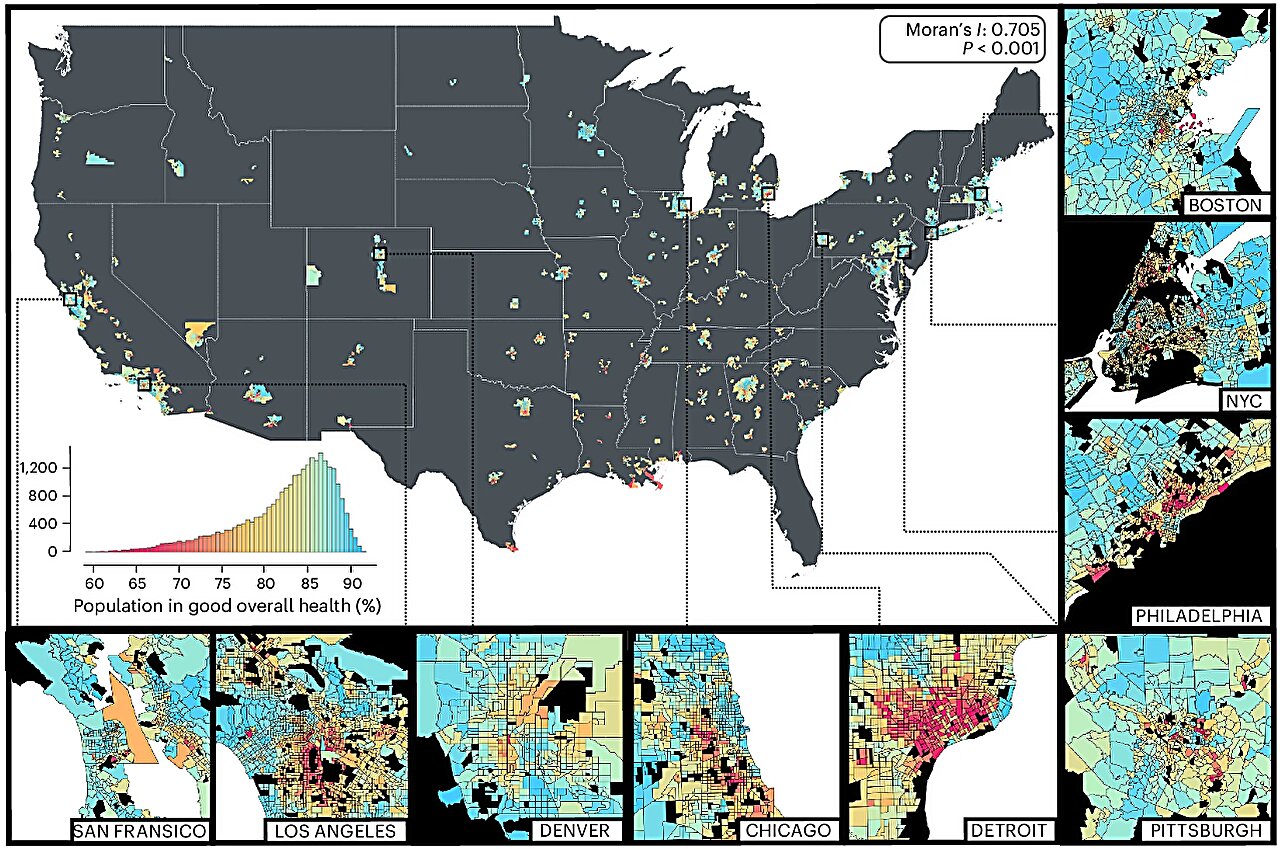
Walking-friendly streets, connected neighborhoods, parks, and mixed-use development are strongly linked to better physical and mental health across the United States, according to a nationwide analysis of 28,323 Census tracts. The findings suggest that thoughtful urban design could become a powerful preventive health tool, with the greatest benefits potentially reaching lower-income communities.
Cities shape daily life in countless ways, but this new nationwide analysis suggests they may also shape health more than many people realize. By examining neighborhoods across the United States, researchers found that the way streets, parks, buildings, and amenities are arranged is closely associated with both physical and mental well-being—even after accounting for socioeconomic differences.
Published today in Nature Health, the study offers one of the broadest looks yet at how urban environments relate to population health and provides practical insights that could help guide future city planning.
Urban Design Emerges as a Major Health Factor
The researchers analyzed 28,323 U.S. Census tracts, combining demographic information from the U.S. Census Bureau with health data from the U.S. Centers for Disease Control and Prevention. They also incorporated geospatial information, including more than 8 million street-view images, to examine how neighborhood characteristics correspond with health outcomes.
Rather than focusing on a handful of cities, the study searched for patterns that remained consistent across urban areas with different layouts, populations, and socioeconomic conditions.
According to co-author Winston Yap, the analysis shows that urban planning and design—including the availability of amenities and how they are arranged throughout a neighborhood—play a critical role in population health.
The researchers emphasized that socioeconomic conditions remain an important driver of health disparities. However, after accounting for those factors, urban design still showed a meaningful relationship with health outcomes.
Walking-Friendly Neighborhoods Benefit Both Body and Mind
The findings indicate that there is no universal blueprint for a healthy city. Instead, multiple design approaches can support well-being as long as they encourage connectivity and easy movement.
Neighborhoods with short, well-connected blocks, a variety of nearby amenities, and opportunities for walking consistently showed positive associations with health.
The study also revealed a strong relationship between good urban design and mental health, not just physical health.
Co-author Fabio Duarte explained that walking offers benefits beyond exercise. Spending more time on foot gives people opportunities to avoid isolation, encounter others unexpectedly, and simply experience the presence of other people in shared public spaces.
These everyday social interactions may contribute to psychological well-being alongside improvements in physical fitness.
Parks, Trees, and Mixed-Use Streets Stand Out
Among the strongest features linked to healthier communities was urban greenery.
Parks consistently ranked as an important element of healthy neighborhoods, while expanding tree canopy also appeared to support better health outcomes.
The analysis further showed that neighborhoods blending residential and commercial activity performed well. Mixed-use buildings located along relatively short blocks create more destinations within walking distance while offering multiple routes through a neighborhood.
Examples highlighted by the researchers include areas such as Manhattan and Boston’s Back Bay, where buildings occupy much of their lots and provide diverse amenities within compact street networks.
Interestingly, the study found that healthy urban form is not limited to traditional grid systems. Although rectangular city blocks often performed well, neighborhoods with curved or circular street layouts could also support wellness when they maintained strong connectivity.
Access to Amenities Makes a Difference
The study found that access to destinations throughout a neighborhood was another important contributor to health.
The presence of cultural institutions, restaurants, and other points of interest was associated with better overall health, while access to health care facilities naturally corresponded with improved physical health outcomes.
Taken together, the findings suggest that neighborhoods offering a variety of destinations within easy reach may encourage healthier lifestyles while supporting broader community well-being.
To better identify which design features mattered most, the researchers applied a graph deep-learning model, an emerging machine-learning technique capable of analyzing complex relationships within large datasets.
This approach helped reveal which combinations of urban characteristics were most strongly connected with neighborhood health.
Data Suggests Cities Can Target Investments More Effectively
The researchers began the project with a practical motivation. They noted that health care systems face growing pressure, making prevention increasingly important for conditions such as obesity, high cholesterol, depression, and other mental health challenges.
The findings suggest that investments in urban design could complement traditional health care by improving environments that support healthier daily lives.
One particularly notable result involved neighborhood investment priorities.
The analysis suggests that improvements made in lower-income neighborhoods could produce roughly four times the health benefits of equivalent investments in wealthier communities that already enjoy strong urban amenities.
According to the researchers, this insight could help planners and policymakers identify where infrastructure improvements may have the greatest public health impact.
The study also highlights the importance of combining openly available demographic, environmental, and health datasets, demonstrating how accessible data can support evidence-based planning for healthier cities.
More Research Is Still Needed
While the findings reveal strong associations between urban design and health, the researchers view this work as one step toward a deeper understanding of how cities influence well-being.
Future studies that track neighborhoods over time could provide additional insight into how changes in urban environments affect health outcomes.
For now, the researchers believe their nationwide analysis offers a broad framework for understanding how the physical structure of cities interacts with the social factors that shape population health.
Why This Matters
The study suggests that healthier communities are not built through health care alone. Walkable neighborhoods, green spaces, connected streets, and easy access to everyday destinations all appear to contribute to better physical and mental health across diverse urban settings.
Perhaps most importantly, the findings indicate that thoughtful urban improvements could deliver especially large benefits in underserved neighborhoods, offering city leaders a data-driven way to improve public health while making communities more connected, accessible, and resilient.