Wildfires are often remembered by what they destroy in the moment. Forests vanish in smoke. Homes collapse into ash. Families flee with little more than what they can carry. When the flames finally die, the world seems to breathe again, as if the danger has passed. But the land remembers in a quieter, slower way. Long after the fire trucks leave and the news cameras move on, the soil itself begins to slip away.
A new study published in Nature Geoscience reveals a hidden aftermath of wildfires that has largely gone unnoticed. When rain falls on scorched landscapes, it does not soak gently into the ground. Instead, it races across the surface, carrying away layers of soil that once held ecosystems together. This process of surface runoff and soil erosion can persist not for months, but for decades.
A Planet Scorched Again and Again
Each year, wildfires burn around 4 million square kilometers of land worldwide, an area roughly equal to the size of the European Union. These fires are not rare disasters confined to a few unlucky regions. They are a global phenomenon, reshaping landscapes across continents.
Despite the scale of this destruction, scientists had never conducted a long-term global assessment of how wildfires affect soil erosion over time. The damage beneath our feet was happening quietly, unmeasured and mostly unaccounted for. To change that, researchers from the European Commission’s Joint Research Center and the University of Basel in Switzerland set out to look beyond the flames.
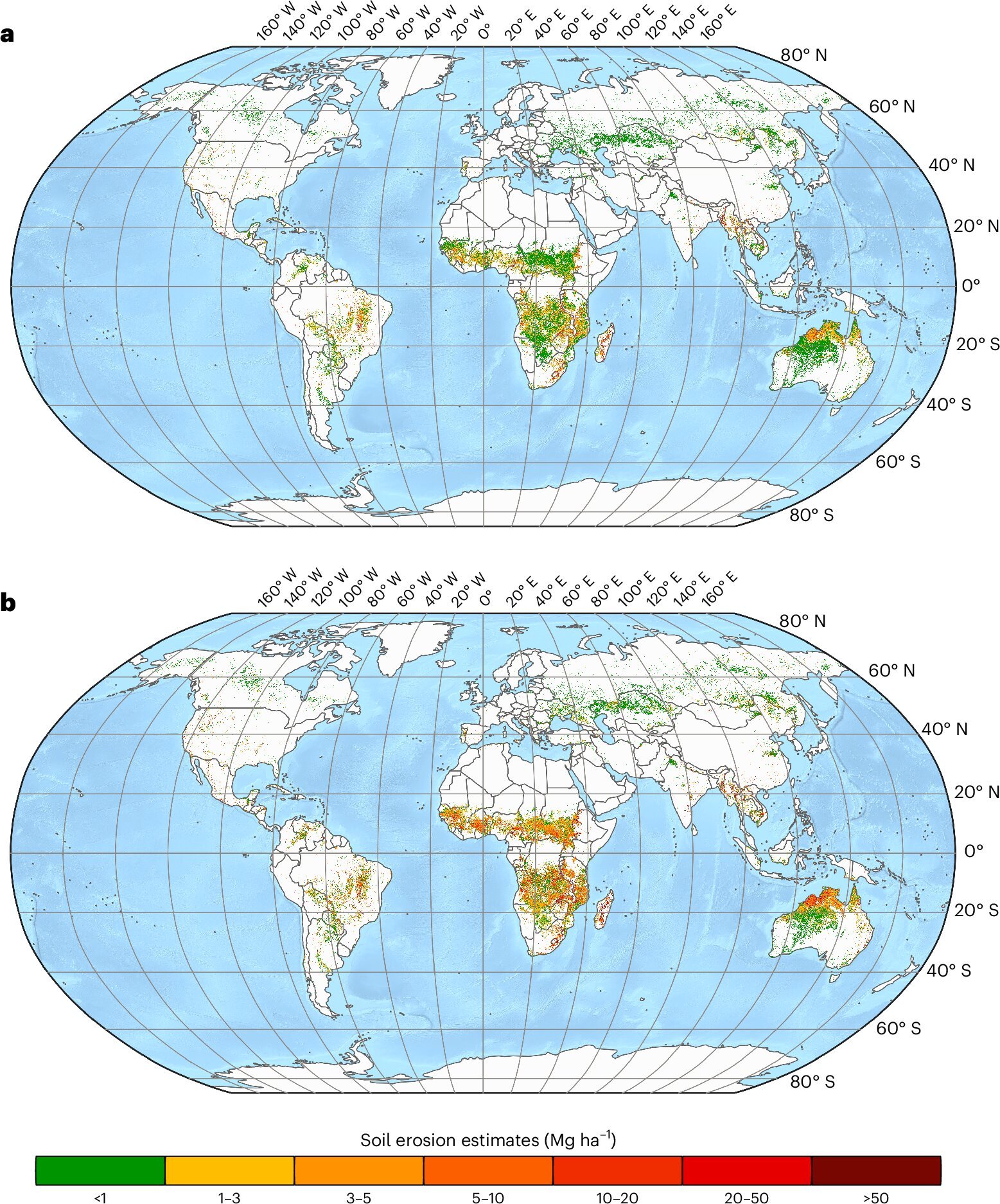
They gathered two decades of data, spanning from 2001 to 2019, and used it to create the world’s first global map of post-fire soil erosion. What they uncovered tells a story far longer and more troubling than the fires themselves.
Teaching a Model to Understand Burned Earth
To measure how much soil is lost after fires, the research team relied on a sophisticated computer model known as RUSLE, short for the Revised Universal Soil Loss Equation. This model estimates how much soil moves across the land based on factors such as vegetation cover and rainfall intensity.
But landscapes after a wildfire behave differently from healthy terrain. Vegetation that once slowed rain and anchored soil is gone. The ground can become more vulnerable, sometimes even water-repellent. To capture this reality, the scientists adapted RUSLE specifically for post-fire conditions.
They then combined the model with satellite data tracking global wildfires over nearly twenty years. By comparing burned areas with how those same places looked before the flames, they could calculate how much soil was lost because of fire, not just immediately, but over time.
The numbers that emerged were staggering.
Billions of Tons Washed Away
According to the study, wildfires are responsible for the loss of 8.1 billion tons of soil every year. That single figure represents 19% of all soil erosion on Earth. Nearly one-fifth of the planet’s soil loss can be traced back to fires and their long shadows.
The damage is not evenly distributed. Africa bears the heaviest burden, accounting for 62% of global post-fire soil erosion. Asia follows with 12%, then South America at 11%, Oceania at 10%, North America at 4%, and Europe at 1%.
These numbers reveal that wildfire-driven erosion is not a regional problem. It is a global imbalance, reshaping landscapes in ways that differ from continent to continent, but add up to a shared planetary loss.
The Long Memory of Fire
One of the study’s most striking findings is how long wildfire damage persists. The common assumption has been that once vegetation begins to return, the land gradually recovers. But the data tells a more complicated story.
Only about 31% of post-fire soil erosion comes from new fires. The remaining 69% is caused by erosion linked to fires that happened years earlier. In other words, most of today’s soil loss is driven by yesterday’s flames.
Even after twenty years, more than 50% of burned areas worldwide have not returned to their pre-fire conditions. The land remains fragile, its defenses against rain still weakened. Each storm becomes another quiet thief, stealing soil grain by grain.
This lingering vulnerability means that wildfires are not isolated events. They set off chains of environmental change that stretch across decades, quietly reshaping landscapes long after the smoke has cleared.
Rain as the Unseen Accomplice
Fire alone does not wash soil away. Rain completes the process. When storms hit burned terrain, water flows faster and more forcefully across the surface. Without plants to slow it down or roots to hold the ground together, soil is easily carried off.
The researchers warn that this problem is likely to intensify. As climate change leads to more intense and frequent rainstorms, post-fire erosion is expected to grow even worse. By 2070, the study estimates that soil erosion linked to wildfires could increase by as much as 28%.
This projection is not a distant abstraction. It is a glimpse into a future where burned landscapes are repeatedly stripped before they can fully heal, caught in a cycle of fire and flood.
Why Waiting Is No Longer an Option
The study’s authors are clear about one thing. Simply waiting for nature to recover on its own is not enough. The scale and persistence of post-fire soil erosion demand deliberate action.
In their paper, the researchers write that their findings “support post-fire management actions towards the mitigation and restoration of affected areas and policies towards land-degradation neutrality.” These are not abstract goals. They reflect an urgent need to protect soil, one of the planet’s most fundamental and fragile resources.
They also emphasize that strengthening global forest resilience is essential. Healthier forests are better able to withstand fires and recover afterward, reducing long-term land degradation and helping ecosystems adapt to a changing climate.
Why This Research Matters
Soil is easy to overlook. It lies beneath our feet, silent and seemingly abundant. Yet it is the foundation of ecosystems, agriculture, and human survival. When soil is lost, it does not quickly return. Its disappearance is often permanent on human timescales.
This research matters because it exposes a hidden cost of wildfires that extends far beyond the flames. It shows that fires are not just moments of destruction, but triggers for decades of quiet erosion that reshape landscapes worldwide. By revealing the true scale and duration of post-fire soil loss, the study challenges how we think about recovery, resilience, and responsibility.
Understanding this process is the first step toward protecting the land after the fire ends. Without that understanding, the world risks losing not just forests and homes, but the very ground that supports life long after the smoke has cleared.
Study Details
D. C. S. Vieira et al, Global estimation of post-fire soil erosion, Nature Geoscience (2026). DOI: 10.1038/s41561-025-01876-0