Fresh water from the Congo River does not simply spread gradually into the Atlantic Ocean. New research shows that giant rotating ocean currents can trap large volumes of river water and carry them hundreds of kilometers offshore, revealing that short-lived but powerful events play a major role in moving freshwater across the ocean.
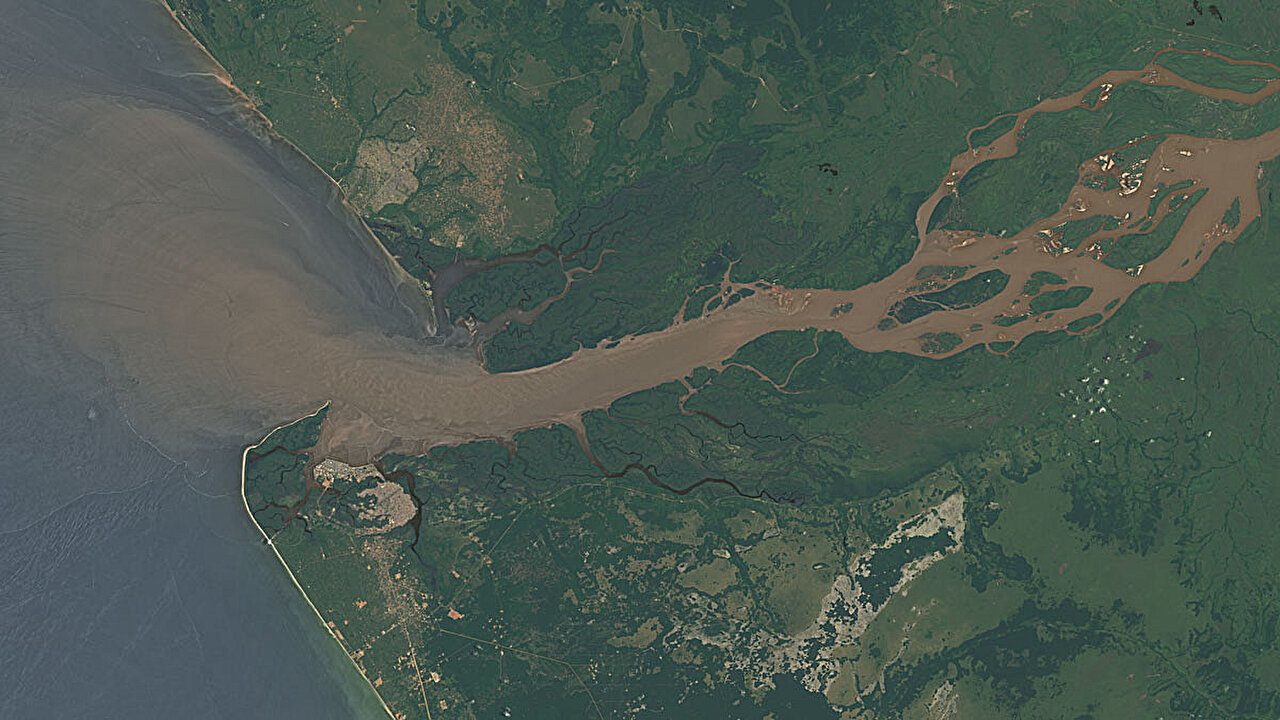
The Congo River pours an average of 40,000 cubic meters of water per second into the Atlantic Ocean, making it the world’s second-largest river by discharge. That enormous flow creates a vast plume of fresh water stretching as far as 800 kilometers (500 miles) from the coast. But exactly how this freshwater reaches the open ocean has remained an important question.
A new study sheds light on that process, showing that swirling ocean currents known as mesoscale eddies can capture freshwater from the Congo River plume and transport it far from the coastline. By combining advanced computer modeling with real-world observations, researchers uncovered how these rotating features dominate freshwater movement during key events rather than through a slow, continuous spread.
The findings were carried out by scientists at the Laboratory of Space Geophysical and Oceanographic Studies (LEGOS) and collaborating laboratories and published in the Journal of Geophysical Research: Oceans.
A Vast Freshwater Plume Extends Deep Into the Atlantic
The Congo River’s extraordinary discharge creates one of the largest freshwater plumes in the Atlantic Ocean. During the wet season, this plume shifts toward the southwest, placing it in a region where it can interact with large rotating ocean currents.
These mesoscale eddies, typically measuring around 100 kilometers (60 miles) across, are capable of capturing portions of the freshwater plume and transporting them well beyond the continental shelf. Understanding this movement is important because the freshwater influences ocean conditions over a broad region.
To investigate the process, researchers focused on the behavior of these eddies and how they interact with the river plume over time.
High-Resolution Modeling Matched Real-World Observations
The research team relied on the NEMO (Nucleus for European Modelling of the Ocean) ocean circulation model, using a detailed 3-kilometer resolution to simulate the Congo River’s discharge into the Atlantic.
The analysis centered on 2016, a year chosen because it offered particularly strong observational records. Scientists compared the model with measurements collected from the Prediction and Research Moored Array in the Tropical Atlantic (PIRATA), along with satellite observations of ocean salinity and currents.
To ensure the simulations accurately represented reality, the researchers validated the model using measurements of sea surface salinity, sea surface height, and surface current data derived from the Automatic Identification System for ship tracking and processed by eOdyn.
The comparison showed that the model successfully reproduced the freshwater plume’s size, position, and seasonal evolution, providing confidence that it could capture the mechanisms responsible for transporting freshwater offshore.
One Rotating Eddy Captured and Carried Freshwater Offshore
Among several notable ocean events during 2016, one stood out.
During March and April, an anticyclonic eddy—rotating counterclockwise in the Southern Hemisphere—formed near the Congo River plume. Over the course of 49 days, the rotating current expanded to a radius of 150 kilometers (90 miles).
Instead of allowing freshwater to gradually mix into surrounding seawater, the eddy trapped low-salinity water within its central core. As it moved, it carried that freshwater approximately 200 kilometers (120 miles) offshore before eventually dissipating.
The observations revealed that these rotating structures can act as temporary transport systems, moving concentrated pockets of freshwater well away from the river’s mouth.
Thousands of Virtual Particles Revealed Where the Water Came From
To better understand how freshwater entered the eddy, researchers conducted particle-tracking experiments.
The team traced more than 5,000 virtual particles backward through time to determine the origins of the water trapped inside the rotating current. Their analysis showed that particles located within the eddy’s core in April could be traced back to the southern section of the Congo River plume during early March.
This reconstruction demonstrated that the offshore freshwater originated directly from the river plume before becoming enclosed within the rotating eddy.
The results also challenged the idea that freshwater primarily spreads through continuous diffusion. Instead, the research indicates that episodic transport events such as this one can dominate the movement of freshwater from the Congo River into the Atlantic Ocean.
Short-Lived Events Can Shape Ocean Freshwater Transport
The study highlights that the journey of freshwater from the Congo River is not always gradual or uniform.
Rather than steadily dispersing into surrounding waters, large rotating eddies can periodically capture substantial amounts of low-salinity water and carry it long distances offshore. These temporary events create an efficient pathway for transporting freshwater across the Atlantic, helping explain how river water reaches areas far from the coastline.
By combining detailed simulations with multiple sources of observational data, the researchers were able to document this process with greater clarity than previously possible.
Why This Matters
Understanding how mesoscale eddies transport freshwater from the Congo River improves scientists’ picture of regional ocean circulation and how freshwater moves through the Atlantic Ocean.
The findings also matter because the Congo River’s freshwater influences marine ecosystems and fisheries that depend on this input. By showing that short-lived rotating currents can dominate offshore freshwater transport, the study provides a clearer understanding of one of the key processes shaping ocean conditions in the region.