Antarctic ice melt may trigger a powerful ocean chain reaction that accelerates further melting, according to a new study published May 15, 2026 in Nature Geoscience. Led by University of Maryland scientist Madeleine Youngs, the research suggests these feedback loops could contribute as much to rising sea levels as the direct warming of the atmosphere.
Antarctica’s melting ice has long been treated as one of the clearest warning signs of a warming planet. But according to new research, the real danger may not just be the melt itself—it’s what that meltwater does next.
A study led by University of Maryland assistant professor Madeleine Youngs argues that many of today’s most influential climate projections may be missing a critical part of the story: the ocean doesn’t simply absorb meltwater. It reacts to it, reshaping circulation patterns in ways that can either accelerate or temporarily slow down further ice loss.
And in some parts of Antarctica, the consequences could be far more severe than current estimates suggest.
The missing factor in sea-level projections
Youngs and her research team focused on how Antarctic meltwater interacts with the ocean’s natural circulation system. Their findings, published May 15, 2026 in Nature Geoscience, point to a major blind spot in how sea-level rise is currently modeled.
Youngs says that most models used to inform international policy do not include ice shelf melt feedback loops. Instead, they treat ice melt as a fixed input—something that happens to the ocean, rather than something that changes the ocean and then feeds back into the melting process.
“Most current climate models that inform international policy don’t consider this feedback loop at all,” Youngs explained. She noted that the Intergovernmental Panel on Climate Change (IPCC) treats melting as a fixed input rather than an interactive one.
Her team’s results suggest that this oversight matters. A lot.
The study indicates that meltwater-driven ocean feedbacks may contribute as much to sea-level rise as the direct impacts of a warming atmosphere.
How meltwater changes the ocean—and speeds up melting
At the heart of the research is a physical process involving temperature and density, two properties that determine how water moves through the ocean.
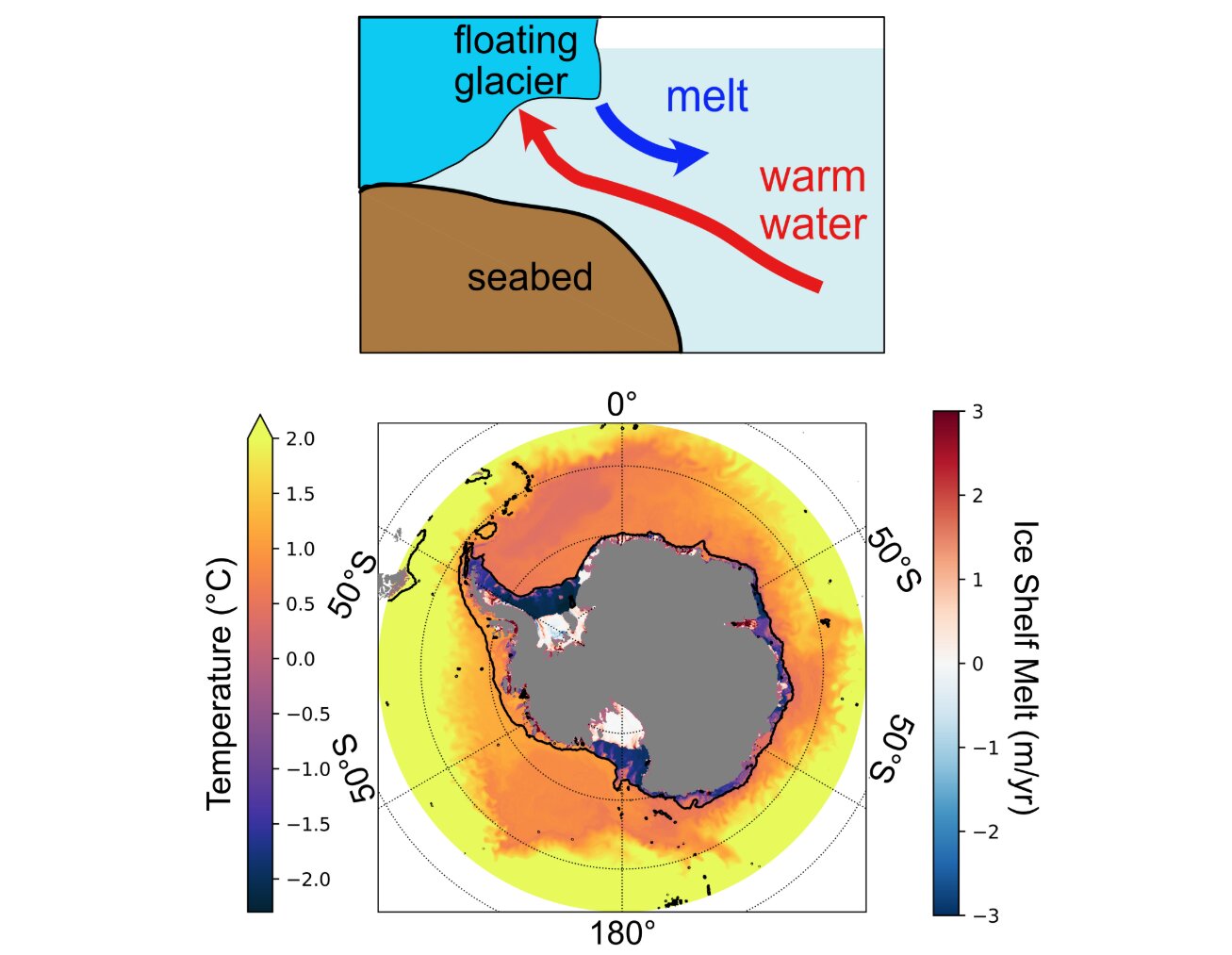
Normally, cold, dense water sinks and forms a protective barrier layer near the ocean floor. That layer acts like a shield, helping block warmer deep-ocean currents from reaching the underside of Antarctic ice shelves.
But when ice melts, it releases freshwater into the ocean. That meltwater is less dense, and when it mixes in, it can dilute and weaken the cold-water barrier.
Once that barrier is weakened, warmer water can push farther inland beneath the ice shelves, melting them from below. That produces even more meltwater, which further weakens the barrier, allowing still more warm water to reach the ice.
The result is a positive feedback loop—a self-reinforcing cycle where melting increases the conditions for even more melting.
“It’s a positive feedback loop where more melt leads to warmer water reaching the ice, which causes even more melt,” Youngs said.
She warned that under continued high emissions, this process could bring the world closer to a climate tipping point sooner than expected.
Why the Weddell Sea may be especially vulnerable
The study found that this feedback effect can become especially dangerous in certain parts of Antarctica.
One of the most concerning regions identified was the Weddell Sea, where the positive feedback cycle appears to amplify rapidly. As ice melts upstream and freshwater enters the ocean, the cold-water barrier erodes. That opens the door for warmer water to flood in, speeding up melting at the base of ice shelves.
In this scenario, the ocean doesn’t just respond to warming—it becomes part of the engine driving further ice loss.
This is exactly the kind of interaction Youngs argues is missing from many climate projections.
A surprising twist near Thwaites Glacier
While the Weddell Sea shows a strong positive feedback loop, the study also found that other high-risk regions behave differently.
In places like the West Antarctic Peninsula and the Amundsen Sea, which includes the Thwaites Glacier—often nicknamed the “Doomsday Glacier”—the feedback pattern becomes more complicated.
Instead of meltwater immediately opening pathways for warm water, freshwater flowing westward from upstream melting can form a colder surface barrier. That temporary barrier can help shield ice shelves from warmer ocean currents, at least for a period of time.
Youngs described this as a negative feedback loop, because the meltwater initially acts in a way that slows further melting rather than accelerating it.
“Our study suggests that these regions—usually regarded as the most at-risk—are actually more protected than we thought, at least in the short term,” she said.
But the study also emphasizes a critical catch: this temporary protection depends on massive upstream melting happening first—a process that still adds significantly to sea-level rise.
In other words, the region may experience a brief slowing of local melt, but only after major ice loss has already occurred elsewhere.
Why current models may be underestimating the threat
The researchers say their work highlights a major gap in how sea-level rise is projected.
Rather than treating Antarctic ice melt as a steady, predictable contribution, the study argues that ice shelf melting should be understood as a dynamic system that actively reshapes the ocean around it.
That matters because the ocean is not a passive background. Its circulation can determine how quickly warm water reaches ice shelves, and meltwater can determine how that circulation changes over time.
The team believes that accurately predicting future ice loss will require models that can capture these shifting feedback loops across different Antarctic regions.
“This is really just a first investigation into this topic,” Youngs said, adding that the feedbacks are real, extremely impactful, and vary depending on where they occur.
The human stakes are enormous
Even small changes in sea-level projections can have global consequences.
Youngs noted that more than 680 million people live in low-lying coastal zones vulnerable to rising seas. If sea levels rise beyond current expectations, storm surges and permanent flooding could expand dramatically in major cities.
The IPCC estimates that Antarctic ice melt could contribute up to 28–34 centimeters of additional sea-level rise by 2100 under high-emissions scenarios. Youngs warned that underestimating feedback-driven melt could push real-world outcomes beyond those already alarming projections.
Even a modest increase beyond the IPCC range could widen the footprint of flooding and increase the reach of storm surges in coastal areas around the world.
What comes next in the research
Youngs’ team is now working on the next stage: building higher-resolution simulations that include meltwater feedback processes and track Antarctic changes from today through 2100.
A key goal is identifying which ice shelves are closest to irreversible collapse, and determining when and where future tipping points may occur.
“The next step is understanding exactly when and where things tip—and what that means for all of us,” Youngs said.
Why this matters
This study challenges a major assumption built into many of the models used to estimate future sea-level rise: that Antarctic melting is a one-way process driven mainly by atmospheric warming. Instead, it shows that the ocean can amplify melting through feedback loops that many models currently ignore.
If these interactions are as influential as the researchers suggest, sea-level rise projections could be missing a major acceleration mechanism—one that could reshape planning for coastal infrastructure, flood risk, and long-term climate policy.
In practical terms, understanding how meltwater changes ocean circulation may be just as important as tracking air temperatures. And for the millions living near coastlines, the difference between conservative estimates and more realistic ones could determine how soon rising seas become an unavoidable crisis.
Study details
Madeleine K. Youngs et al, Antarctic ice-shelf basal melt shaped by competing feedbacks, Nature Geoscience (2026). DOI: 10.1038/s41561-026-01975-6