Scientists using the James Webb Space Telescope have identified a faint galaxy called LAP1-B as it existed roughly 13 billion years ago, just 800 million years after the Big Bang. The galaxy appears to be one of the most chemically primitive ever observed, with gas showing extremely low oxygen levels and other signatures that may hint at the influence of the universe’s first stars.
The early universe is notoriously difficult to study—not because scientists lack curiosity, but because its most important objects are incredibly faint and unimaginably distant. Now, a new discovery is offering an unusually direct look at a galaxy forming near the dawn of cosmic history.
In a study published in Nature, researchers report observations of a faint galaxy known as LAP1-B, captured as it existed around 13 billion years ago. The findings suggest the galaxy may preserve chemical clues linked to the earliest generations of stars, offering a rare glimpse into the universe’s earliest phase of galaxy building.
A galaxy seen near the beginning of cosmic time
Astronomers have long sought galaxies from the era when the first stars began lighting up the universe. These objects are hard to detect because their light has traveled for billions of years and arrives at Earth extremely weak.
That challenge is exactly what the James Webb Space Telescope (JWST) was designed to overcome. Launched in 2021, the observatory has the sensitivity needed to examine the distant universe during the period when early galaxies were still forming.
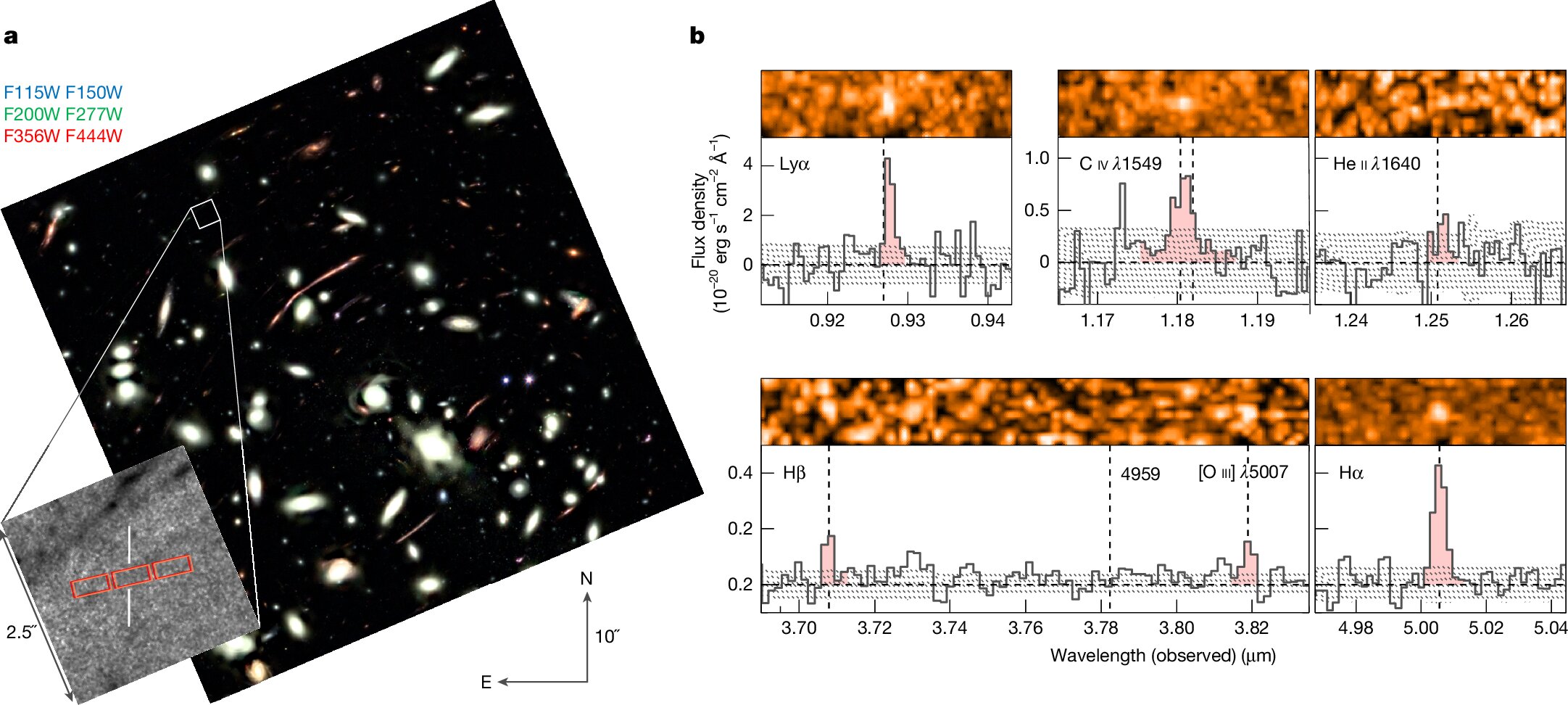
The team behind the new research, led by astronomer Kimihiko Nakajima of Kanazawa University in Japan, focused JWST on a region of the deep universe and identified LAP1-B, a faint galaxy observed from a time when the universe was only 800 million years old.
In their paper, the researchers described the galaxy as a kind of cosmic precursor—what they called a “fossil in the making.” They argue it may represent an early version of the ancient ultra-faint dwarf galaxies that astronomers observe much closer to home today.
A natural “magnifying glass” made LAP1-B visible
Under normal circumstances, LAP1-B would likely have been invisible even to JWST.
What made it detectable was gravitational lensing, a phenomenon where a massive cluster of galaxies between Earth and the target bends and amplifies the distant light behind it. In this case, the lensing effect boosted LAP1-B’s brightness by about 100 times, effectively turning the foreground galaxy cluster into a powerful cosmic magnifier.
That amplification allowed researchers to do more than simply detect the galaxy—it allowed them to study its light in detail.
Most of the galaxy’s glow comes from gas, not stars
When the researchers examined LAP1-B’s brightness, they realized something unexpected: much of the light was not coming directly from stars.
Instead, the galaxy’s glow was dominated by luminous gas clouds. Those clouds emit light when energized, and that light carries a valuable fingerprint of the elements present within the gas.
To decode it, the team split the galaxy’s light into a spectrum and studied its emission lines, which reveal the chemical makeup of the material producing the glow.
That analysis quickly revealed LAP1-B as something extraordinary.
One of the most chemically primitive galaxies ever observed
The emission lines showed that LAP1-B contains almost no heavy elements—materials like oxygen that form later in cosmic history as stars evolve and explode.
The team measured the galaxy’s oxygen abundance and found it to be about 240 times lower than the Sun’s, placing LAP1-B among the most chemically primitive star-forming galaxies ever identified.
This matters because heavy elements accumulate over time. A galaxy with almost none suggests an environment that has undergone very little previous star formation, making it a strong candidate for studying what the universe looked like when the first stars were just beginning to shape it.
Radiation signatures hint at the earliest generation of stars
The team also detected evidence of intense ionizing radiation in the galaxy’s emission lines.
Ionizing radiation is powerful enough to strip electrons from atoms, and astronomers expect it to be especially strong in environments dominated by the earliest kinds of stars. These first stars would have been fundamentally different from most stars seen today, because they formed from gas that contained almost no heavy elements.
The strength of LAP1-B’s ionizing signal aligns with what scientists would anticipate from a galaxy experiencing extremely early star formation.
A chemical ratio that matches predictions for the first star explosions
Perhaps the most intriguing clue came from the galaxy’s chemistry.
The researchers measured an unusually high carbon-to-oxygen ratio, a specific chemical pattern that matches predictions for the earliest stellar explosions in cosmic history.
According to the team, this elevated ratio resembles the theoretical chemical imprint expected from Population III stars—the very first stars believed to have formed in the universe. These stars would have been the first sources capable of forging heavier elements and spreading them into surrounding space through explosive deaths.
The stars most familiar today belong to a later category known as Population I stars, which formed after multiple generations of stellar evolution had already enriched the universe with heavy elements.
The chemistry seen in LAP1-B suggests it may preserve traces of that earliest enrichment process, potentially offering observational support for what until now has largely remained theoretical.
Dark matter appears to hold the tiny galaxy together
The researchers didn’t just analyze the galaxy’s composition—they also examined how its gas was moving.
By measuring the motion and speed of the gas, the team concluded that LAP1-B appears to be gravitationally bound by a large amount of dark matter, an invisible form of matter that does not emit light but exerts gravitational force.
That result suggests LAP1-B is not just a loose cloud of gas and stars, but a structured galaxy held together by a massive dark matter component—an important detail for understanding how early galaxies formed and survived.
A rare snapshot of galaxy formation in progress
Taken together, the findings suggest LAP1-B is not just another distant galaxy. It may represent a transitional stage of cosmic history, when the first stars were beginning to transform the universe from a simple hydrogen-and-helium environment into one enriched with heavier elements.
The team describes the discovery as an unusually rare look into early galaxy growth, stating that their observations offer a direct view into the beginnings of galaxy formation.
In other words, LAP1-B may be showing astronomers what a galaxy looks like when it is still close to its starting point.
Why This Matters
LAP1-B offers scientists a valuable chance to study a galaxy that appears to have formed before the universe became chemically complex. With oxygen levels 240 times lower than the Sun’s, evidence of intense ionizing radiation, and an elevated carbon-to-oxygen ratio, it may preserve chemical signatures linked to the universe’s earliest stars.
Because the first stars are nearly impossible to observe directly, galaxies like LAP1-B may be one of the best ways to understand how the first stellar generations shaped everything that came after. This discovery strengthens the idea that JWST can uncover not just distant galaxies, but early environments that still carry the fingerprints of the universe’s first light.
Study Details
Kimihiko Nakajima et al, An ultra-faint, chemically primitive galaxy forming in the reionization era, Nature (2026). DOI: 10.1038/s41586-026-10374-1
Alexander Ji, Relics of the first stars spotted in a distant, ultra-faint galaxy, Nature (2026). DOI: 10.1038/d41586-026-01151-1