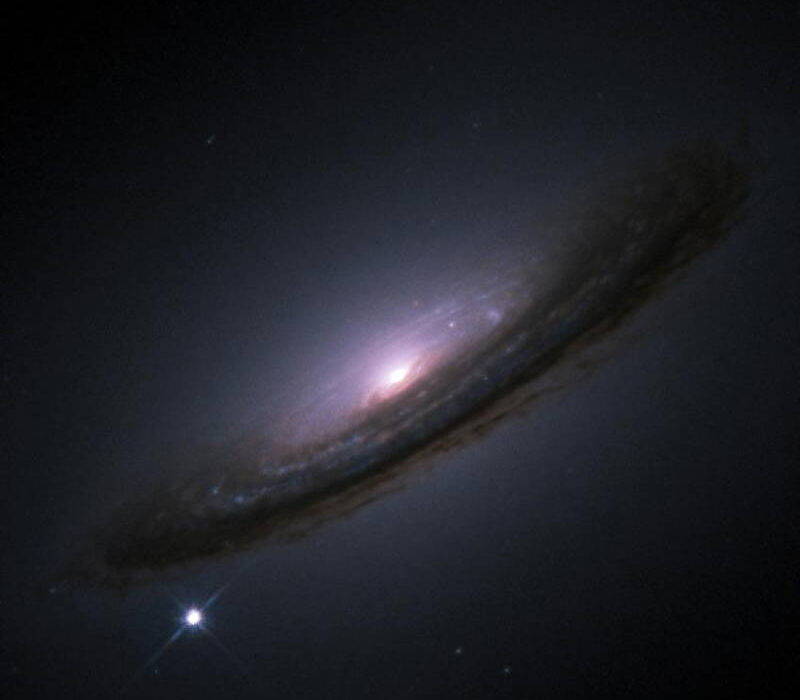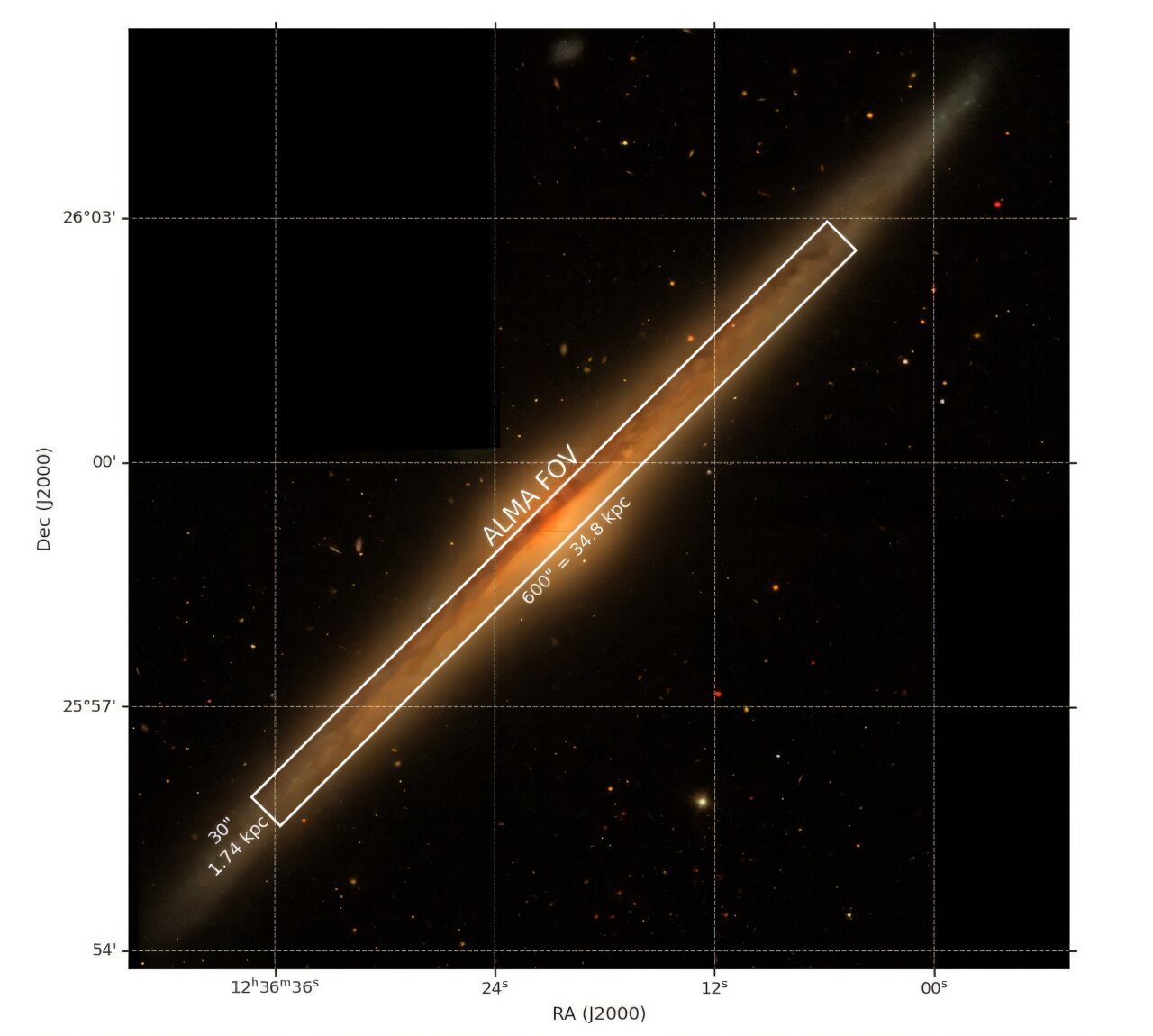
Using the high-resolution capabilities of the ALMA telescope, astronomers have mapped the molecular gas structure of NGC 4565, a Milky Way analog known as the Needle galaxy. The study reveals a surprisingly thin molecular disk with giant molecular clouds that mirror the properties of those found in our own cosmic neighborhood, including a massive star-forming complex dubbed the “East Ring Pileup.”
The cosmos is filled with galaxies of all shapes and orientations, but few are as striking as NGC 4565. Known colloquially as the Needle galaxy due to its remarkably narrow, elongated profile when viewed from Earth, it offers astronomers a rare “edge-on” perspective of a spiral system. This orientation provides a unique laboratory for understanding how gas—the raw material for stars—is distributed across a galactic disk.
Recently, an international team of astronomers led by Grace Krahm of The Ohio State University turned the Atacama Large Millimeter/submillimeter Array (ALMA) toward this slender celestial object. Their findings, published on the arXiv preprint server on April 15, provide one of the most detailed looks yet at the molecular gas residing within the Needle’s interstellar medium. By peering into this distant system, located approximately 39 million light years away, the team is uncovering the mechanical inner workings of a galaxy that bears a striking resemblance to our own Milky Way.
A Galactic Analog in Sharp Relief
The Needle galaxy is more than just a visual curiosity; it is a heavyweight of the local universe. Stretching across 176,000 light years in diameter and boasting a mass of 80 billion solar masses, it serves as a critical analog for both the Milky Way and the Andromeda galaxy. Because we view it edge-on, researchers can study the vertical structure of its gas in ways that are impossible with face-on galaxies.
The team specifically focused on two types of carbon monoxide emissions: 12CO(2-1) and 13CO(2-1). These molecules act as proxies for molecular hydrogen, which is the primary fuel for star formation but is notoriously difficult to detect directly. By mapping these emissions, the researchers were able to resolve structures on the scale of giant molecular clouds (GMCs) across the entire molecular disk. This included venturing into the low-density outer regions where atomic gas typically reigns supreme.
The Architecture of the Molecular Disk
The ALMA observations revealed a distinct radial pattern in how the Needle organizes its matter. At the very center, inside its prominent ring, the galaxy contains surprisingly little molecular gas. Moving outward, the landscape changes into a disk dominated by molecular hydrogen, which eventually transitions into an outer disk composed primarily of hydrogen-iodide. This specific layout mirrors the radial profiles seen in Andromeda and another spiral galaxy, NGC 2775, suggesting a common evolution for large spiral systems.
One of the most significant findings involves the “thinness” of the galaxy. Despite its massive scale, the molecular disk of the Needle galaxy remains remarkably flat. The researchers noted minimal vertical flaring, a phenomenon where a gas disk thickens as it moves further from the galactic center. Even as the radius increases, the gas stays tightly confined to the midplane.
The data also showed that the 13CO/12CO line ratio remained flat over a vast distance, specifically between a radius of 16,300 and 42,400 light years. This consistency indicates that the optical depth and the abundance of different carbon isotopes are uniform across the disk, pointing to a stable and well-mixed interstellar environment.
Anatomy of Giant Molecular Clouds
As the “building blocks” of stellar nurseries, giant molecular clouds were a primary focus of the ALMA campaign. The researchers discovered that these clouds in the Needle galaxy are not randomly oriented. Instead, they are preferentially aligned with the galaxy’s major axis. These clouds exhibit moderate axis ratios of approximately 1.5, giving them a slightly elongated shape.
When analyzing the physical characteristics of these clouds—such as their sizes, velocity dispersions, surface densities, and virial parameters—the team found they were remarkably standard. Even though the Needle galaxy is viewed from a high-inclination angle, the properties of its clouds align closely with those found in galaxies viewed from the top-down. This suggests that the fundamental physics governing cloud formation and stability remains consistent across different galactic environments.
The Jewel in the East Ring Pileup
Among the most exciting discoveries was a massive concentration of gas and light on the galaxy’s ring. The team identified a prominent star-forming complex and named it the “East Ring Pileup.” This region represents a high-density accumulation of molecular gas, acting as a high-output factory for new stars.
Tucked within this pileup is a compact, ultra-bright region the researchers have dubbed the “Jewel.” This specific area shines brightly across multiple wavelengths of light. Its density is so extreme that it is comparable to the most famous starburst regions in our own Local Group, such as 30 Doradus (the Tarantula Nebula). The presence of the Jewel highlights that even in a relatively stable spiral galaxy, localized “pileups” can create the extreme conditions necessary for intense bursts of star formation.
Why This Matters
Understanding the distribution and behavior of molecular gas is the key to unlocking the life cycle of galaxies. Because NGC 4565 is so similar to the Milky Way, studying its “Needle” profile allows astronomers to verify theories about our own home that are difficult to test from our position inside the disk.
The discovery of the “Jewel” and the “East Ring Pileup” provides a rare look at how high-mass star formation occurs in edge-on systems. By proving that the properties of giant molecular clouds remain consistent regardless of a galaxy’s orientation, this study reinforces the idea that the laws of the interstellar medium are universal. These insights into the cycling of gas between different phases help scientists predict how galaxies will evolve, how long they will continue to form stars, and how they eventually grow old and quiet in the vastness of space.
Study Details
Grace Krahm et al, The Radial and Vertical Structure of Molecular Gas in the Edge-On Galaxy NGC 4565, arXiv (2026). DOI: 10.48550/arxiv.2604.14136