Archaeologists analyzing a 1,600-year-old burial in Oudenburg, Belgium, have uncovered evidence of a transition from official Roman currency to a weight-based bullion system. The inclusion of ancient coins and scrap metal in a single purse suggests that as Roman administration collapsed, citizens adapted by using “Hackbronze” to maintain local trade. This discovery potentially represents a critical “missing link” connecting the Late Roman monetary economy with the subsequent Merovingian era.
The collapse of an empire is rarely a sudden blackout; it is often a slow, flickering transition. In the northern reaches of Gaul during the early 5th century AD, the flickering was literal, as the bronze coins that fueled daily life simply stopped arriving. When the Roman army withdrew and the administration shifted, the mints went silent, leaving the local population with a dwindling supply of official currency. How does a society function when the money runs out?
A team of researchers led by Dr. Flückiger may have found the answer tucked inside a disintegrated leather purse from a grave in Oudenburg. The findings, recently published in the journal Britannia, suggest that residents of this coastal fort did not revert to simple bartering. Instead, they pioneered a clever, weight-based system that bridged the gap between Roman coins and the early medieval economy.
The Ghost Fort of the North Sea
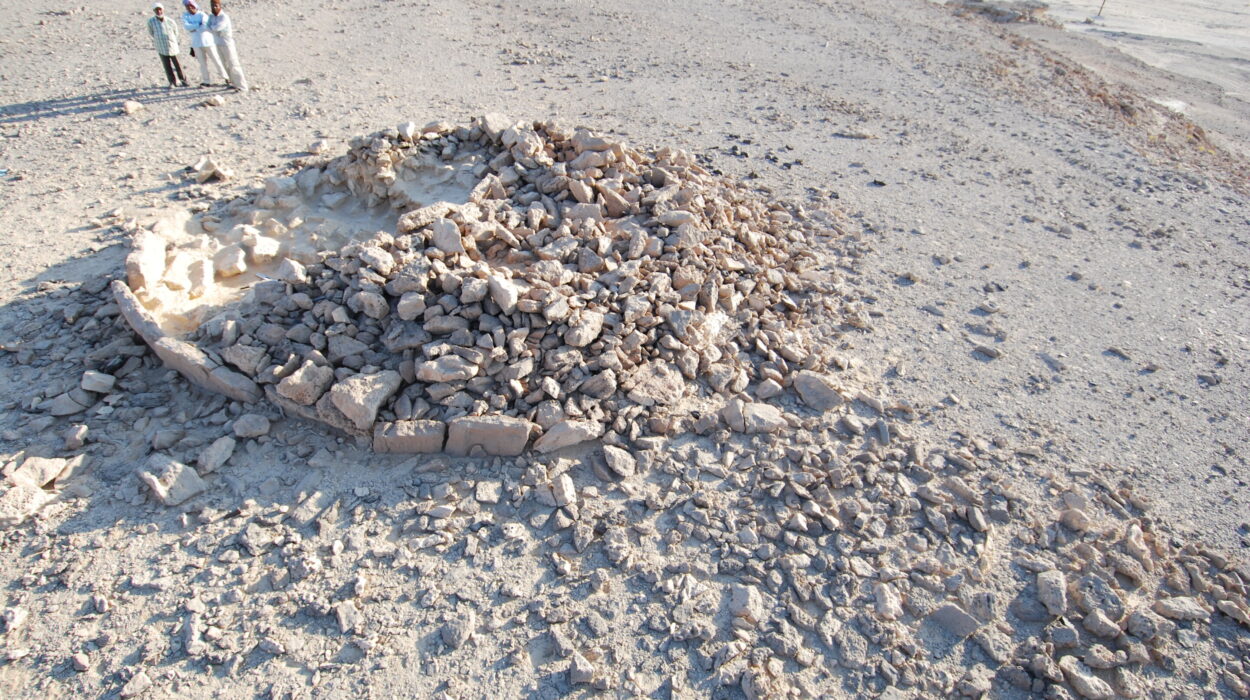
The story begins at Oudenburg, a site originally chosen by the Roman army in the late 2nd century AD for a strategic coastal fort. For over two hundred years, it was a hub of activity, remaining occupied until the early to mid-5th century. During excavations of a site known as Graveyard A, researchers unearthed burial A-104.
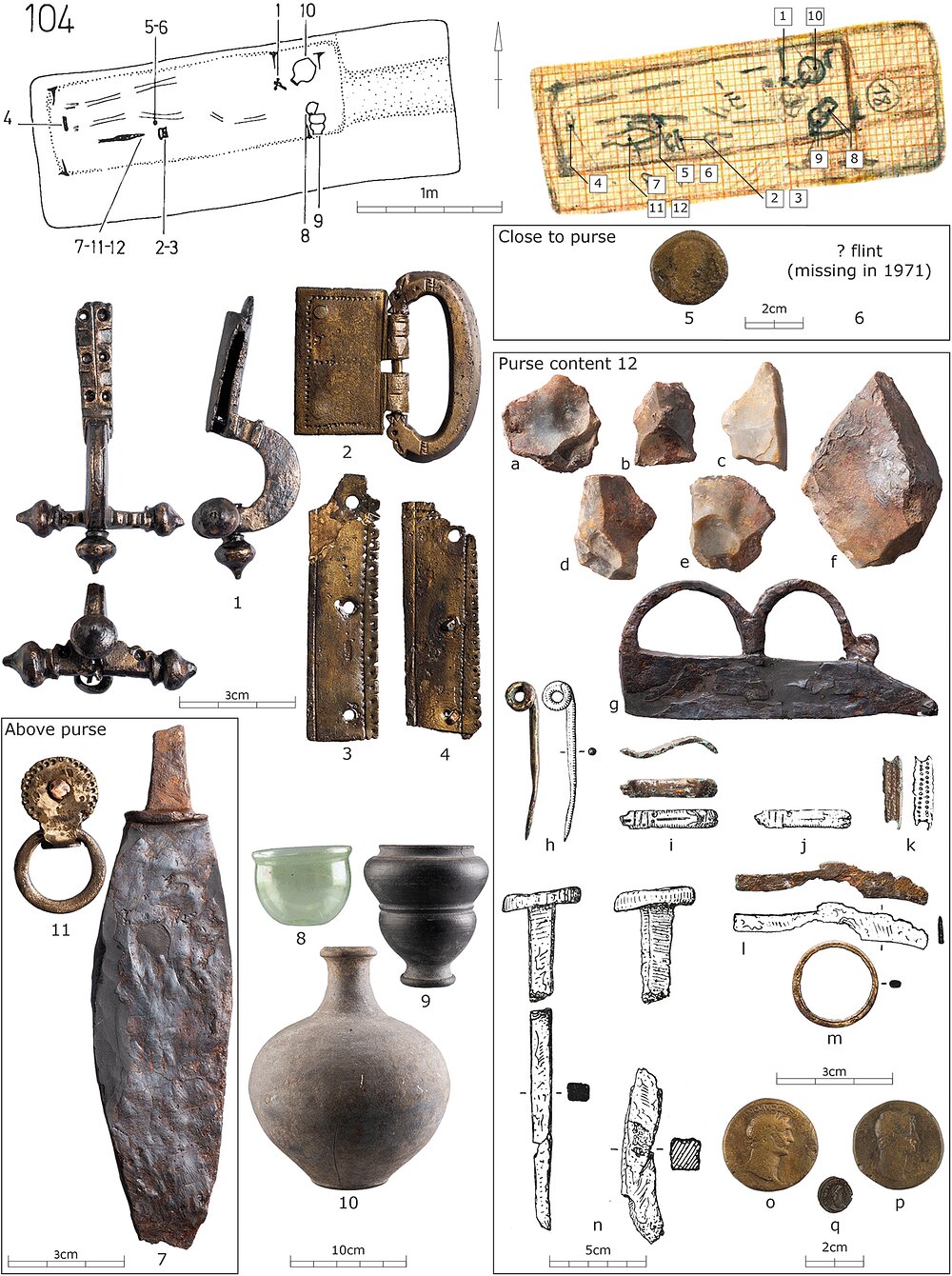
Based on the artifacts found alongside the deceased—a crossbow brooch, a belt plaque, a knife, and various glass and ceramic vessels—the burial is dated to the early 5th century. This timing is critical. It aligns almost perfectly with the period when base-metal coinage ceased to be the official currency in the northwestern provinces. While gold and silver remained part of the official system, the small change used for bread, tools, and daily services—the bronze coins—vanished.
What Was Inside the Oudenburg Purse?
When archaeologists reached the area where the deceased’s belt would have been, they found a mass of dirt and fiber fragments—the remains of a purse. Inside, they found more than just coins. The assemblage included an iron fire striker, six pieces of flint, two belt hooks, and a brooch pin.
However, it was the metal content that caught the researchers’ attention. The purse contained three bronze coins (with a fourth found nearby) and several pieces of what appeared to be junk: a flat metal fragment, a sharp piece of scrap metal, and a small ringlet.
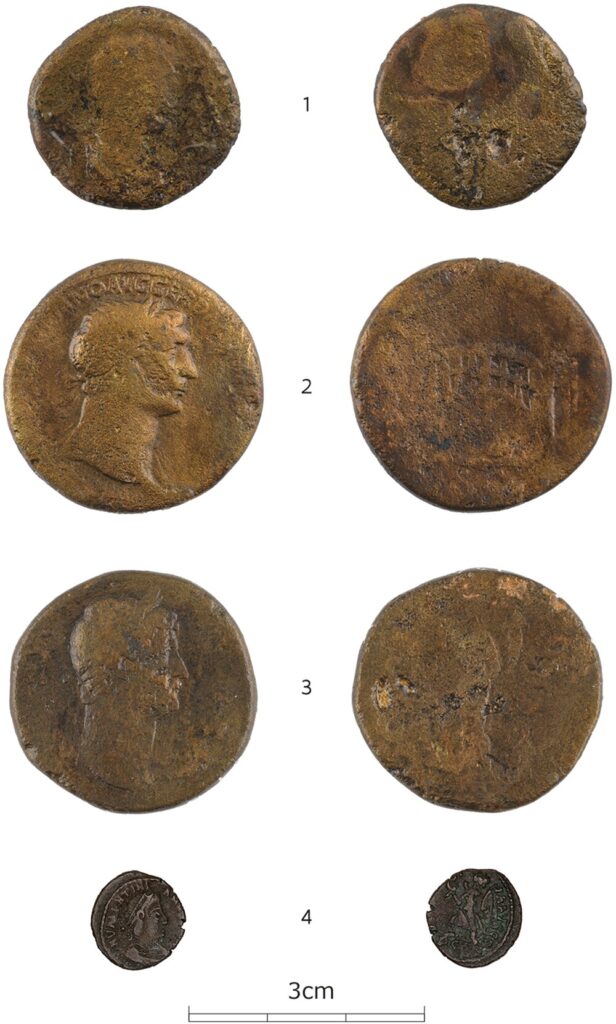
The coins themselves were an odd mix. Two were Trajanic coins minted in Rome between AD 98 and 117, nearly 300 years old by the time they were buried. One was a Hadrianic coin from AD 138, and the newest was a Valentinian II AE4 coin minted in Arles between AD 388 and 402.
From Currency to Bullion: The Weight Evidence
In many archaeological contexts, coins minted centuries apart are dismissed as “intrusive” or accidental. But the deliberate placement of these items in a personal purse suggests they were still considered valuable.
The researchers explored several theories. Were they lucky charms? Mementos of a distant past? The data points to a more practical reality: weight-based bullion.
When the team measured the combined weight of the coins and the scrap metal, they discovered a striking mathematical correlation. The total weight of the coins was approximately 56.77 grams, which is almost exactly equal to two Roman unciae (ounces). Meanwhile, the individual pieces of scrap metal—which were too damaged to be repaired—held a material value roughly equal to a single AE4 coin.
This suggests that in the absence of a steady supply of new minted currency, the value of an object shifted from its “face value” to its material weight. This practice of using scrap metal as currency is known as Hackbronze.
A Bridge to the Middle Ages
While other burials from the era have been found with coins, burial A-104 is unique because of its early date and its high volume of scrap metal. Dr. Flückiger notes that while a contemporary burial in Tongeren contained 47 bronze coins (equal to 10 Roman solidi), it lacked the metal fragments found at Oudenburg.
This makes the Oudenburg find a “missing link.” Later, during the Merovingian era, purses containing Hackbronze became a standard feature in burials. We see this in sites like Kaiseraugst in Switzerland, where 10 male burials, a child’s burial, and even a female burial contained a mix of coins and scrap metal.
By finding this practice in the early 5th century, researchers have shown that the transition to the medieval monetary system began much earlier than previously thought, born out of the immediate necessity of the Roman withdrawal.
Why This Matters
The Oudenburg discovery changes our understanding of how societies survive the collapse of central governance. Rather than falling into economic chaos, the people of the Late Roman frontier showed remarkable adaptability. They took the remnants of the old world—centuries-old coins and broken metal scraps—and recalibrated them into a functional, standardized system of weights.
This research provides a rare glimpse into the “micro-economy” of a disappearing empire. It suggests that the Merovingian monetary systems did not emerge out of thin air but were a direct evolution of strategies developed by Roman citizens to keep trade alive. Dr. Flückiger now hopes to expand this research to see if other late Roman burials show similar weight-based patterns and to investigate whether bits of glass found in later Merovingian purses were also used as a form of currency.
Study Details
Anna Flückiger et al, A Fifth-century Purse Assemblage with Coins and Hackbronze from Oudenburg Reconsidered, Britannia (2026). DOI: 10.1017/s0068113x26100695